Expert article: "Speech development at home: 5 games that will replace"
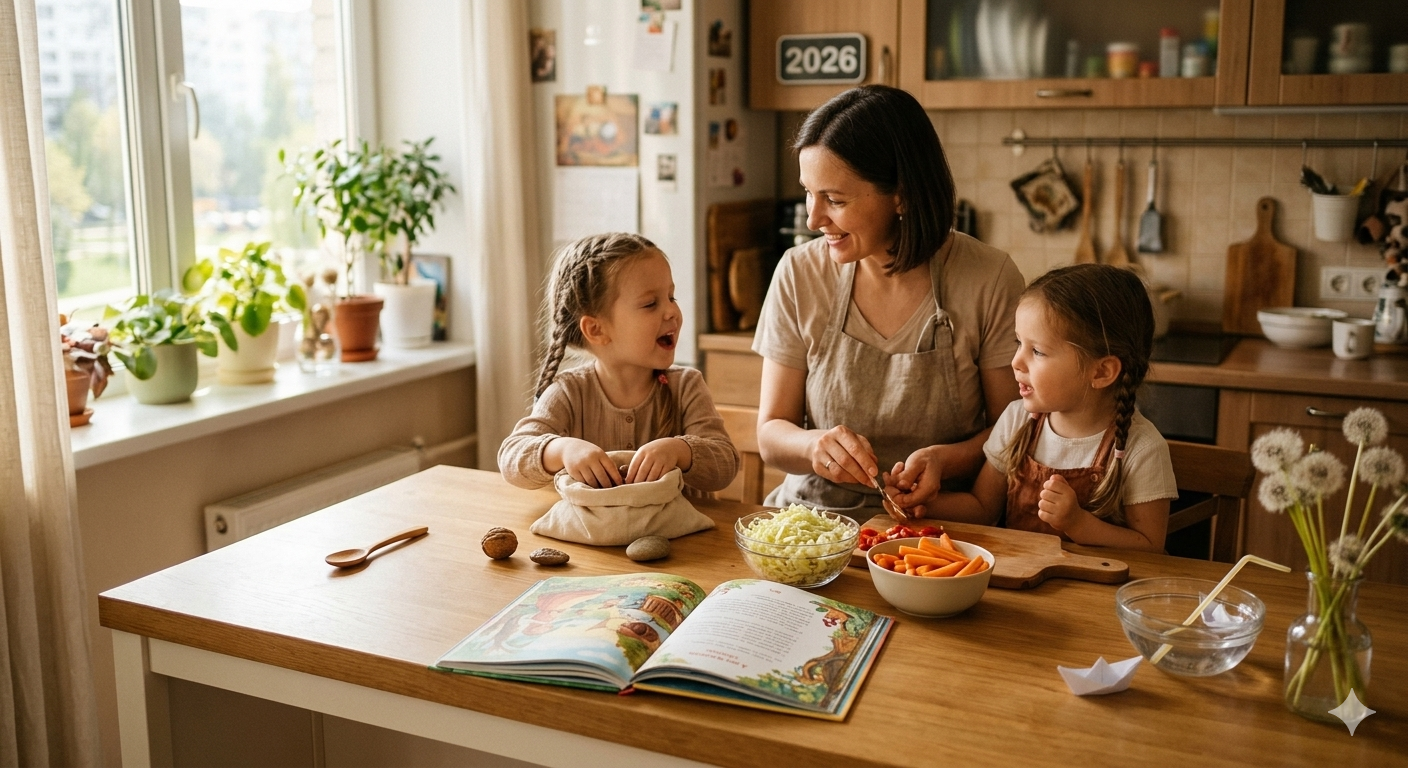
Development of Speech at Home: 5 Games to Replace a Speech Therapist
In 2026, gadgets became an integral part of life, but they are the main enemy of live speech. As an educator, I see that children increasingly come to kindergarten with a "poor" vocabulary. But the good news is that language can be developed in a fun way, simply by preparing dinner in the kitchen.
1. Game "Magic Bag" (Development of Sensory Skills)
Speech is at your fingertips. A child's brain is structured so that the areas responsible for fine motor skills and language are located nearby.
What to do: Put various objects in an opaque bag: a spoon, a pine cone, a ball, a cube. The child has to blindly feel the object and describe it without naming it: "It's round, fluffy...". This trains epithets and imagination.
2. Game "What if..."
This is an exercise for developing logical thinking and complex sentences.
Example: "What if cats could fly?" or "What if it rained candy?". Listen to the child, do not interrupt, ask follow-up questions like "Why?". This encourages them to build long, coherent phrases.
3. Kitchen Laboratory (Enrichment of Vocabulary)
When you cook, name everything you do. But not just "I am cutting," but "I am shredding cabbage," "I am sautéing carrots," "I am blanching tomatoes."
Result: The child absorbs complex verbs that they won't hear in cartoons. This makes their speech rich and "adult."
4. Game "Prove the Word"
While reading a familiar fairy tale, stop at the most interesting place or at the end of a sentence. Give the child a chance to finish the thought themselves. This develops memory and a sense of language.
5. Breathing Exercises (Foundation of Sound Production)
Clear speech is impossible without a strong exhalation.
Simple exercise: Blow together on paper boats in the bath, on dandelion seeds, or simply through a straw into a glass of water, creating a "storm." This is the best preparation for the speech apparatus for complex sounds (R, SH, L).
Here is a professional and meaningful conclusion for this article, which logically wraps up the thought and emphasizes your role as an expert educator:
The development of speech is not just special exercises at the table, but primarily live communication woven into daily life. As practice in 2026 shows, no modern application or educational cartoon can replace a child's emotional contact with parents and joint play.
By using these simple methods daily, you are not just preparing the child's articulatory apparatus for school or correcting their pronunciation. You are building a strong foundation for their self-confidence, developing logical thinking, and teaching the child to express their thoughts clearly and beautifully.
Remember: your attention and involvement are the best tools for development. Even 15 minutes of such "conscious" play a day can create a miracle, turning an ordinary conversation into an exciting journey into the world of words.
In 2026, gadgets became an integral part of life, but they are the main enemy of live speech. As an educator, I see that children increasingly come to kindergarten with a "poor" vocabulary. But the good news is that language can be developed in a fun way, simply by preparing dinner in the kitchen.
1. Game "Magic Bag" (Development of Sensory Skills)
Speech is at your fingertips. A child's brain is structured so that the areas responsible for fine motor skills and language are located nearby.
What to do: Put various objects in an opaque bag: a spoon, a pine cone, a ball, a cube. The child has to blindly feel the object and describe it without naming it: "It's round, fluffy...". This trains epithets and imagination.
2. Game "What if..."
This is an exercise for developing logical thinking and complex sentences.
Example: "What if cats could fly?" or "What if it rained candy?". Listen to the child, do not interrupt, ask follow-up questions like "Why?". This encourages them to build long, coherent phrases.
3. Kitchen Laboratory (Enrichment of Vocabulary)
When you cook, name everything you do. But not just "I am cutting," but "I am shredding cabbage," "I am sautéing carrots," "I am blanching tomatoes."
Result: The child absorbs complex verbs that they won't hear in cartoons. This makes their speech rich and "adult."
4. Game "Prove the Word"
While reading a familiar fairy tale, stop at the most interesting place or at the end of a sentence. Give the child a chance to finish the thought themselves. This develops memory and a sense of language.
5. Breathing Exercises (Foundation of Sound Production)
Clear speech is impossible without a strong exhalation.
Simple exercise: Blow together on paper boats in the bath, on dandelion seeds, or simply through a straw into a glass of water, creating a "storm." This is the best preparation for the speech apparatus for complex sounds (R, SH, L).
Here is a professional and meaningful conclusion for this article, which logically wraps up the thought and emphasizes your role as an expert educator:
The development of speech is not just special exercises at the table, but primarily live communication woven into daily life. As practice in 2026 shows, no modern application or educational cartoon can replace a child's emotional contact with parents and joint play.
By using these simple methods daily, you are not just preparing the child's articulatory apparatus for school or correcting their pronunciation. You are building a strong foundation for their self-confidence, developing logical thinking, and teaching the child to express their thoughts clearly and beautifully.
Remember: your attention and involvement are the best tools for development. Even 15 minutes of such "conscious" play a day can create a miracle, turning an ordinary conversation into an exciting journey into the world of words.

 Krivoi Rog
  Available for hire