Automated Trading Platform: Years of Strategy Validation in Hour
AI и машинное обучение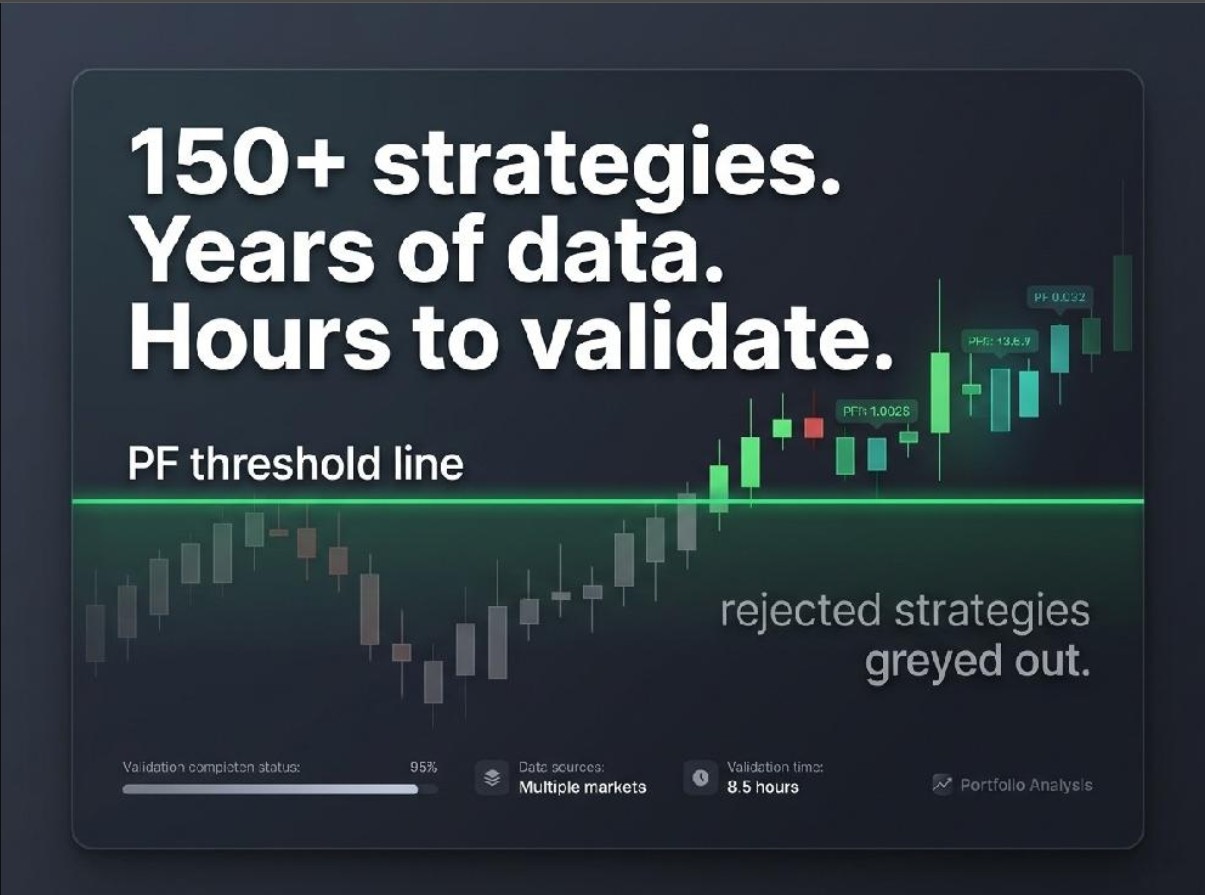
Automated Trading Platform: Years of Strategy Validation in Hours
The Situation
The client is a US-based active retail trader managing personal capital across crypto and equity markets. Technically sophisticated, comfortable with APIs and backtests, but constrained by a fundamental problem every retail quant faces: no infrastructure to know which patterns actually work versus which only look good in hindsight.
The Problem
Backtests were lying. One pattern showed a backtest profit factor of 2.5 but produced zero winning trades live. Another showed a rejected 0.34 in backtest but delivered 3.12 live. The client was losing real money on strategies that looked strong on paper, and validating a single idea required months of live paper trading before he could commit capital. Manual scanning across 100+ assets was impossible, and a silent stop-loss failure on a legacy exchange endpoint had already cost him roughly $300 in a single incident.
The Solution
I built a production-grade Node.js platform that runs four independent engines in parallel. A forward paper engine silently tests 150+ strategy variants against real market data, walking each candidate signal forward across years of historical bars to compute real win rates, profit factors, and drawdown. A scoring pipeline runs 12 pattern detectors on 4-hour charts, confirms on 1-hour timeframes, and weighs session timing, order flow, volume profile, and liquidation data. Only strategies that clear strict thresholds (50+ forward trades, PF above 1.5, WR above 55%, drawdown under 20%) are promoted to live execution. The live engine routes trades to Binance Futures through the current algo API with explicit order verification, places scaled take-profits and stop-losses automatically, and runs a separate exit monitor that closes positions against the broader market trend.
For equities, 128 tickers are scanned after NYSE close through a parallel detector library. A forward-PnL tracker fills each signal at the next day's open and walks it to resolution, which is how the platform identified that 9 of 12 detectors have no real edge on stocks while 3 do.
Tech Stack: Node.js, Supabase, PostgreSQL, Docker, Binance Futures API, Telegram Bot API, REST APIs, cron-based orchestration
The Results
- 150+ strategies tested in parallel against years of historical data, replacing months of sequential live paper trading
- 174% PnL improvement on the live engine after systematic session-gating discovery through backtesting
- 3 of 12 stock detectors statistically validated (the other 9 were eliminated before they could lose money live)
- 441 automated tests across detectors, sizing, walk-forward simulation, and chart rendering
- Look-ahead bias caught systematically: one strategy cluster dropped from PF 3.43 to PF 0.11 after fixing a paper-evaluation bug, preventing live deployment of a losing system
- Zero silent order failures after the algo API migration and verification layer were deployed
How It Works
1. Hourly cron job pulls OHLCV data for top 100 crypto pairs into Supabase
2. 12 pattern detectors scan 4-hour bars and score each setup on timing, order flow, and confluence
3. Qualified setups are saved as pending zones with a 72-hour expiry window
4. Paper engine walks all setups forward against real bars across 150+ strategy variants
5. Strategies that pass 50+ trades with thresholds met become live promotion candidates
6. Live engine executes during London and NY sessions only, with partial TPs, full SL, and a separate trend-based exit monitor
The Situation
The client is a US-based active retail trader managing personal capital across crypto and equity markets. Technically sophisticated, comfortable with APIs and backtests, but constrained by a fundamental problem every retail quant faces: no infrastructure to know which patterns actually work versus which only look good in hindsight.
The Problem
Backtests were lying. One pattern showed a backtest profit factor of 2.5 but produced zero winning trades live. Another showed a rejected 0.34 in backtest but delivered 3.12 live. The client was losing real money on strategies that looked strong on paper, and validating a single idea required months of live paper trading before he could commit capital. Manual scanning across 100+ assets was impossible, and a silent stop-loss failure on a legacy exchange endpoint had already cost him roughly $300 in a single incident.
The Solution
I built a production-grade Node.js platform that runs four independent engines in parallel. A forward paper engine silently tests 150+ strategy variants against real market data, walking each candidate signal forward across years of historical bars to compute real win rates, profit factors, and drawdown. A scoring pipeline runs 12 pattern detectors on 4-hour charts, confirms on 1-hour timeframes, and weighs session timing, order flow, volume profile, and liquidation data. Only strategies that clear strict thresholds (50+ forward trades, PF above 1.5, WR above 55%, drawdown under 20%) are promoted to live execution. The live engine routes trades to Binance Futures through the current algo API with explicit order verification, places scaled take-profits and stop-losses automatically, and runs a separate exit monitor that closes positions against the broader market trend.
For equities, 128 tickers are scanned after NYSE close through a parallel detector library. A forward-PnL tracker fills each signal at the next day's open and walks it to resolution, which is how the platform identified that 9 of 12 detectors have no real edge on stocks while 3 do.
Tech Stack: Node.js, Supabase, PostgreSQL, Docker, Binance Futures API, Telegram Bot API, REST APIs, cron-based orchestration
The Results
- 150+ strategies tested in parallel against years of historical data, replacing months of sequential live paper trading
- 174% PnL improvement on the live engine after systematic session-gating discovery through backtesting
- 3 of 12 stock detectors statistically validated (the other 9 were eliminated before they could lose money live)
- 441 automated tests across detectors, sizing, walk-forward simulation, and chart rendering
- Look-ahead bias caught systematically: one strategy cluster dropped from PF 3.43 to PF 0.11 after fixing a paper-evaluation bug, preventing live deployment of a losing system
- Zero silent order failures after the algo API migration and verification layer were deployed
How It Works
1. Hourly cron job pulls OHLCV data for top 100 crypto pairs into Supabase
2. 12 pattern detectors scan 4-hour bars and score each setup on timing, order flow, and confluence
3. Qualified setups are saved as pending zones with a 72-hour expiry window
4. Paper engine walks all setups forward against real bars across 150+ strategy variants
5. Strategies that pass 50+ trades with thresholds met become live promotion candidates
6. Live engine executes during London and NY sessions only, with partial TPs, full SL, and a separate trend-based exit monitor