30 AI Agents, 5 Platforms, One Dashboard: Autonomous Content Sys
AI и машинное обучение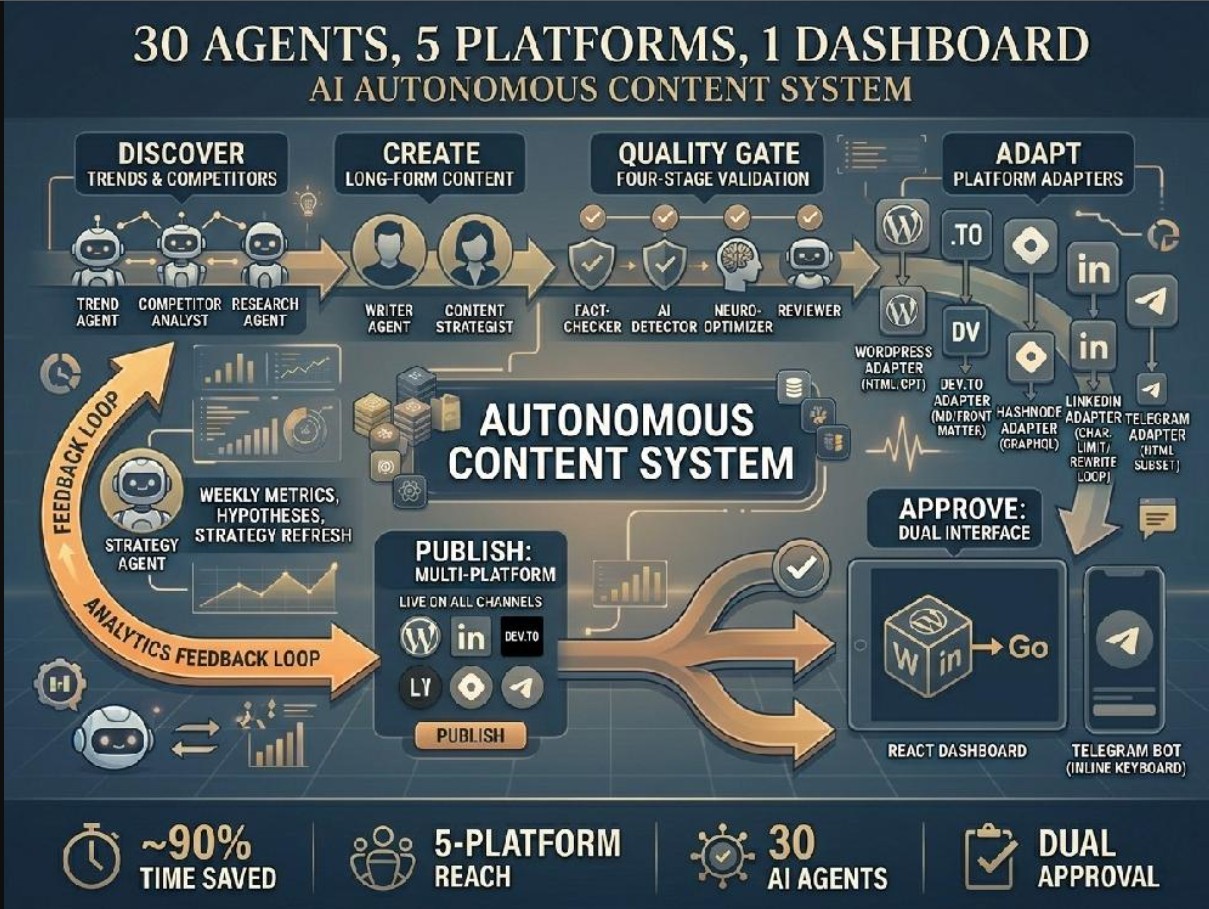
The Situation
A solo content strategist was managing multi-channel publishing: blog, LinkedIn, Dev.to, Hashnode, and Telegram. Every article required manual research, writing, quality review, platform-specific reformatting, and individual publishing through each platform's UI. One piece of content consumed 4-6 hours before going live on all channels.
The Problem
Each platform had different format requirements: WordPress needed HTML with custom post types, Dev.to used markdown with front matter, Hashnode required GraphQL, LinkedIn stripped markdown and enforced a 2,900-character limit, Telegram used its own HTML subset. Adapting one article for five platforms was tedious and error-prone.
No feedback loop existed. Analytics lived in five separate dashboards. Strategy decisions were gut-based. Quality was inconsistent. Every step depended on the client being available to execute manually.
The Solution
I built an autonomous content system with 30 specialized AI agents orchestrated through BullMQ job chains. The full content lifecycle runs autonomously: trend discovery → research → writing → fact-checking → AI detection → neuromarketing optimization → platform adaptation → approval → publishing.
Pipeline architecture. Each content item moves through a configurable agent sequence. A four-stage quality gate (fact-checker → AI detector → neuro-optimizer → reviewer) validates every draft. The pipeline pauses at approval gates and notifies via Telegram inline keyboards or React dashboard.
Dynamic pipelines. Agent sequences are configurable per channel or per content item through a drag-and-drop UI. Three-tier priority: item overrides → channel defaults → system defaults. Parallel agent execution supported.
Multi-platform publishing. LinkedIn's character limit enforced at three levels: adapter prompt, output validation, and a publisher-level rewrite loop (re-invokes AI to shorten, up to 3 attempts). WordPress publishes as custom post types with formatted HTML. All five publishers run from one action.
Analytics feedback loop. Weekly pipeline collects metrics, generates hypotheses about what's working, and auto-triggers strategy refresh.
Tech Stack: Node.js, TypeScript, Express.js, BullMQ, Redis, PostgreSQL (Supabase), React 18, Vite, Tailwind CSS, Grammy (Telegram Bot), Anthropic Claude API, Google Gemini, OpenAI Whisper, Tavily API, Docker, Vitest, Playwright
The Results
- ~85% reduction in time per article (4-6 hours → ~30 minutes of oversight)
- 5-platform simultaneous publishing from one approval
- 30 AI agents with configurable pipelines and full cost tracking
- Four-stage quality gate for consistent content quality
- Dual approval interface (React dashboard + Telegram bot)
- Analytics feedback loop that auto-adjusts content strategy
- 606 automated tests (unit, integration, E2E)
How It Works
1. Discover. Cron jobs run trend discovery and competitor analysis
2. Create. Research and writer agents produce long-form content
3. Quality Gate. Fact-checker, AI detector, neuro-optimizer, reviewer validate the draft
4. Adapt. Platform adapters reformat for each channel's requirements
5. Approve. Client reviews via dashboard or Telegram, approves or rejects
6. Publish. Publishers push to all selected platforms simultaneously
The pipeline is fully resumable. It retries with exponential backoff, picks up where it left off.
A solo content strategist was managing multi-channel publishing: blog, LinkedIn, Dev.to, Hashnode, and Telegram. Every article required manual research, writing, quality review, platform-specific reformatting, and individual publishing through each platform's UI. One piece of content consumed 4-6 hours before going live on all channels.
The Problem
Each platform had different format requirements: WordPress needed HTML with custom post types, Dev.to used markdown with front matter, Hashnode required GraphQL, LinkedIn stripped markdown and enforced a 2,900-character limit, Telegram used its own HTML subset. Adapting one article for five platforms was tedious and error-prone.
No feedback loop existed. Analytics lived in five separate dashboards. Strategy decisions were gut-based. Quality was inconsistent. Every step depended on the client being available to execute manually.
The Solution
I built an autonomous content system with 30 specialized AI agents orchestrated through BullMQ job chains. The full content lifecycle runs autonomously: trend discovery → research → writing → fact-checking → AI detection → neuromarketing optimization → platform adaptation → approval → publishing.
Pipeline architecture. Each content item moves through a configurable agent sequence. A four-stage quality gate (fact-checker → AI detector → neuro-optimizer → reviewer) validates every draft. The pipeline pauses at approval gates and notifies via Telegram inline keyboards or React dashboard.
Dynamic pipelines. Agent sequences are configurable per channel or per content item through a drag-and-drop UI. Three-tier priority: item overrides → channel defaults → system defaults. Parallel agent execution supported.
Multi-platform publishing. LinkedIn's character limit enforced at three levels: adapter prompt, output validation, and a publisher-level rewrite loop (re-invokes AI to shorten, up to 3 attempts). WordPress publishes as custom post types with formatted HTML. All five publishers run from one action.
Analytics feedback loop. Weekly pipeline collects metrics, generates hypotheses about what's working, and auto-triggers strategy refresh.
Tech Stack: Node.js, TypeScript, Express.js, BullMQ, Redis, PostgreSQL (Supabase), React 18, Vite, Tailwind CSS, Grammy (Telegram Bot), Anthropic Claude API, Google Gemini, OpenAI Whisper, Tavily API, Docker, Vitest, Playwright
The Results
- ~85% reduction in time per article (4-6 hours → ~30 minutes of oversight)
- 5-platform simultaneous publishing from one approval
- 30 AI agents with configurable pipelines and full cost tracking
- Four-stage quality gate for consistent content quality
- Dual approval interface (React dashboard + Telegram bot)
- Analytics feedback loop that auto-adjusts content strategy
- 606 automated tests (unit, integration, E2E)
How It Works
1. Discover. Cron jobs run trend discovery and competitor analysis
2. Create. Research and writer agents produce long-form content
3. Quality Gate. Fact-checker, AI detector, neuro-optimizer, reviewer validate the draft
4. Adapt. Platform adapters reformat for each channel's requirements
5. Approve. Client reviews via dashboard or Telegram, approves or rejects
6. Publish. Publishers push to all selected platforms simultaneously
The pipeline is fully resumable. It retries with exponential backoff, picks up where it left off.