Wave Packets Scattered by Bragg Structures
#Matlab #Physics #Mathematics
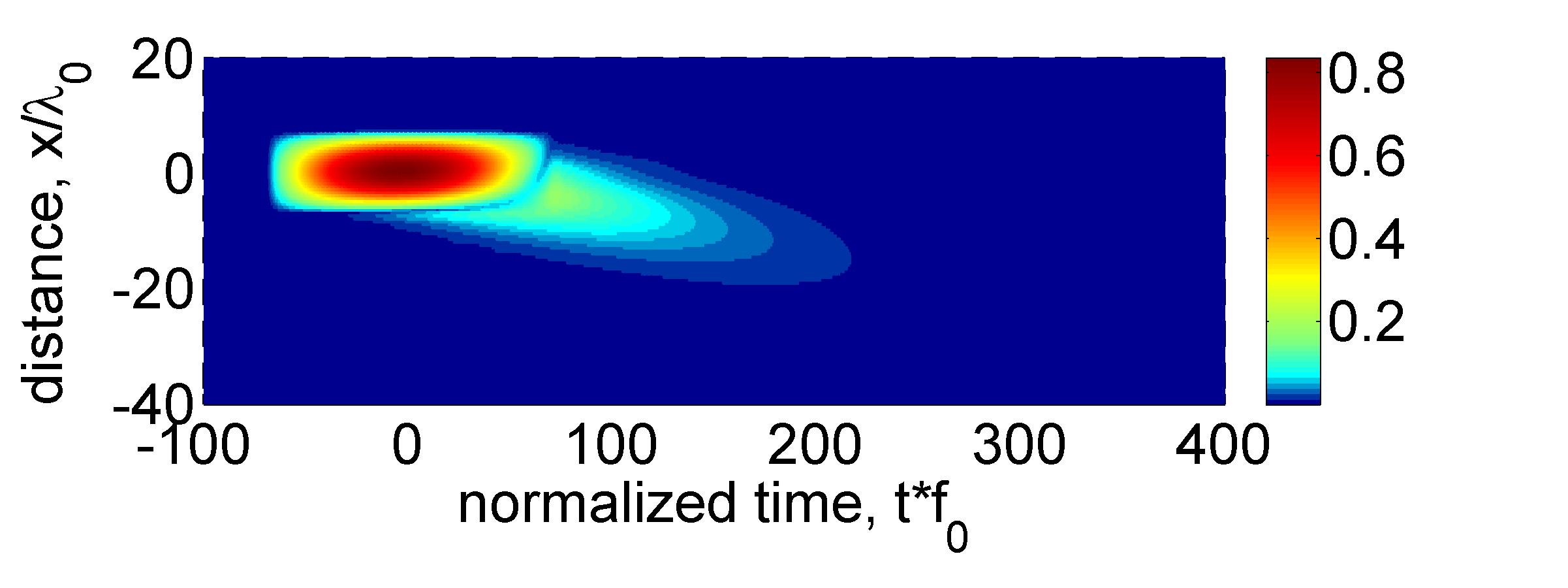
The time delay, space shift and widening of wave packet transmitted and reflected by structures with Bragg mirrors is investigated. The specific structures such as Bragg mirrors, resonators, and structures with chirp variation of thickness of the “period” are also considered. The calculation is carried out under the conditions that carrier frequency and incidence angle are in the vicinity of the Bragg resonance. Integral (mass center) and differential (group) estimates of the delay time and space shift are then compared. The conditions for the appearance of anomalous (negative) mass center delay or mass center shift (Goos-Hänchen shift) of the reflected wave packet are determined. The shape transformations of the wave packet illuminating periodic and quasiperiodic apodized Bragg reflectors are then considered. Spatial apodization of permittivity contrast yields a much smaller shape deformation of the transmitted wave packet upon incidence at angles and carrier frequency near the edges of the reflection band, as well in the Bragg reflection band, in comparison with phenomena in similar periodic structures. The values of group delay for layered structures with a small chirp variation of optical (electrical) thickness of the period along longitudinal coordinates is experimentally obtained in the microwave range.
GD and GS packet negative values are inherent to asymmetric Bragg resonators and observed under the condition that a resonance thickness layer is located closer to the end of a structure. In the case of large wave packet durations and extent, integral and deferential packet estimates take approximately equal values. CMD and CMS have anomalous values via packet distortions: widening, variation of asymmetry, coefficient of kurtosis.
The time delay, space shift and widening of wave packet transmitted and reflected by structures with Bragg mirrors is investigated. The specific structures such as Bragg mirrors, resonators, and structures with chirp variation of thickness of the “period” are also considered. The calculation is carried out under the conditions that carrier frequency and incidence angle are in the vicinity of the Bragg resonance. Integral (mass center) and differential (group) estimates of the delay time and space shift are then compared. The conditions for the appearance of anomalous (negative) mass center delay or mass center shift (Goos-Hänchen shift) of the reflected wave packet are determined. The shape transformations of the wave packet illuminating periodic and quasiperiodic apodized Bragg reflectors are then considered. Spatial apodization of permittivity contrast yields a much smaller shape deformation of the transmitted wave packet upon incidence at angles and carrier frequency near the edges of the reflection band, as well in the Bragg reflection band, in comparison with phenomena in similar periodic structures. The values of group delay for layered structures with a small chirp variation of optical (electrical) thickness of the period along longitudinal coordinates is experimentally obtained in the microwave range.
GD and GS packet negative values are inherent to asymmetric Bragg resonators and observed under the condition that a resonance thickness layer is located closer to the end of a structure. In the case of large wave packet durations and extent, integral and deferential packet estimates take approximately equal values. CMD and CMS have anomalous values via packet distortions: widening, variation of asymmetry, coefficient of kurtosis.

 Днепр
Днепр  Свободен для работы