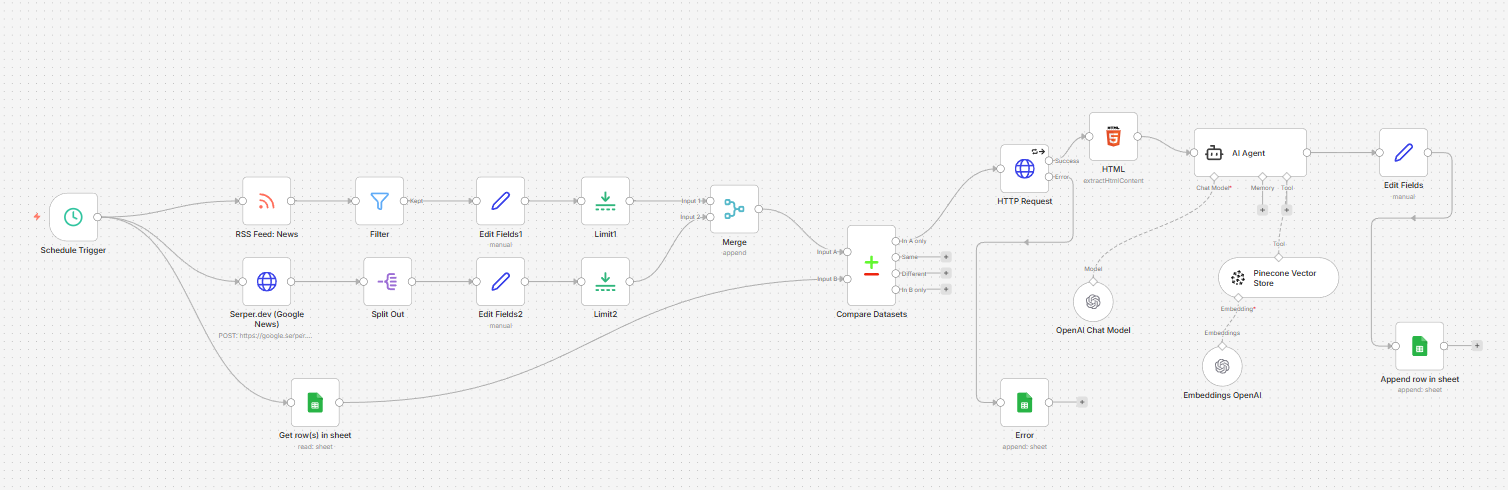
Creation of an intelligent system that replaces 30+ hours of manual monitoring per month with a fully autonomous agent based on RAG architecture.
Context
Caritas Ukraine is one of the largest charitable organizations in the country (over 40 regional branches) in the NGO and humanitarian aid sector. The communications team manually monitored the media daily: searching on Google, copying headlines into Google Sheets, checking Facebook, Instagram, and LinkedIn. Existing third-party solutions had a limit of 10 queries per session, which was absolutely insufficient for such scale.
Problem
Relevance: The search yielded hundreds of results about Caritas's international offices, most of which were not related to activities in Ukraine.
Criticality: A missed mention could mean an inappropriate press inquiry or a timely identified reputational risk for any of the 40+ local offices.
Losses: Over 30 hours per month were spent on mechanical "copy-paste" work — a whole working week of a specialist.
Goal: Complete automation of data collection, geographical filtering, and report generation.
Solution
I designed an autonomous AI agent based on n8n, using RAG (Retrieval-Augmented Generation) architecture. Instead of simple keyword searches, the system works with the deep context of the organization: it "understands" which branches exist, where they operate, and which topics are relevant for each of them.
The agent independently searches for information in the media and social networks, filters out irrelevant international mentions, classifies results by topics and sentiment, removes duplicates, and prepares draft reports for management — without human involvement.
Implementation Process
Audit and Research: A complete structure of the organization (40+ branches) was formed to create accurate geographical and contextual filters.
Architecture Design: The logic of the "Analytical Agent" was developed — a multi-step workflow that works with the organization's vectorized data.
Building the RAG System: A vector database (Pinecone) was integrated, containing data about the structure and regional context of Caritas Ukraine.
Prompt Engineering: Prompts were configured for deduplication, topic classification, and sentiment analysis for different types of publications.
A/B Testing: A comparison of the results of manual searches and the AI agent's output was conducted to confirm filtering accuracy.
Optimization: Batch processing of data was implemented, which reduced API costs by 10 times without loss of quality.
Results
- Time savings of 85% — 8 hours of manual work per week fully automated.
- Budget preservation (~$180/month) — comparison of the cost of specialist working hours to API expenses.
- Filtering accuracy of 95% — confirmed by A/B tests; complete absence of duplicates.
- Reduction of API costs by 10 times due to process optimization.
- Strategic shift: the communications team moved from data collection to strategic analysis.
- Reliability and transparency: each mention is logged, classified, and easily traceable.
#N8N #AI_Agents #openai-api #ChatGPT-4 #RAG #API_Integration #AI_Automation #MediaMonitoring #Workflow_Optimization #DataAnalysis
Context
Caritas Ukraine is one of the largest charitable organizations in the country (over 40 regional branches) in the NGO and humanitarian aid sector. The communications team manually monitored the media daily: searching on Google, copying headlines into Google Sheets, checking Facebook, Instagram, and LinkedIn. Existing third-party solutions had a limit of 10 queries per session, which was absolutely insufficient for such scale.
Problem
Relevance: The search yielded hundreds of results about Caritas's international offices, most of which were not related to activities in Ukraine.
Criticality: A missed mention could mean an inappropriate press inquiry or a timely identified reputational risk for any of the 40+ local offices.
Losses: Over 30 hours per month were spent on mechanical "copy-paste" work — a whole working week of a specialist.
Goal: Complete automation of data collection, geographical filtering, and report generation.
Solution
I designed an autonomous AI agent based on n8n, using RAG (Retrieval-Augmented Generation) architecture. Instead of simple keyword searches, the system works with the deep context of the organization: it "understands" which branches exist, where they operate, and which topics are relevant for each of them.
The agent independently searches for information in the media and social networks, filters out irrelevant international mentions, classifies results by topics and sentiment, removes duplicates, and prepares draft reports for management — without human involvement.
Implementation Process
Audit and Research: A complete structure of the organization (40+ branches) was formed to create accurate geographical and contextual filters.
Architecture Design: The logic of the "Analytical Agent" was developed — a multi-step workflow that works with the organization's vectorized data.
Building the RAG System: A vector database (Pinecone) was integrated, containing data about the structure and regional context of Caritas Ukraine.
Prompt Engineering: Prompts were configured for deduplication, topic classification, and sentiment analysis for different types of publications.
A/B Testing: A comparison of the results of manual searches and the AI agent's output was conducted to confirm filtering accuracy.
Optimization: Batch processing of data was implemented, which reduced API costs by 10 times without loss of quality.
Results
- Time savings of 85% — 8 hours of manual work per week fully automated.
- Budget preservation (~$180/month) — comparison of the cost of specialist working hours to API expenses.
- Filtering accuracy of 95% — confirmed by A/B tests; complete absence of duplicates.
- Reduction of API costs by 10 times due to process optimization.
- Strategic shift: the communications team moved from data collection to strategic analysis.
- Reliability and transparency: each mention is logged, classified, and easily traceable.
#N8N #AI_Agents #openai-api #ChatGPT-4 #RAG #API_Integration #AI_Automation #MediaMonitoring #Workflow_Optimization #DataAnalysis