An audit of the database found 165 GB of ballast (39%) without stopping operations.
Databases & SQL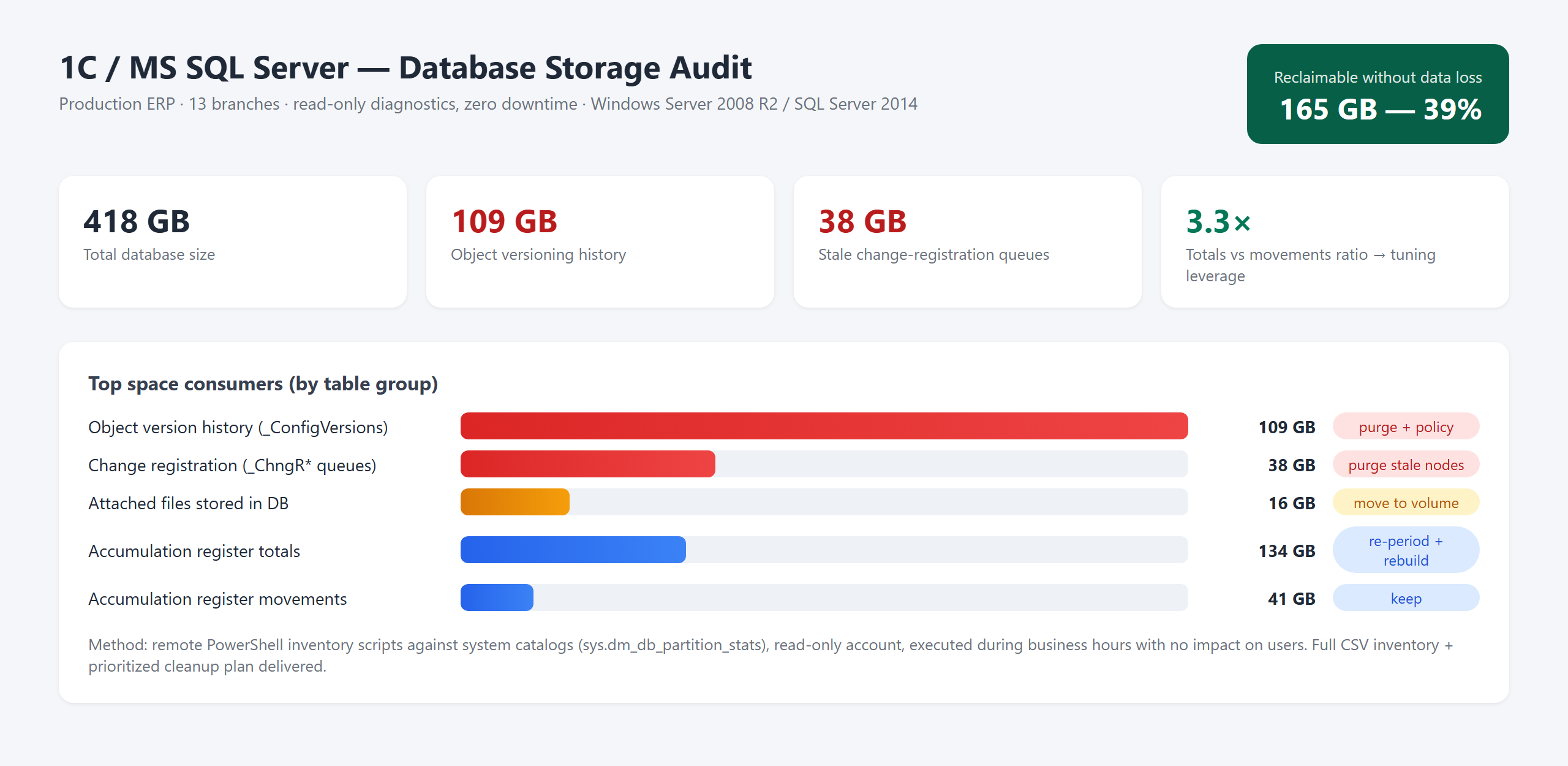
Client Pain Point
The 1C working database on MS SQL Server (13 branches) has grown to 418 GB. Disks are running out, backups take hours, and everything is noticeably slowing down. The standard IT advice is: "buy a more powerful server." However, no one could say what exactly is consuming the space — the database looks like a black box with thousands of system tables.
What Has Been Done
Remote read-only diagnostics during working hours with zero downtime — on legacy infrastructure (Windows Server 2008 R2 / SQL Server 2014), where modern tools simply do not run.
PowerShell inventory scripts on SQL Server system catalogs: exact size, number of rows, and growth profile of each table group.
Cryptic internal names of 1C tables matched with business meaning — the report states "object version history" instead of "_ConfigVersions."
Each space consumer has been classified: safe to clean / remove from the database / keep and optimize.
Result
165 GB — 39% of the database — can be freed without losing a single document:
109 GB of outdated object versions (+ storage policy to prevent it from growing again).
38 GB of dead change registration queues from long-deleted exchange nodes.
16 GB of attached files that belong on the file volume, not in the database.
The main lever for performance has been found: the totals of registers weigh 3.3 times more than the movements themselves — the re-periodization plan reduces both size and query time.
Delivered: a complete CSV inventory + a prioritized step-by-step cleaning plan.
The purchase of a new server has been canceled.
Stack
PowerShell · T-SQL (DMV, system catalogs) · MS SQL Server · 1C internals · read-only account
The 1C working database on MS SQL Server (13 branches) has grown to 418 GB. Disks are running out, backups take hours, and everything is noticeably slowing down. The standard IT advice is: "buy a more powerful server." However, no one could say what exactly is consuming the space — the database looks like a black box with thousands of system tables.
What Has Been Done
Remote read-only diagnostics during working hours with zero downtime — on legacy infrastructure (Windows Server 2008 R2 / SQL Server 2014), where modern tools simply do not run.
PowerShell inventory scripts on SQL Server system catalogs: exact size, number of rows, and growth profile of each table group.
Cryptic internal names of 1C tables matched with business meaning — the report states "object version history" instead of "_ConfigVersions."
Each space consumer has been classified: safe to clean / remove from the database / keep and optimize.
Result
165 GB — 39% of the database — can be freed without losing a single document:
109 GB of outdated object versions (+ storage policy to prevent it from growing again).
38 GB of dead change registration queues from long-deleted exchange nodes.
16 GB of attached files that belong on the file volume, not in the database.
The main lever for performance has been found: the totals of registers weigh 3.3 times more than the movements themselves — the re-periodization plan reduces both size and query time.
Delivered: a complete CSV inventory + a prioritized step-by-step cleaning plan.
The purchase of a new server has been canceled.
Stack
PowerShell · T-SQL (DMV, system catalogs) · MS SQL Server · 1C internals · read-only account