Back-end for 'Mapster' travel service
Python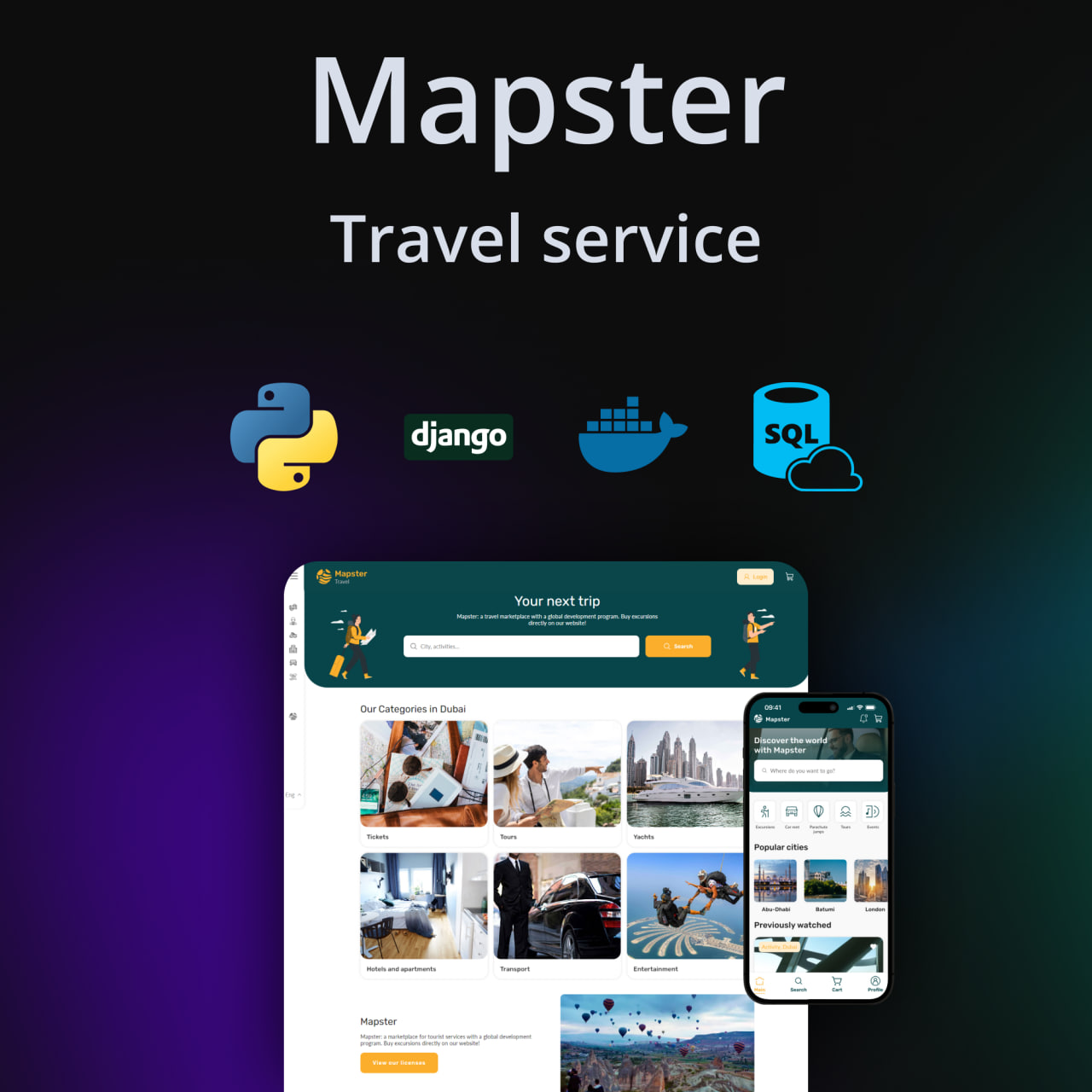
The goal was to create a project that accommodates the complex creation of tours, which can be composed of car rental, accommodation, booking airline tickets, cabs, excursions, transfers on the part of the client. We also created the ability to place all these services on the part of our partners. At the same time, the project contains a global admin panel that covers all of the above functions.
The most challenging part was to create the architecture of the project, which consists of 9 different services that unite into one complex system. We had to create the most suitable UI library, create custom components and make many identical services in a short period of time. The original goal was that all these 9 services had to be created within 3 months. They all had to be multi-currency, multi-lingual, with complex pricing systems for different types of goods. In essence, all these services are marketplaces, but with a much more complex and larger functionality for adding goods. On ordinary marketplaces, goods are added and realized according to a certain template. In our case, all these goods are very different from each other and cannot be fitted to a certain template.
For the back-end we chose Django Rest Framework because this is a fairly universal web framework with serialization capabilities that reliably protects user data and conveniently organizes data migration. This framework provides its own authentication and authorization mechanisms such as token authentication, OAuth and JWT. It has excellent documentation and a large, responsive community. It also provides more flexible and powerful tools for managing API access rights.
#Django
#Docker
#Python
#React_Native
#Vue.js
#Web_Application
#Web_Development
The most challenging part was to create the architecture of the project, which consists of 9 different services that unite into one complex system. We had to create the most suitable UI library, create custom components and make many identical services in a short period of time. The original goal was that all these 9 services had to be created within 3 months. They all had to be multi-currency, multi-lingual, with complex pricing systems for different types of goods. In essence, all these services are marketplaces, but with a much more complex and larger functionality for adding goods. On ordinary marketplaces, goods are added and realized according to a certain template. In our case, all these goods are very different from each other and cannot be fitted to a certain template.
For the back-end we chose Django Rest Framework because this is a fairly universal web framework with serialization capabilities that reliably protects user data and conveniently organizes data migration. This framework provides its own authentication and authorization mechanisms such as token authentication, OAuth and JWT. It has excellent documentation and a large, responsive community. It also provides more flexible and powerful tools for managing API access rights.
#Django
#Docker
#Python
#React_Native
#Vue.js
#Web_Application
#Web_Development