Context and Challenge
The Telegram advertising market is maturing rapidly: brands need transparency, auto-labeling, and a "safe deal," while channel owners require a convenient showcase, placement schedule, and clear performance economics. The platform is positioned as an exchange where verified channels are gathered and document flow is simplified—this sets expectations for speed and result control right "out of the box."
Product Idea
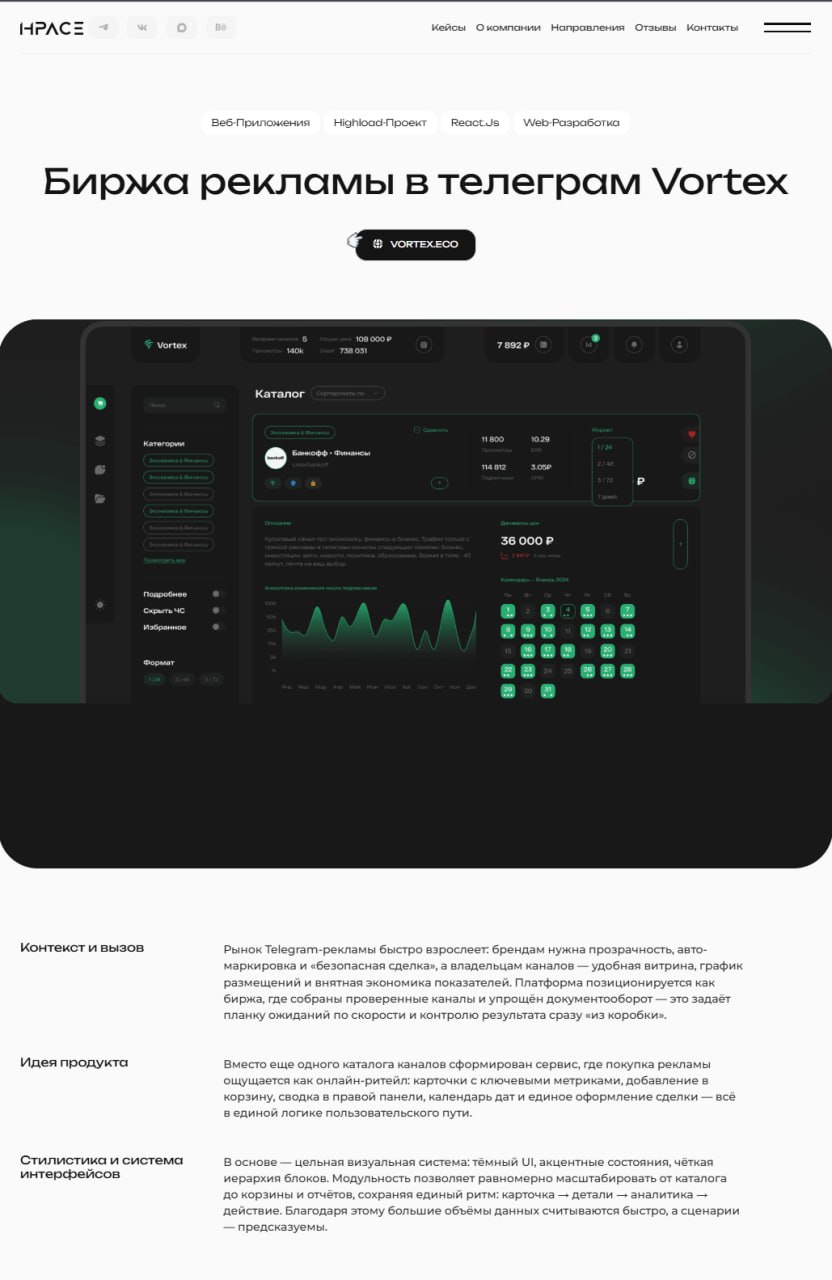
Instead of yet another channel catalog, a service has been created where purchasing advertising feels like online retail: cards with key metrics, adding to the cart, a summary in the right panel, a calendar of dates, and a unified deal design—all within a single user journey logic.
Stylistics and Interface System
At its core is a cohesive visual system: dark UI, accent states, clear block hierarchy. Modularity allows for even scaling from catalog to cart and reports, maintaining a unified rhythm: card → details → analytics → action. As a result, large volumes of data are read quickly, and scenarios are predictable.
The Telegram advertising market is maturing rapidly: brands need transparency, auto-labeling, and a "safe deal," while channel owners require a convenient showcase, placement schedule, and clear performance economics. The platform is positioned as an exchange where verified channels are gathered and document flow is simplified—this sets expectations for speed and result control right "out of the box."
Product Idea
Instead of yet another channel catalog, a service has been created where purchasing advertising feels like online retail: cards with key metrics, adding to the cart, a summary in the right panel, a calendar of dates, and a unified deal design—all within a single user journey logic.
Stylistics and Interface System
At its core is a cohesive visual system: dark UI, accent states, clear block hierarchy. Modularity allows for even scaling from catalog to cart and reports, maintaining a unified rhythm: card → details → analytics → action. As a result, large volumes of data are read quickly, and scenarios are predictable.