LibreSDR PLUTO based on Zynq7020
Embedded Systems & Microcontrollers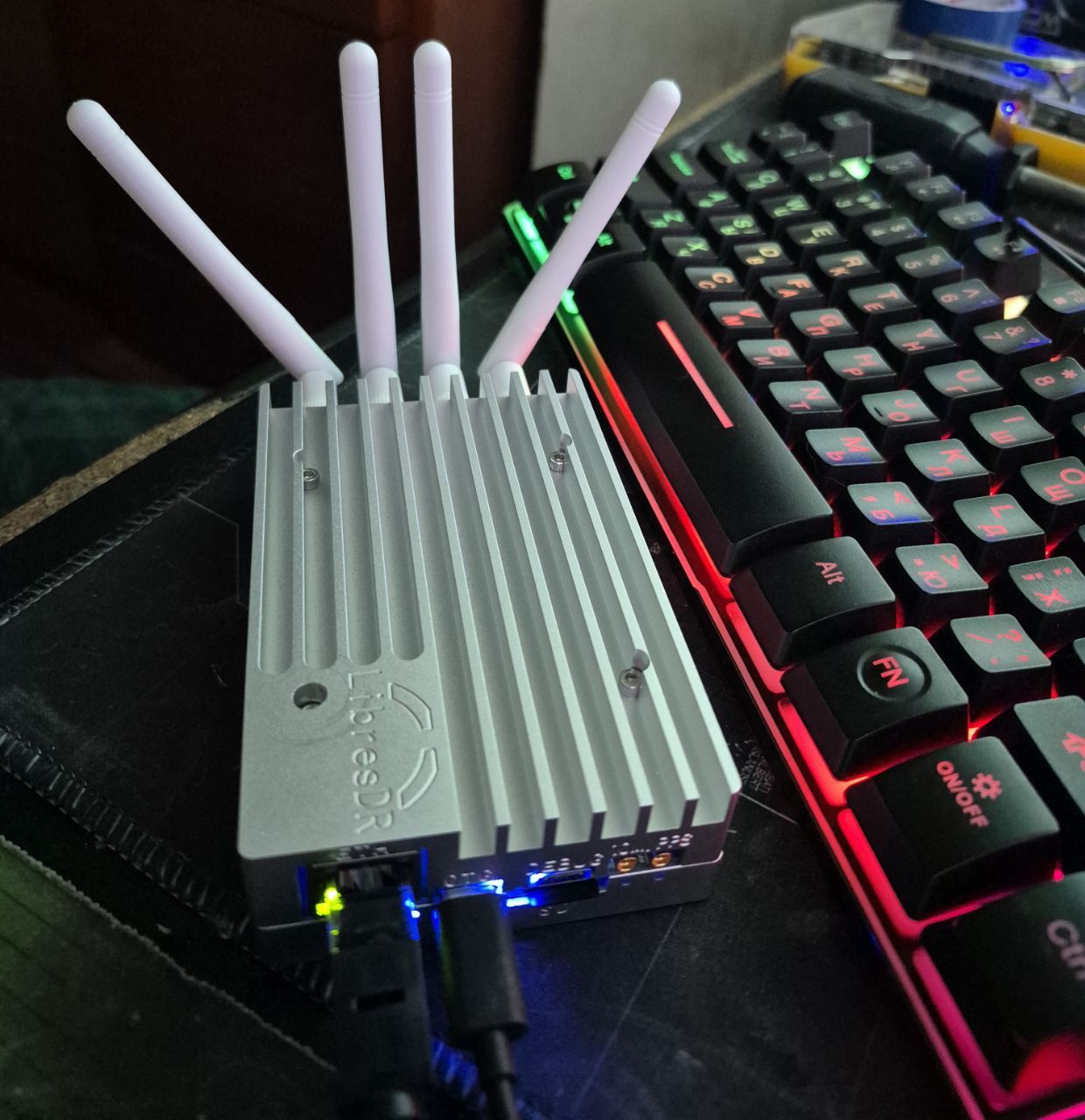
My experience with LibreSDR PLUTO based on Zynq7020
Recently I had the opportunity to work with LibreSDR PLUTO — a modern SDR radio station operating in the 70 MHz – 6 GHz range and supporting 4 antennas (2 TX + 2 RX).
This device turned out to be not just an alternative to the popular ADALM-PLUTO, but a powerful and flexible tool for professional tasks.
What I especially liked:
High precision and stability thanks to VCTCXO 40 MHz (0.5 ppm)
Convenient connectivity via Gigabit Ethernet and USB Type-C (OTG and Debug)
MicroSD support — quick boot and firmware switching
Aluminum housing — both aesthetic and effective heat dissipation
Synchronization support via 1 PPS and 10 MHz for complex multi-channel projects
Technical highlights:
Frequency range: 70 MHz – 6 GHz
Bandwidth: up to 20 MHz
12-bit DAC/ADC
512 MB RAM and 32 MB FLASH
Full TDD and FDD support
Possible applications:
Signal research in civil and industrial ranges
Communication system prototyping
Experiments with digital signal processing (DSP)
Work in GNU Radio, SDRangel, MATLAB and other environments
Conclusion: LibreSDR PLUTO pleasantly surprised me.
It is truly a flexible, productive, and well-thought-out SDR that will suit both engineers and radio enthusiasts.
I am happy to have this device in my toolkit — and I am already planning several new experiments with it.
Recently I had the opportunity to work with LibreSDR PLUTO — a modern SDR radio station operating in the 70 MHz – 6 GHz range and supporting 4 antennas (2 TX + 2 RX).
This device turned out to be not just an alternative to the popular ADALM-PLUTO, but a powerful and flexible tool for professional tasks.
What I especially liked:
High precision and stability thanks to VCTCXO 40 MHz (0.5 ppm)
Convenient connectivity via Gigabit Ethernet and USB Type-C (OTG and Debug)
MicroSD support — quick boot and firmware switching
Aluminum housing — both aesthetic and effective heat dissipation
Synchronization support via 1 PPS and 10 MHz for complex multi-channel projects
Technical highlights:
Frequency range: 70 MHz – 6 GHz
Bandwidth: up to 20 MHz
12-bit DAC/ADC
512 MB RAM and 32 MB FLASH
Full TDD and FDD support
Possible applications:
Signal research in civil and industrial ranges
Communication system prototyping
Experiments with digital signal processing (DSP)
Work in GNU Radio, SDRangel, MATLAB and other environments
Conclusion: LibreSDR PLUTO pleasantly surprised me.
It is truly a flexible, productive, and well-thought-out SDR that will suit both engineers and radio enthusiasts.
I am happy to have this device in my toolkit — and I am already planning several new experiments with it.