Furniture in Latvia - Riga | Commerce | Google Ads
Contextual Advertising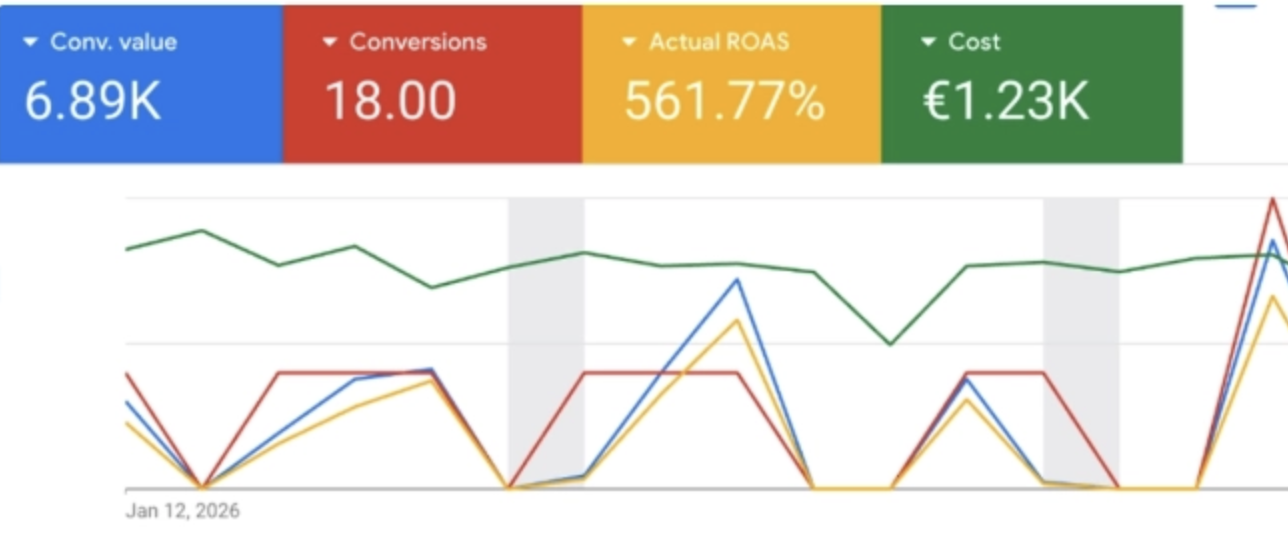
Client – an online furniture store in the Latvian market. The work began with an audit of the existing but ineffective advertising account. The main problem was incorrect optimization: the system was trained on all possible micro-conversions, such as page views or clicks on buttons, which scattered the budget and did not bring real sales.
An additional challenge: the work was conducted in the absence of classic shopping campaigns (Google Shopping), which required finding alternative ways. The analysis also showed that competitors were actively buying the client's branded traffic, taking away the most "hot" audience. In conclusion, the situation in the advertising account.
**What was done (Strategy and implementation):** After a deep audit, it was decided to radically change the account structure: ineffective campaigns were stopped, and optimization goals were strictly shifted exclusively to macro-conversions (Purchases).
Main steps of the launch:
1. Brand protection: A separate branded search campaign was launched. This allowed for immediate protection of the brand from aggressive competitors, reclaiming "own" traffic, and giving the system strong signals about who exactly is our target audience.
2. Alternative to Shopping (DSA):*Since Google Merchant Center was not used, we launched dynamic search ads (DSA) for all product cards. This allowed the system to independently generate relevant ads for low-frequency product queries, effectively replacing the functionality of classic shopping.
3. Structuring search: Classic search campaigns were launched, divided by main product categories.
4. Implementation of Performance Max: Launch of the PMax campaign (without feed) with a group of objects focused on the priority category – "Wardrobes."
5. Account hygiene: A strict cleaning of search queries was conducted, placements were adjusted, and budgets and bidding strategies were corrected.
Thanks to the shift in focus to real sales and the correct structure, we achieved rapid growth in profitability. Currently, there are 5 campaigns running steadily in the account: 4 search (including branded and DSA) and 1 PMax. The branded campaign predictably brought the highest number of conversions.
Despite the increase in costs, we achieved phenomenal growth in value and profitability (ROAS increased by over 1300%). Abandoning micro-conversions allowed Google Ads algorithms to finally understand the profile of the real buyer.
After successfully retraining the algorithms on real buyers, we moved to the scaling stage. Over the last 30 days, the advertising budget was consciously increased to **€1.26k** (spending increased by 110%). This step significantly increased sales volume: we received **16 direct purchases** and **27 phone number clicks** (the total number of conversions increased by 45.45%).
An important achievement of the optimization was the reduction in customer acquisition cost. Despite the increase in spending, the average cost per conversion (CPA) was **€78.86**, which is significantly lower than the figure from the first month (€106).
This case proves that even in the competitive furniture niche and in the absence of classic Google Shopping, the correct account architecture (Brand Search + DSA + PMax) and a strict focus exclusively on macro-conversions allow Google algorithms to effectively find the target audience, consistently generate sales, and successfully scale the business.
An additional challenge: the work was conducted in the absence of classic shopping campaigns (Google Shopping), which required finding alternative ways. The analysis also showed that competitors were actively buying the client's branded traffic, taking away the most "hot" audience. In conclusion, the situation in the advertising account.
**What was done (Strategy and implementation):** After a deep audit, it was decided to radically change the account structure: ineffective campaigns were stopped, and optimization goals were strictly shifted exclusively to macro-conversions (Purchases).
Main steps of the launch:
1. Brand protection: A separate branded search campaign was launched. This allowed for immediate protection of the brand from aggressive competitors, reclaiming "own" traffic, and giving the system strong signals about who exactly is our target audience.
2. Alternative to Shopping (DSA):*Since Google Merchant Center was not used, we launched dynamic search ads (DSA) for all product cards. This allowed the system to independently generate relevant ads for low-frequency product queries, effectively replacing the functionality of classic shopping.
3. Structuring search: Classic search campaigns were launched, divided by main product categories.
4. Implementation of Performance Max: Launch of the PMax campaign (without feed) with a group of objects focused on the priority category – "Wardrobes."
5. Account hygiene: A strict cleaning of search queries was conducted, placements were adjusted, and budgets and bidding strategies were corrected.
Thanks to the shift in focus to real sales and the correct structure, we achieved rapid growth in profitability. Currently, there are 5 campaigns running steadily in the account: 4 search (including branded and DSA) and 1 PMax. The branded campaign predictably brought the highest number of conversions.
Despite the increase in costs, we achieved phenomenal growth in value and profitability (ROAS increased by over 1300%). Abandoning micro-conversions allowed Google Ads algorithms to finally understand the profile of the real buyer.
After successfully retraining the algorithms on real buyers, we moved to the scaling stage. Over the last 30 days, the advertising budget was consciously increased to **€1.26k** (spending increased by 110%). This step significantly increased sales volume: we received **16 direct purchases** and **27 phone number clicks** (the total number of conversions increased by 45.45%).
An important achievement of the optimization was the reduction in customer acquisition cost. Despite the increase in spending, the average cost per conversion (CPA) was **€78.86**, which is significantly lower than the figure from the first month (€106).
This case proves that even in the competitive furniture niche and in the absence of classic Google Shopping, the correct account architecture (Brand Search + DSA + PMax) and a strict focus exclusively on macro-conversions allow Google algorithms to effectively find the target audience, consistently generate sales, and successfully scale the business.