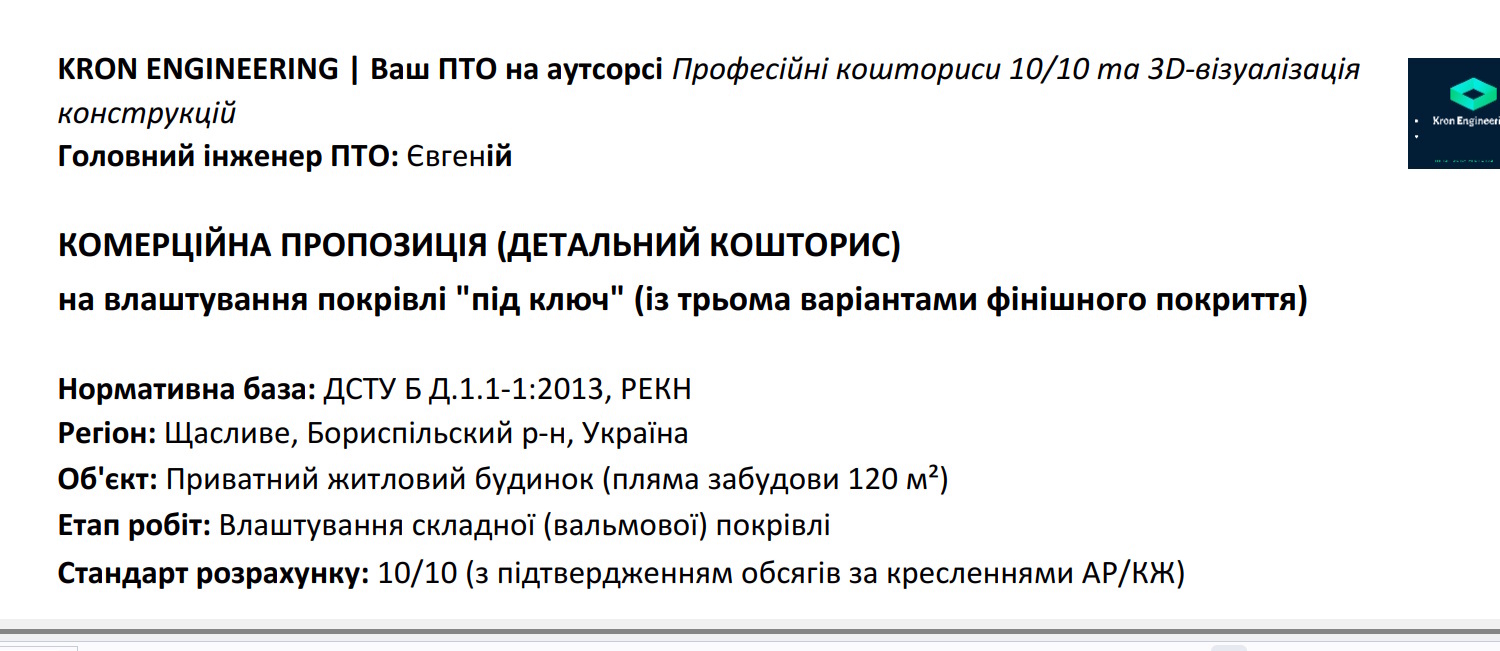
Reference estimate (AR/KJ) | Complex hipped roof 171 m2
Description:
Type of object: Private residential house (120 sq.m by footprint).
Scope of work: Complete calculation of the roof structure with a comparative analysis of 3 types of covering.
What has been implemented in this case:
Detailed calculation of volumes: Exact areas of slopes, lengths of ridges, edges, and eaves have been determined taking into account the slope.
Estimate according to DSTU/REKN: The work is divided into technological stages (mauerlat, rafter system, insulation, lathing).
Variability: 3 options for the finishing covering have been calculated (metal tiles, bitumen, and ceramic tiles).
Engineering support: A material list has been compiled considering the technological reserve for cutting.
Commercial block: Clearly defined areas of responsibility for the contractor, deadlines, and guarantees.
CONCLUSIONS AND ENGINEER'S RECOMMENDATIONS (excerpt from the calculation):
In each estimate, I do not just sum up the numbers, but also provide a technical justification for optimizing the budget. An example of my conclusion for this object:
"For the complex hipped roof, I strongly recommend Option 2 (Bitumen tiles). You will significantly save on material waste: 5% waste compared to 20% in metal on diagonal cuts. Bitumen tiles perfectly navigate all the geometric complexities of a hipped roof, providing absolute waterproofing and no noise during rain. Ceramic is a premium choice but requires mandatory recalculation of the foundation and walls for additional load (up to 50 kg/sq.m)."
This document is an example of the "Standard 10/10" approach, where each figure is justified by geometric calculation and regulatory framework.
Description:
Type of object: Private residential house (120 sq.m by footprint).
Scope of work: Complete calculation of the roof structure with a comparative analysis of 3 types of covering.
What has been implemented in this case:
Detailed calculation of volumes: Exact areas of slopes, lengths of ridges, edges, and eaves have been determined taking into account the slope.
Estimate according to DSTU/REKN: The work is divided into technological stages (mauerlat, rafter system, insulation, lathing).
Variability: 3 options for the finishing covering have been calculated (metal tiles, bitumen, and ceramic tiles).
Engineering support: A material list has been compiled considering the technological reserve for cutting.
Commercial block: Clearly defined areas of responsibility for the contractor, deadlines, and guarantees.
CONCLUSIONS AND ENGINEER'S RECOMMENDATIONS (excerpt from the calculation):
In each estimate, I do not just sum up the numbers, but also provide a technical justification for optimizing the budget. An example of my conclusion for this object:
"For the complex hipped roof, I strongly recommend Option 2 (Bitumen tiles). You will significantly save on material waste: 5% waste compared to 20% in metal on diagonal cuts. Bitumen tiles perfectly navigate all the geometric complexities of a hipped roof, providing absolute waterproofing and no noise during rain. Ceramic is a premium choice but requires mandatory recalculation of the foundation and walls for additional load (up to 50 kg/sq.m)."
This document is an example of the "Standard 10/10" approach, where each figure is justified by geometric calculation and regulatory framework.