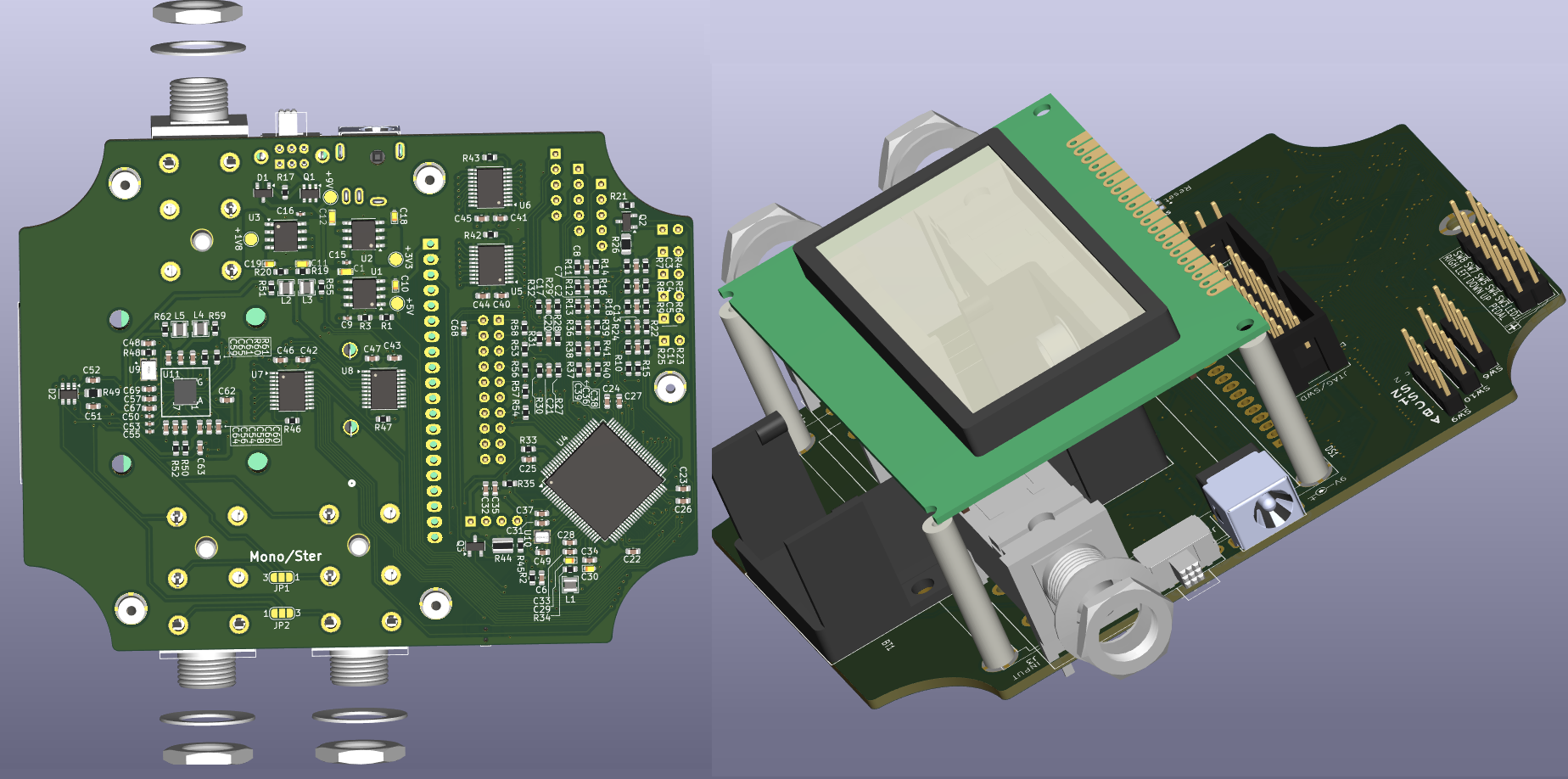
The device receives an analog audio signal, digitizes it, modifies the signal according to an algorithm, after which digital-to-analog conversion and signal amplification occur. The control elements are not shown in the photo - they are located on the casing and connect to the corresponding sockets on the board.
The board has one audio input and two outputs, which have high voltage protection circuits. Control is done using buttons (4 pcs. + pedal), encoders (3 pcs.). Information display is implemented through a monochrome display. Power can be supplied from an external source or from a built-in battery - there is a switch, and protections against reverse polarity and high input voltage are implemented. In case of inactivity, the board can switch to power-saving mode to conserve battery - the circuit allows turning off the power to all elements except the microprocessor. For debugging, two UART and JTAG ports are provided.
The board has one audio input and two outputs, which have high voltage protection circuits. Control is done using buttons (4 pcs. + pedal), encoders (3 pcs.). Information display is implemented through a monochrome display. Power can be supplied from an external source or from a built-in battery - there is a switch, and protections against reverse polarity and high input voltage are implemented. In case of inactivity, the board can switch to power-saving mode to conserve battery - the circuit allows turning off the power to all elements except the microprocessor. For debugging, two UART and JTAG ports are provided.