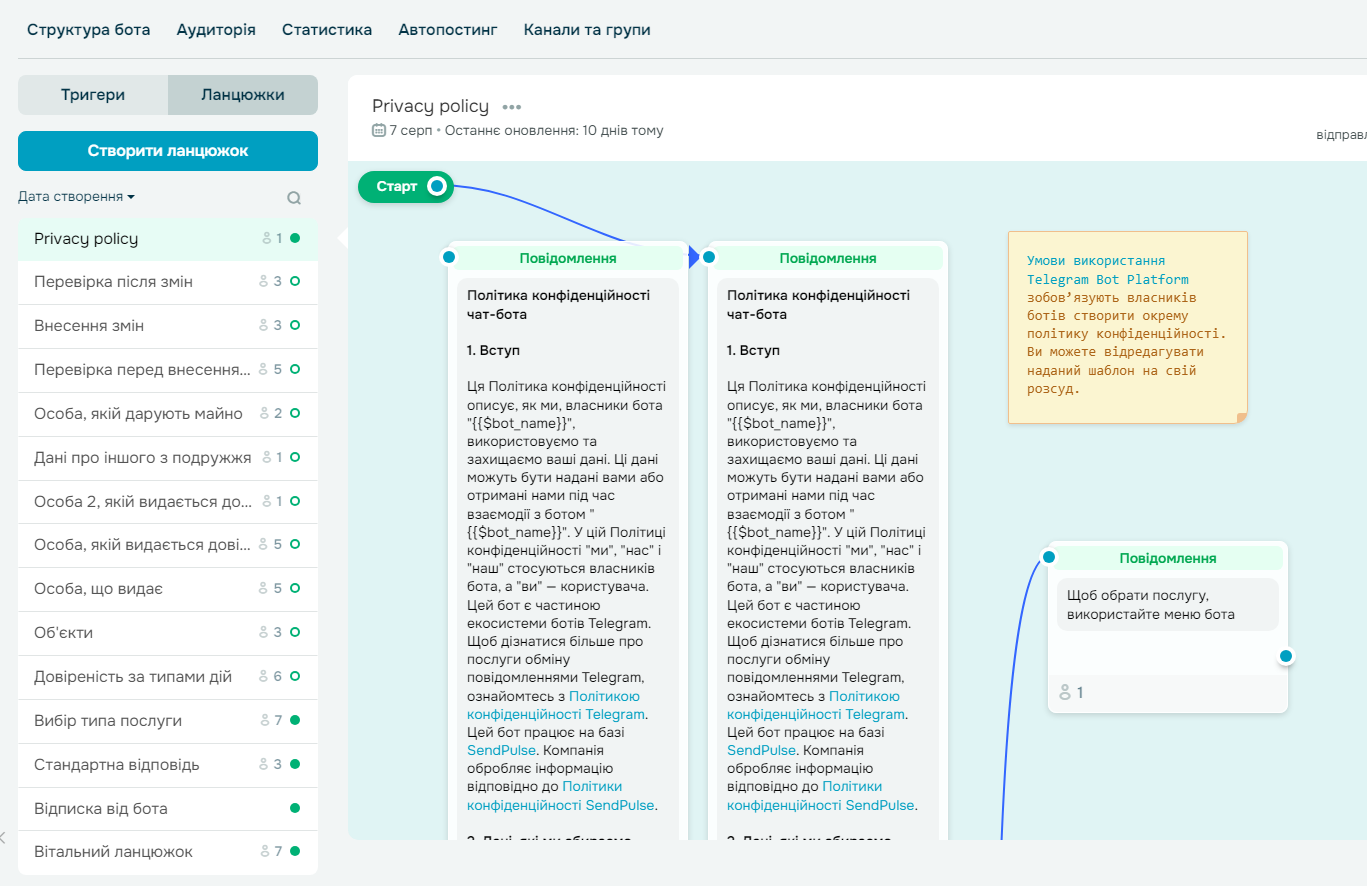
Goal: to increase the efficiency of notary assistants' work and reduce the workload through maximum automation of information collection and its transfer to standard documents.
Implementation: Telegram, SendPulse, Google Sheets, Google Docs, Google Apps Script
The link to the bot is placed on the notary's website or sent to the user in personal correspondence.
Bot operation logic:
1. The user activates the bot, selects the type of service/type of power of attorney.
2. The bot step-by-step surveys the user. Depending on the selected type of service, information is requested: who issues the power of attorney, to whom (options - one/two persons), object of actions (real estate, vehicle, land plot), data about the spouse (if necessary).
3. The bot sends the collected data to the user for verification - if changes are needed, there is an option to either change the information of individual logical blocks or to go through the bot again from the very beginning.
4. Verified and agreed data is transferred by the bot to a Google sheet - a separate sheet is provided for each type of document.
5. When changes are made to the table, a script is activated that checks which specific sheet has been changed, selects the corresponding document template for that sheet, creates a new Google document based on it, and transfers data from the table according to the markup with tags.
6. A PDF file is sent to the user for information, and a link to the created Google document with notes is sent to employees in a separate Telegram group for review and necessary changes.
Result:
1. Significant savings in employees' working time:
- due to information collection by the bot (self-passing of the bot by the user takes, depending on the specific situation, from 8-10 to 18-20 minutes)
- automatic data transfer and document formation
At this stage of communication with the client, the employee connects only for final verification and minimal edits, as well as for scheduling a meeting.
2. Reduction in the client's waiting time for a response and improvement in service quality - the client does not need to wait for an employee to become available, they can go through the bot at a convenient time for themselves, not just during the notary's working hours, including breaks (waiting for the user's response is provided for up to 24 hours).
Implementation: Telegram, SendPulse, Google Sheets, Google Docs, Google Apps Script
The link to the bot is placed on the notary's website or sent to the user in personal correspondence.
Bot operation logic:
1. The user activates the bot, selects the type of service/type of power of attorney.
2. The bot step-by-step surveys the user. Depending on the selected type of service, information is requested: who issues the power of attorney, to whom (options - one/two persons), object of actions (real estate, vehicle, land plot), data about the spouse (if necessary).
3. The bot sends the collected data to the user for verification - if changes are needed, there is an option to either change the information of individual logical blocks or to go through the bot again from the very beginning.
4. Verified and agreed data is transferred by the bot to a Google sheet - a separate sheet is provided for each type of document.
5. When changes are made to the table, a script is activated that checks which specific sheet has been changed, selects the corresponding document template for that sheet, creates a new Google document based on it, and transfers data from the table according to the markup with tags.
6. A PDF file is sent to the user for information, and a link to the created Google document with notes is sent to employees in a separate Telegram group for review and necessary changes.
Result:
1. Significant savings in employees' working time:
- due to information collection by the bot (self-passing of the bot by the user takes, depending on the specific situation, from 8-10 to 18-20 minutes)
- automatic data transfer and document formation
At this stage of communication with the client, the employee connects only for final verification and minimal edits, as well as for scheduling a meeting.
2. Reduction in the client's waiting time for a response and improvement in service quality - the client does not need to wait for an employee to become available, they can go through the bot at a convenient time for themselves, not just during the notary's working hours, including breaks (waiting for the user's response is provided for up to 24 hours).