Situation: Financial company "InvestPro" was preparing to launch a new investment product aimed at attracting new clients who previously had little experience in investing. To successfully enter the market and conduct effective marketing, a deep analysis of the potential target audience was needed.
Problems:
Uncertainty about key characteristics of potential investors: Lack of clear understanding of demographic, psychographic features, financial capabilities, and investment goals of potential clients.
Risk of ineffective product positioning: Misunderstanding the needs and expectations of the target audience could lead to incorrect product positioning and ineffective marketing messages.
Difficulty in choosing communication channels: Not knowing where to find potential clients and which communication channels would be most effective for them.
Risk of low interest in the product: Insufficient understanding of the motivations and barriers of potential investors could result in low engagement with the new product.
Solution: Conducting a comprehensive analysis of the target audience for the investment product, including research on demographic data, financial behavior, investment goals, and barriers faced by potential clients.
Task:
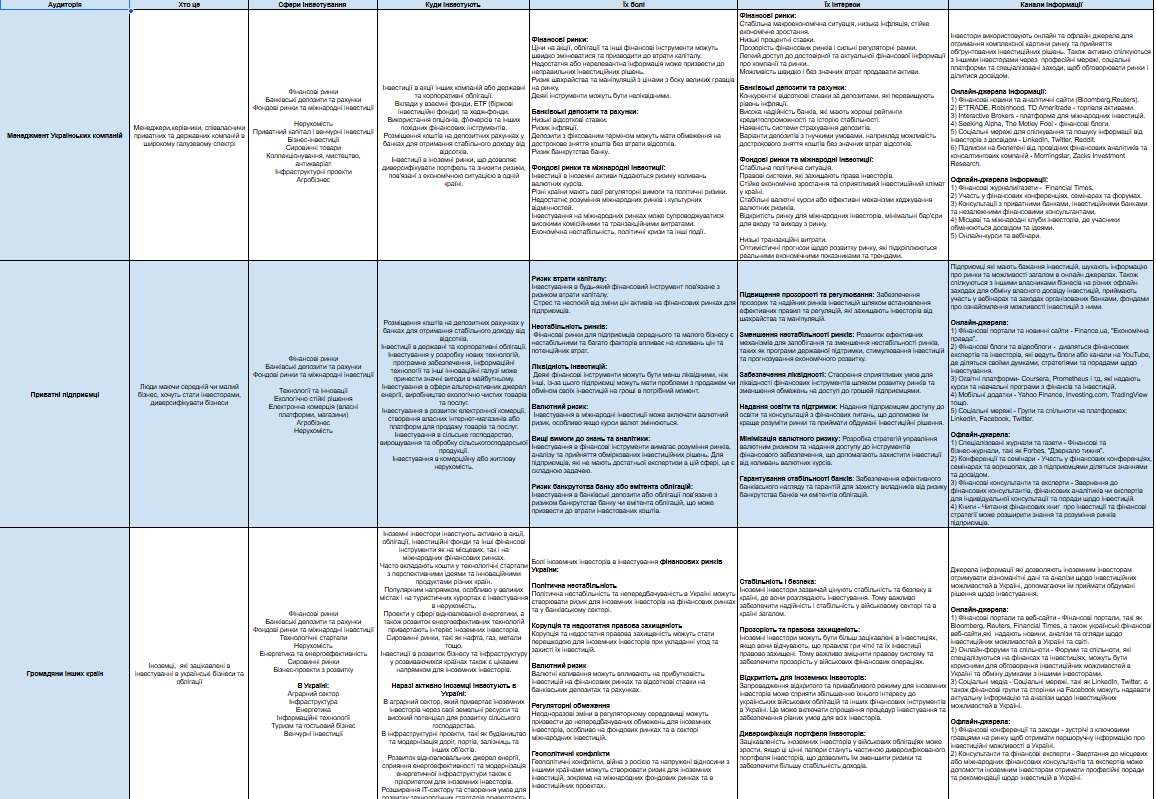
Identify the main segments of the potential target audience for the investment product.
Describe typical representatives of each segment (personas), considering their financial capabilities, investment goals, level of knowledge about investments, and attitude towards risk.
Identify the main needs, motivations, and barriers that may influence investment decisions in the product.
Determine the most effective communication channels to reach different segments of the target audience.
Provide recommendations on product positioning and development of marketing messages tailored to the needs of the target audience.
Action:
Conducted desk research on the investment market and analyzed data on potential investors (statistical reports, consumer behavior studies in financial services).
Organized a series of in-depth interviews with representatives of different population groups who could potentially be interested in the investment product.
Carried out online surveys among the target audience to gather quantitative data on their financial habits, investment goals, and awareness levels.
Analyzed the collected data to identify key needs, motivations (e.g., desire for financial independence, capital preservation, passive income), and barriers (e.g., lack of knowledge, fear of risk, distrust of financial institutions).
Determined the most effective communication channels for each segment (social networks, thematic forums, financial publications, webinars).
Results:
Identified three main segments of the target audience for the investment product.
Developed detailed personas that allowed a deep understanding of the needs and motivations of potential clients.
Discovered key needs (simplicity, accessibility, low entry barrier), motivations (capital growth, financial stability), and barriers (fear of losing money, complexity of understanding investment mechanisms).
Determined optimal communication channels for each audience segment.
Provided recommendations for positioning the product as a simple, accessible, and reliable tool for beginners in investing.
Problems:
Uncertainty about key characteristics of potential investors: Lack of clear understanding of demographic, psychographic features, financial capabilities, and investment goals of potential clients.
Risk of ineffective product positioning: Misunderstanding the needs and expectations of the target audience could lead to incorrect product positioning and ineffective marketing messages.
Difficulty in choosing communication channels: Not knowing where to find potential clients and which communication channels would be most effective for them.
Risk of low interest in the product: Insufficient understanding of the motivations and barriers of potential investors could result in low engagement with the new product.
Solution: Conducting a comprehensive analysis of the target audience for the investment product, including research on demographic data, financial behavior, investment goals, and barriers faced by potential clients.
Task:
Identify the main segments of the potential target audience for the investment product.
Describe typical representatives of each segment (personas), considering their financial capabilities, investment goals, level of knowledge about investments, and attitude towards risk.
Identify the main needs, motivations, and barriers that may influence investment decisions in the product.
Determine the most effective communication channels to reach different segments of the target audience.
Provide recommendations on product positioning and development of marketing messages tailored to the needs of the target audience.
Action:
Conducted desk research on the investment market and analyzed data on potential investors (statistical reports, consumer behavior studies in financial services).
Organized a series of in-depth interviews with representatives of different population groups who could potentially be interested in the investment product.
Carried out online surveys among the target audience to gather quantitative data on their financial habits, investment goals, and awareness levels.
Analyzed the collected data to identify key needs, motivations (e.g., desire for financial independence, capital preservation, passive income), and barriers (e.g., lack of knowledge, fear of risk, distrust of financial institutions).
Determined the most effective communication channels for each segment (social networks, thematic forums, financial publications, webinars).
Results:
Identified three main segments of the target audience for the investment product.
Developed detailed personas that allowed a deep understanding of the needs and motivations of potential clients.
Discovered key needs (simplicity, accessibility, low entry barrier), motivations (capital growth, financial stability), and barriers (fear of losing money, complexity of understanding investment mechanisms).
Determined optimal communication channels for each audience segment.
Provided recommendations for positioning the product as a simple, accessible, and reliable tool for beginners in investing.