Audit
Interface Design (UI/UX)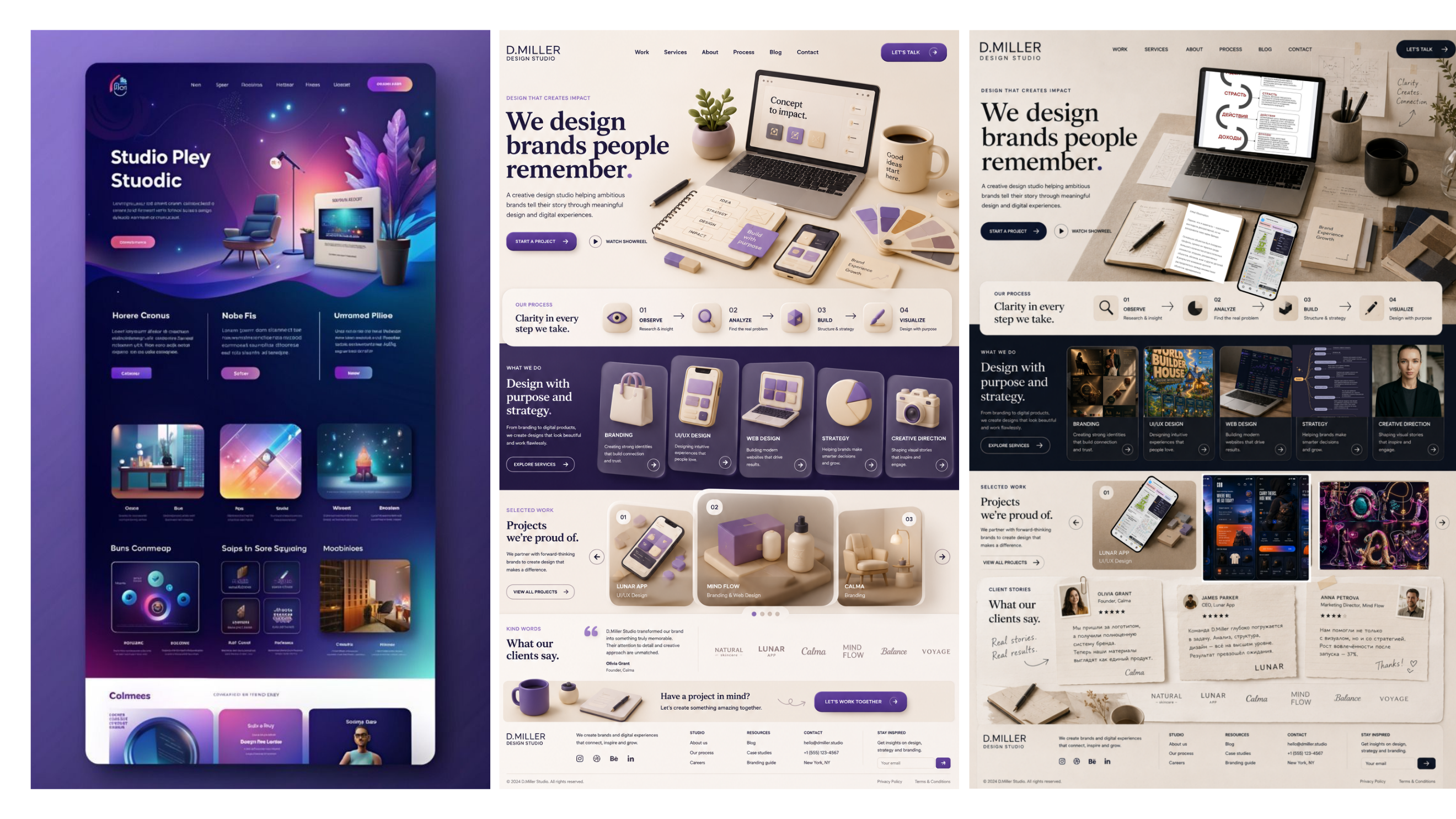
Design Audit — From AI Abstraction to Human-Centered Design
Initial Observation
As part of the experiment, I decided to explore how the perception of the interface changes with a gradual transition from a fully AI-generated design to a design that incorporates human logic and real work artifacts.
To this end, three versions of one website were created.
---
Version 01 — AI
The first version was completely created by artificial intelligence.
Strengths:
- modern visual aesthetics;
- appealing color palette;
- striking gradients;
- quality composition.
However, after viewing, the question arose:
"What does this company do?"
Most of the objects served a decorative function:
- chair;
- plant;
- lamp;
- abstract shapes.
They created an atmosphere but did not explain the product.
As a result, the site looked beautiful, but the meaning had to be guessed.
---
Version 02 — AI + Design Direction
In the second stage, I preserved the strengths of the original concept but began to guide the AI through a design task.
Main goal:
to replace abstract objects with understandable visual metaphors.
The interface included:
- laptop;
- notebook;
- phone;
- color palette;
- elements of the workflow.
The site became significantly clearer.
A connection emerged between the objects and the studio's services.
However, most of the content still remained conceptual and could belong to almost any design team.
---
Version 03 — AI + Human Curation
In the third stage, human design was involved in the process.
I began to replace abstract images with real work artifacts:
- interfaces;
- diagrams;
- strategies;
- game projects;
- real cases;
- client stories.
The feedback section was also completely redesigned.
Instead of perfect template quotes, there appeared:
- photos of clients;
- real reviews;
- signatures;
- elements of paper notes.
The site began to tell not only about the visuals but also about the studio's thought process.
---
Key Difference
Version 01
AI creates atmosphere.
Version 02
AI creates atmosphere and begins to explain the product.
Version 03
AI creates the foundation, while humans add context, meaning, and evidence.
---
Conclusion
This experiment revealed an interesting pattern.
Artificial intelligence excels at creating aesthetics and visual mood.
However, it is the human who determines:
- which objects make sense;
- which elements inspire trust;
- which artifacts better explain the product;
- how the design tells the story of the business.
As a result, the final version became not just beautiful.
It became understandable, human-centered, and focused on real user tasks.
The main takeaway from the project:
AI can create a visual shell. Humans turn it into a product experience.
Initial Observation
As part of the experiment, I decided to explore how the perception of the interface changes with a gradual transition from a fully AI-generated design to a design that incorporates human logic and real work artifacts.
To this end, three versions of one website were created.
---
Version 01 — AI
The first version was completely created by artificial intelligence.
Strengths:
- modern visual aesthetics;
- appealing color palette;
- striking gradients;
- quality composition.
However, after viewing, the question arose:
"What does this company do?"
Most of the objects served a decorative function:
- chair;
- plant;
- lamp;
- abstract shapes.
They created an atmosphere but did not explain the product.
As a result, the site looked beautiful, but the meaning had to be guessed.
---
Version 02 — AI + Design Direction
In the second stage, I preserved the strengths of the original concept but began to guide the AI through a design task.
Main goal:
to replace abstract objects with understandable visual metaphors.
The interface included:
- laptop;
- notebook;
- phone;
- color palette;
- elements of the workflow.
The site became significantly clearer.
A connection emerged between the objects and the studio's services.
However, most of the content still remained conceptual and could belong to almost any design team.
---
Version 03 — AI + Human Curation
In the third stage, human design was involved in the process.
I began to replace abstract images with real work artifacts:
- interfaces;
- diagrams;
- strategies;
- game projects;
- real cases;
- client stories.
The feedback section was also completely redesigned.
Instead of perfect template quotes, there appeared:
- photos of clients;
- real reviews;
- signatures;
- elements of paper notes.
The site began to tell not only about the visuals but also about the studio's thought process.
---
Key Difference
Version 01
AI creates atmosphere.
Version 02
AI creates atmosphere and begins to explain the product.
Version 03
AI creates the foundation, while humans add context, meaning, and evidence.
---
Conclusion
This experiment revealed an interesting pattern.
Artificial intelligence excels at creating aesthetics and visual mood.
However, it is the human who determines:
- which objects make sense;
- which elements inspire trust;
- which artifacts better explain the product;
- how the design tells the story of the business.
As a result, the final version became not just beautiful.
It became understandable, human-centered, and focused on real user tasks.
The main takeaway from the project:
AI can create a visual shell. Humans turn it into a product experience.