Banner "Dream of Travel"
Banners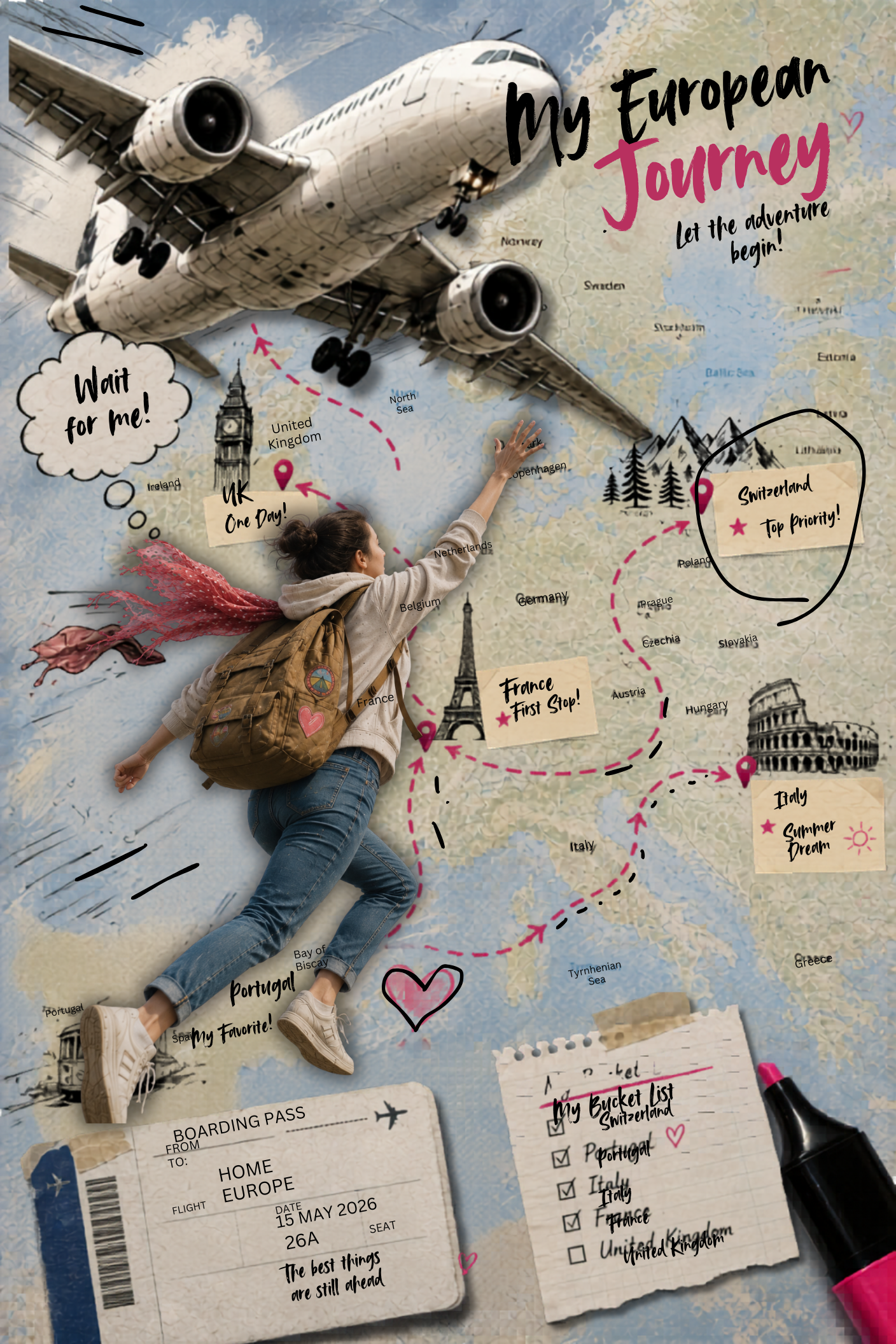
Design Analysis — Enhancing Message Perception through Visual Hierarchy
Business Task
The initial concept, created with the help of AI, I am not sharing as it is someone else's work, simultaneously contained numerous themes related to travel: countries, transport, languages, food, landscapes, attractions, and various experiences.
Despite its visual appeal, the composition lacked a clear semantic center. Several visual stories competed for the viewer's attention, increasing cognitive load and reducing communication effectiveness.
Strategic Observation
The user first perceives the image and only then reads the text.
In the original version, the gaze moved chaotically between unrelated elements, making it difficult to identify the main idea of the poster.
As a result, the design communicated:
"Travel in general"
instead of a specific goal, dream, or story.
Solution
Instead of showcasing multiple destinations and experiences simultaneously, I restructured the composition around one clear narrative:
"A person striving for their dream of travel."
Key changes:
• Replaced disparate images with a unified structure based on a map.
• Established a clear visual hierarchy.
• Added a character to create an emotional connection with the viewer.
• Transformed the airplane from a decorative element into a visual symbol of the goal.
• Used the travel route to guide the viewer's attention.
• Reduced color and semantic noise, enhancing focus on the main idea.
Result
The redesign transformed a collection of tourist images into a cohesive visual story.
Now the viewer can instantly understand:
- the goal of the journey;
- desired destinations;
- the route itself;
- the emotional motivation of the hero.
This approach improves the readability of the composition, enhances message memorability, and makes visual communication more effective through storytelling.
Business Task
The initial concept, created with the help of AI, I am not sharing as it is someone else's work, simultaneously contained numerous themes related to travel: countries, transport, languages, food, landscapes, attractions, and various experiences.
Despite its visual appeal, the composition lacked a clear semantic center. Several visual stories competed for the viewer's attention, increasing cognitive load and reducing communication effectiveness.
Strategic Observation
The user first perceives the image and only then reads the text.
In the original version, the gaze moved chaotically between unrelated elements, making it difficult to identify the main idea of the poster.
As a result, the design communicated:
"Travel in general"
instead of a specific goal, dream, or story.
Solution
Instead of showcasing multiple destinations and experiences simultaneously, I restructured the composition around one clear narrative:
"A person striving for their dream of travel."
Key changes:
• Replaced disparate images with a unified structure based on a map.
• Established a clear visual hierarchy.
• Added a character to create an emotional connection with the viewer.
• Transformed the airplane from a decorative element into a visual symbol of the goal.
• Used the travel route to guide the viewer's attention.
• Reduced color and semantic noise, enhancing focus on the main idea.
Result
The redesign transformed a collection of tourist images into a cohesive visual story.
Now the viewer can instantly understand:
- the goal of the journey;
- desired destinations;
- the route itself;
- the emotional motivation of the hero.
This approach improves the readability of the composition, enhances message memorability, and makes visual communication more effective through storytelling.