Client Pain Point
A small business has 3 vehicles. Fuel receipts are collected in glove compartments, repairs are remembered by someone, and at the end of the month, the owner cannot answer basic questions: how much does a kilometer actually cost? Which vehicle is eating up the budget? The discipline of "fill in the spreadsheet" does not survive the collision with real drivers.
What Has Been Done
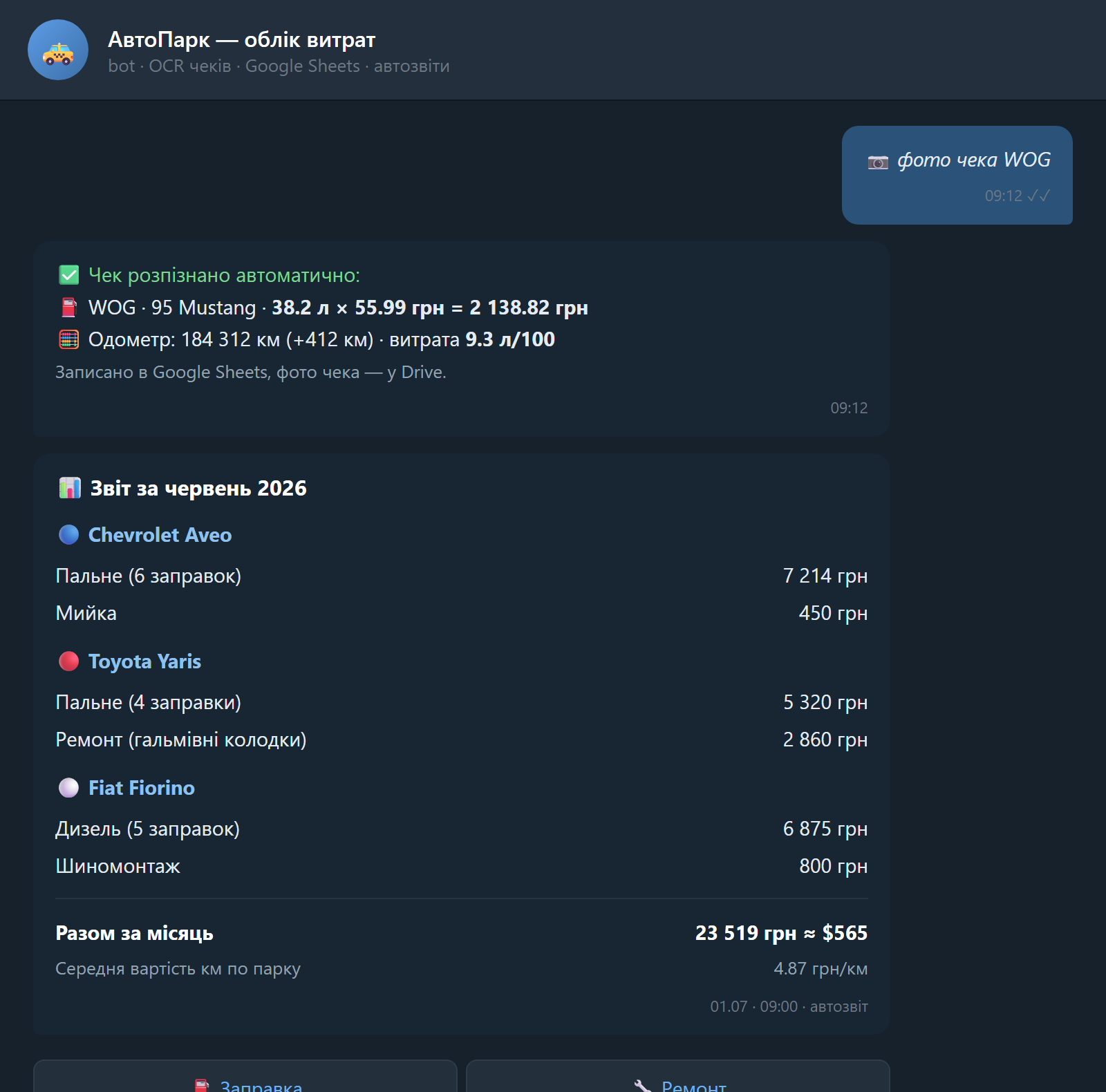
A Telegram bot that drivers actually use: take a photo of the receipt — AI recognition (Claude Vision) extracts the gas station, type of fuel, liters, price, and total amount.
Photo of the odometer → Google Cloud Vision reads the mileage; the bot immediately calculates the distance, consumption per 100 km, and cost per kilometer.
Smart confirmation: the bot detects discrepancies in dates and price jumps before recording — dirty data does not enter the accounting.
Everything is stored in Google Sheets (sheets are created automatically with the correct structure); photos of receipts are archived in Google Drive by vehicle folders.
Auto-reports: on the 1st of the month at 09:00, the owner receives a complete report for each vehicle; on January 1st — an annual summary.
Life nuances taken into account: one vehicle reports in miles (auto-conversion to km), one is diesel with trip data from dashboard photos.
Result
Entering expenses takes ~30 seconds, so drivers actually do it.
The owner sees the cost per km, fuel consumption, and monthly summaries for each vehicle without opening spreadsheets.
Reports come automatically — "need to sit down for accounting" no longer exists.
Complete audit trail: each expense is backed by a photo of the receipt in Drive.
Stack
Python · python-telegram-bot · Claude Vision + Google Cloud Vision (OCR) · Google Sheets/Drive API · APScheduler · systemd/VPS
A small business has 3 vehicles. Fuel receipts are collected in glove compartments, repairs are remembered by someone, and at the end of the month, the owner cannot answer basic questions: how much does a kilometer actually cost? Which vehicle is eating up the budget? The discipline of "fill in the spreadsheet" does not survive the collision with real drivers.
What Has Been Done
A Telegram bot that drivers actually use: take a photo of the receipt — AI recognition (Claude Vision) extracts the gas station, type of fuel, liters, price, and total amount.
Photo of the odometer → Google Cloud Vision reads the mileage; the bot immediately calculates the distance, consumption per 100 km, and cost per kilometer.
Smart confirmation: the bot detects discrepancies in dates and price jumps before recording — dirty data does not enter the accounting.
Everything is stored in Google Sheets (sheets are created automatically with the correct structure); photos of receipts are archived in Google Drive by vehicle folders.
Auto-reports: on the 1st of the month at 09:00, the owner receives a complete report for each vehicle; on January 1st — an annual summary.
Life nuances taken into account: one vehicle reports in miles (auto-conversion to km), one is diesel with trip data from dashboard photos.
Result
Entering expenses takes ~30 seconds, so drivers actually do it.
The owner sees the cost per km, fuel consumption, and monthly summaries for each vehicle without opening spreadsheets.
Reports come automatically — "need to sit down for accounting" no longer exists.
Complete audit trail: each expense is backed by a photo of the receipt in Drive.
Stack
Python · python-telegram-bot · Claude Vision + Google Cloud Vision (OCR) · Google Sheets/Drive API · APScheduler · systemd/VPS