Development and launch of a rotary roller conveyor into production
Mechanical Engineering & Instrument Making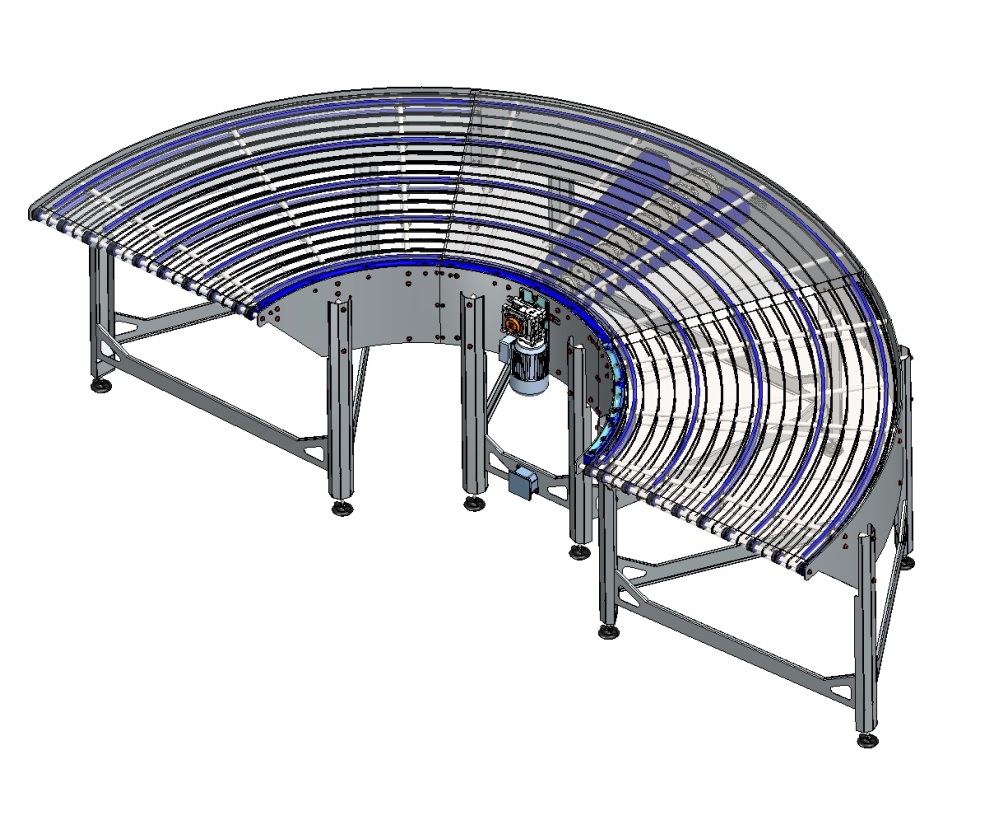
As part of this project, a complete cycle of development for custom equipment for an automated production line was carried out. The main task was to create a reliable and technologically advanced module for changing the direction of product movement by 180 degrees while maintaining orientation.
Completed work scope:
Design in SOLIDWORKS: Creation of a complete 3D assembly model (more than 150 unique parts). Development of the kinematic scheme and calculation of loads on the drive units.
Engineering analysis: Verification of the assembly and functionality of mechanisms in a virtual environment. Optimization of the design to reduce material consumption without losing frame rigidity.
Technological adaptation: The design was developed considering modern processing methods — laser cutting and bending on CNC machines. Mortise-tenon joints were used, which minimized the use of expensive tooling during assembly and eliminated "human factor" errors.
Preparation of design documentation: Development of a complete package of design documentation, specifications, and files for CNC machines (DXF for laser, unfoldings for bending).
Selection of components: Calculation and selection of motor-reducers, bearing units, and drive elements.
Result:
The project has been successfully implemented "in metal." Currently, 4 units of equipment have been manufactured and put into operation. Based on this model, a modification with a 90-degree rotation angle has been developed. The equipment demonstrates high reliability and accuracy of operation as part of the conveyor line.
Completed work scope:
Design in SOLIDWORKS: Creation of a complete 3D assembly model (more than 150 unique parts). Development of the kinematic scheme and calculation of loads on the drive units.
Engineering analysis: Verification of the assembly and functionality of mechanisms in a virtual environment. Optimization of the design to reduce material consumption without losing frame rigidity.
Technological adaptation: The design was developed considering modern processing methods — laser cutting and bending on CNC machines. Mortise-tenon joints were used, which minimized the use of expensive tooling during assembly and eliminated "human factor" errors.
Preparation of design documentation: Development of a complete package of design documentation, specifications, and files for CNC machines (DXF for laser, unfoldings for bending).
Selection of components: Calculation and selection of motor-reducers, bearing units, and drive elements.
Result:
The project has been successfully implemented "in metal." Currently, 4 units of equipment have been manufactured and put into operation. Based on this model, a modification with a 90-degree rotation angle has been developed. The equipment demonstrates high reliability and accuracy of operation as part of the conveyor line.