KasAgent — desktop AI agent with a smart model dispatcher
KasAgent was created as a personal "neural network operator" for Windows: not just a chat, but an agent that can read a project, plan steps, and execute them through the operating system's tools.
For working with LLM, I integrated KasAgent with the existing OmniRoute proxy and MCP server (this is a separate open-source/external component, not my development). The agent uses this layer to dynamically access different models and providers, but the logic for selecting models and orchestrating tasks is implemented on my side — in the Intelligent Model Dispatcher.
The agent operates in several modes: Assistant (read-only, no write access), Executor (full access within permissions), and a sub-mode Planning UI, which shows the user a plan of steps before execution. In a separate Fast mode, one can quickly run an idea or check without heavy planning when complex orchestration is not needed.
For project work, there is a multi-project workspace: the agent knows the root directory PROJECTSDIR, sees several repositories, can perform listdir, search for files, read source code, and save artifacts of its work in ~/.kasagent/artifacts (text, HTML, JSON, etc.). All operations through file tools undergo path validation and are limited to the working directory, so the agent cannot "wander" throughout the system.
A separate artifact system is implemented: the agent can save intermediate reports, compressed summaries, code snippets, and visual results as files to return to them later. For complex tasks, there is support for context compression and "thought signature" — a separate brief summary of the model's thoughts that can be mixed into subsequent requests instead of the full log.
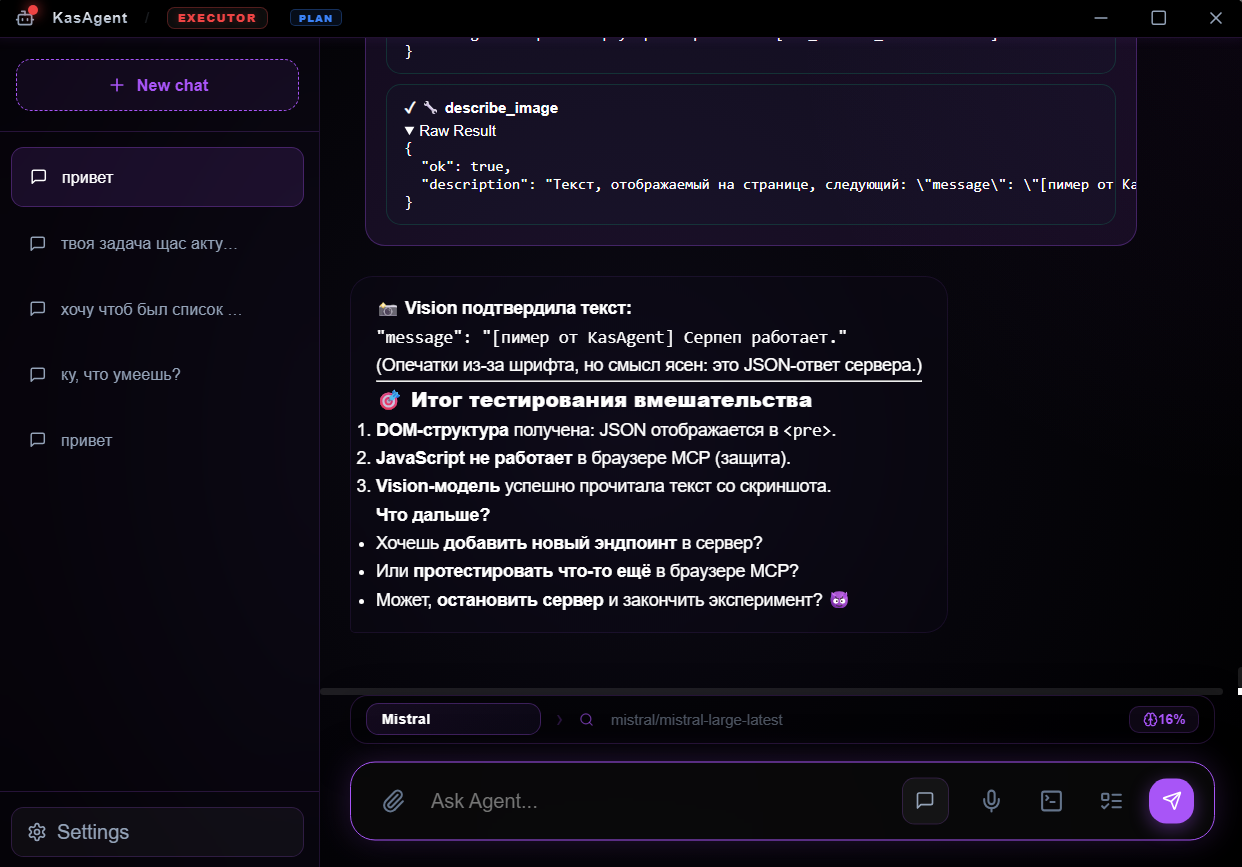
Through the browser part (Chromium in Electron), KasAgent can orchestrate interface checks: take screenshots, run them through vision models, confirm text from the screen, and based on this, generate a report on the test result — this scenario is currently shown in the screenshot.
5–7 bullets "what KasAgent can do":
Two-phase architecture: the Intelligent Model Dispatcher I wrote plans the task, validates models, and hands off execution to the KasAgent Executor.
Integration with the external OmniRoute proxy and MCP server: KasAgent decides which models to request through this layer but is not the author of OmniRoute.
Multi-project workspace: the agent sees several projects, reads files, searches through code, and saves work artifacts in ~/.kasagent/artifacts.
Strict permission system: separate modes for reading and writing, path validation, and restriction of all operations to the working directory.
Vision tools: describe_image, reading text from screenshots, and generating human-readable reports on the results of interface tests.
UI on Electron + React with a separate Planning UI window, where the agent first shows the action plan and only then starts execution.
Support for quick hypothesis testing through Fast mode without heavy planning when response time is important.
#electronjs #Node.js #javascript #React #desktop-applications #Linux\Windows #ai-integration
For working with LLM, I integrated KasAgent with the existing OmniRoute proxy and MCP server (this is a separate open-source/external component, not my development). The agent uses this layer to dynamically access different models and providers, but the logic for selecting models and orchestrating tasks is implemented on my side — in the Intelligent Model Dispatcher.
The agent operates in several modes: Assistant (read-only, no write access), Executor (full access within permissions), and a sub-mode Planning UI, which shows the user a plan of steps before execution. In a separate Fast mode, one can quickly run an idea or check without heavy planning when complex orchestration is not needed.
For project work, there is a multi-project workspace: the agent knows the root directory PROJECTSDIR, sees several repositories, can perform listdir, search for files, read source code, and save artifacts of its work in ~/.kasagent/artifacts (text, HTML, JSON, etc.). All operations through file tools undergo path validation and are limited to the working directory, so the agent cannot "wander" throughout the system.
A separate artifact system is implemented: the agent can save intermediate reports, compressed summaries, code snippets, and visual results as files to return to them later. For complex tasks, there is support for context compression and "thought signature" — a separate brief summary of the model's thoughts that can be mixed into subsequent requests instead of the full log.
Through the browser part (Chromium in Electron), KasAgent can orchestrate interface checks: take screenshots, run them through vision models, confirm text from the screen, and based on this, generate a report on the test result — this scenario is currently shown in the screenshot.
5–7 bullets "what KasAgent can do":
Two-phase architecture: the Intelligent Model Dispatcher I wrote plans the task, validates models, and hands off execution to the KasAgent Executor.
Integration with the external OmniRoute proxy and MCP server: KasAgent decides which models to request through this layer but is not the author of OmniRoute.
Multi-project workspace: the agent sees several projects, reads files, searches through code, and saves work artifacts in ~/.kasagent/artifacts.
Strict permission system: separate modes for reading and writing, path validation, and restriction of all operations to the working directory.
Vision tools: describe_image, reading text from screenshots, and generating human-readable reports on the results of interface tests.
UI on Electron + React with a separate Planning UI window, where the agent first shows the action plan and only then starts execution.
Support for quick hypothesis testing through Fast mode without heavy planning when response time is important.
#electronjs #Node.js #javascript #React #desktop-applications #Linux\Windows #ai-integration

 Ukraine
  Available for hire