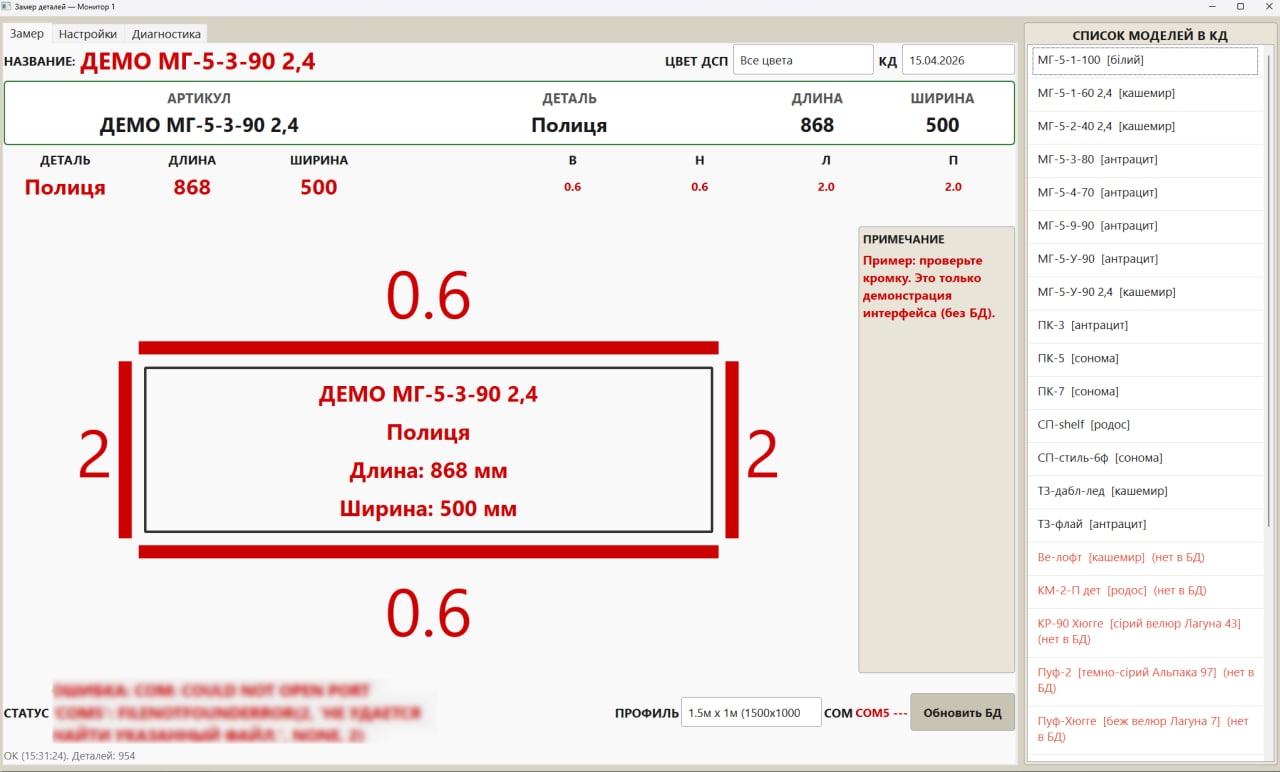
Measurement system for furniture parts for production — from sensor to order.
Imagine a workshop or edge banding area: the operator places the part, coordinates come from the sensor, and the screen immediately shows — which position it is from the order, whether the geometry matches the specification, what has already been measured, and what has not. This is not "just another table in Excel," but a workplace for a real flow: two monitors, a large interface, minimal unnecessary clicks — so that a person in gloves and in the noise of the workshop does not get lost.
What is this system
A desktop application (Windows) for automatic matching of actual part dimensions with the nomenclature and orders. Data about parts and orders is pulled from the cloud, measurements are recorded locally in a database, and progress on items and orders is visible in real time. It is convenient to provide the client with a single executable file with a configuration file alongside — without installing Python and "dancing" with the environment.
How it benefits production
Reduction of errors: less confusion about "is this a shelf or a side" — the system itself searches for matches based on dimensions with tolerances.
Speed: no need to manually search for a line in a huge specification.
Transparency: what has been measured and what has not — visible by order and items.
Repeatability: the same logic across all shifts, less dependence on the "experienced" person.
Current capabilities
Data reception via COM port (configurable string template, e.g., coordinates X/Y), stabilization of readings (thresholds, time of stable value) — to avoid recording measurements on a "shaky" part. Local SQLite: parts, orders, measurement history. Selection of parts by dimensions with tolerances, accounting for quantity, edges, notes. Integration with Google Sheets: synchronization of the catalog of parts and orders on a schedule — up-to-date specifications without manual file imports. Sensor/distance profiles, settings via ini — without recompiling the program.
Current integrations and "where to develop"
Also, development of a program for a microcontroller to control sensors according to the technical documentation from the sensor manufacturer.
There is also integration with a CRM/ERP system.
If you need to customize for your ERP, your sensors, or your regulations — we will discuss the roadmap and timelines.
#Production #Automation #CRM #Furniture #DesktopDevelopment #APIDevelopment #WindowsApplications
Imagine a workshop or edge banding area: the operator places the part, coordinates come from the sensor, and the screen immediately shows — which position it is from the order, whether the geometry matches the specification, what has already been measured, and what has not. This is not "just another table in Excel," but a workplace for a real flow: two monitors, a large interface, minimal unnecessary clicks — so that a person in gloves and in the noise of the workshop does not get lost.
What is this system
A desktop application (Windows) for automatic matching of actual part dimensions with the nomenclature and orders. Data about parts and orders is pulled from the cloud, measurements are recorded locally in a database, and progress on items and orders is visible in real time. It is convenient to provide the client with a single executable file with a configuration file alongside — without installing Python and "dancing" with the environment.
How it benefits production
Reduction of errors: less confusion about "is this a shelf or a side" — the system itself searches for matches based on dimensions with tolerances.
Speed: no need to manually search for a line in a huge specification.
Transparency: what has been measured and what has not — visible by order and items.
Repeatability: the same logic across all shifts, less dependence on the "experienced" person.
Current capabilities
Data reception via COM port (configurable string template, e.g., coordinates X/Y), stabilization of readings (thresholds, time of stable value) — to avoid recording measurements on a "shaky" part. Local SQLite: parts, orders, measurement history. Selection of parts by dimensions with tolerances, accounting for quantity, edges, notes. Integration with Google Sheets: synchronization of the catalog of parts and orders on a schedule — up-to-date specifications without manual file imports. Sensor/distance profiles, settings via ini — without recompiling the program.
Current integrations and "where to develop"
Also, development of a program for a microcontroller to control sensors according to the technical documentation from the sensor manufacturer.
There is also integration with a CRM/ERP system.
If you need to customize for your ERP, your sensors, or your regulations — we will discuss the roadmap and timelines.
#Production #Automation #CRM #Furniture #DesktopDevelopment #APIDevelopment #WindowsApplications