ProTrade Journal — a platform for simulating and analyzing tradi
Web Programming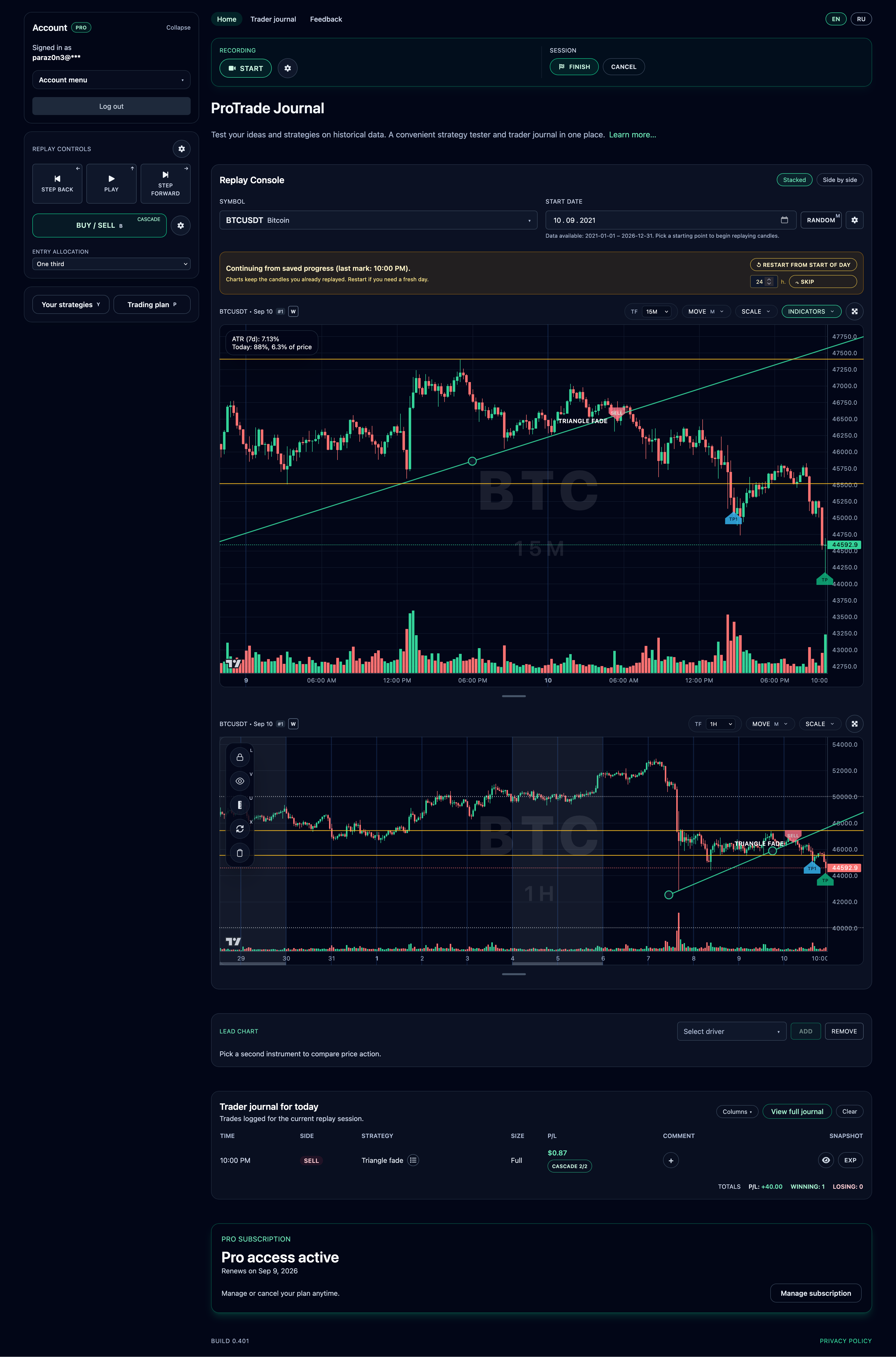
Historical simulator. The core module is an interactive “market on history”: the user selects a day and an instrument (or a random day and instrument are opened), sees a stream of quotes, opens/closes trades, adds screenshots and comments. The system records every action and recalculates PnL as if it were real trading. This allows you to train strategies without risk, practice scenarios, and reproduce rare market conditions.
Journal and analytics. After a session, trades are automatically added to the journal: equity curves, strategy cohorts, win/loss reports, filters by setups and tags, and journal comparisons. The journal supports CSV import/export, making migration from other systems easier.
AI assistant. A built-in assistant (powered by ChatGPT) analyzes selected trades: identifies rule violations, suggests alternative entries, and generates insights based on statistics.
Screen recordings. Pro users can record the entire process (screen + voice), choose presets for social media, and add background tracks. The resulting videos help share with a team, conduct reviews, and capture the thought process.
Infrastructure and stack.
Backend: FastAPI + Celery, TimescaleDB (Postgres), Redis, MinIO / S3.
Frontend: Next.js 13, React, Tailwind CSS, custom component library, and real-time updates.
The entire project is containerized with Docker, with HTML caching, backups, CI/CD, health checks, and monitoring.
Journal and analytics. After a session, trades are automatically added to the journal: equity curves, strategy cohorts, win/loss reports, filters by setups and tags, and journal comparisons. The journal supports CSV import/export, making migration from other systems easier.
AI assistant. A built-in assistant (powered by ChatGPT) analyzes selected trades: identifies rule violations, suggests alternative entries, and generates insights based on statistics.
Screen recordings. Pro users can record the entire process (screen + voice), choose presets for social media, and add background tracks. The resulting videos help share with a team, conduct reviews, and capture the thought process.
Infrastructure and stack.
Backend: FastAPI + Celery, TimescaleDB (Postgres), Redis, MinIO / S3.
Frontend: Next.js 13, React, Tailwind CSS, custom component library, and real-time updates.
The entire project is containerized with Docker, with HTML caching, backups, CI/CD, health checks, and monitoring.