QUIKL — pressure as a source of movement
Corporate Style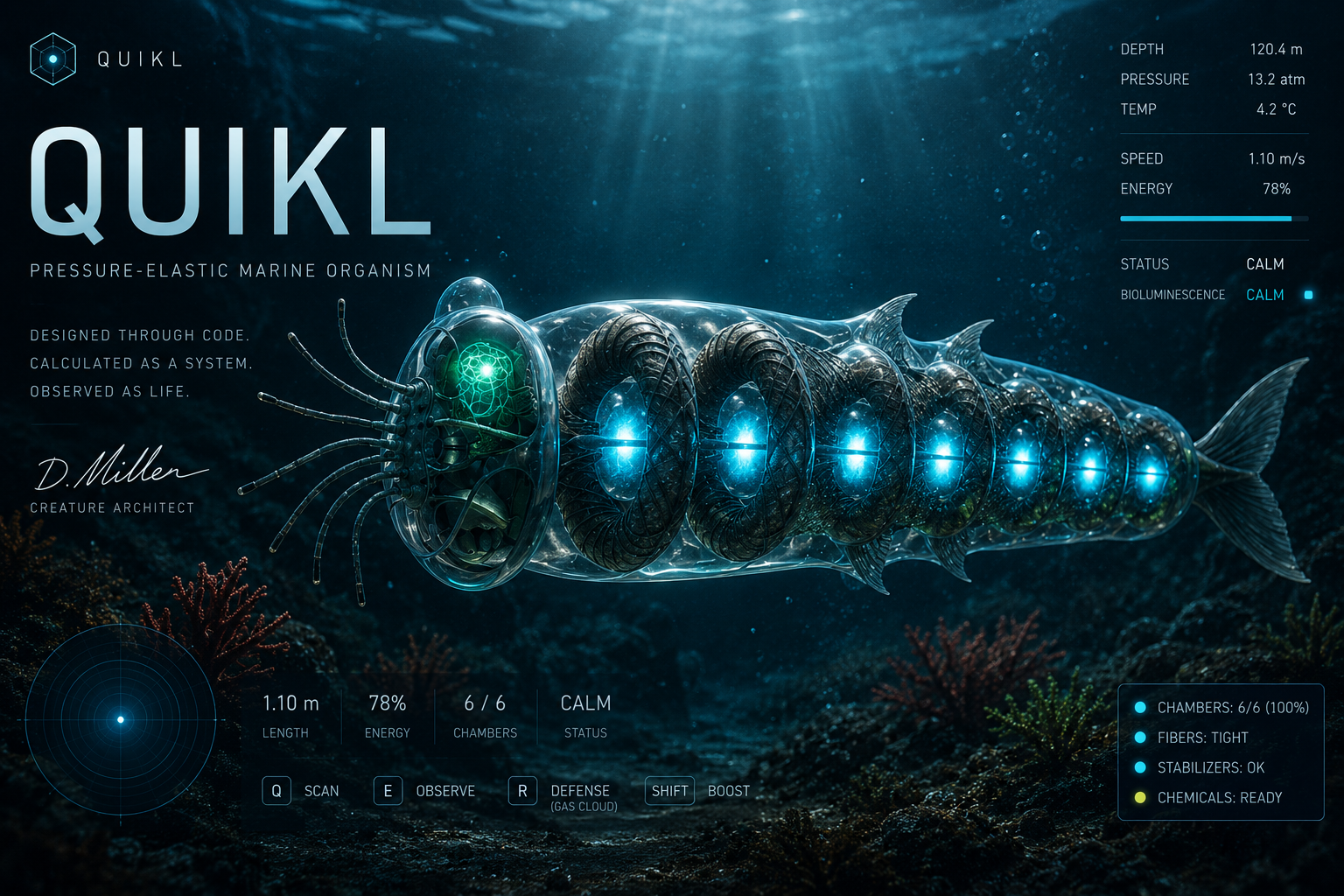
QUIKL — not a concept art of a creature and not an illustration of a fictional organism. This is the design of a biomechanical system. The organism was developed as an interconnected structure, where each form is a consequence of rules, not an artistic decision. At the core of the project is the idea of using the external environment as a source of energy. Quikl does not produce movement in the traditional way — it converts the pressure of surrounding water into stored elastic energy and releases it at the moment of jumping. Each element of the organism was designed through function:
— segmented body structure
— compression chambers
— reactive acceleration
— hydrodynamic adaptation
— heat exchange
— tissue regeneration system
— material limitations and extreme operating modes
The project built the internal logic of the organism:
medium pressure
→ compression
→ energy accumulation
→ release
→ cooling
→ recovery
The form of the organism was not created manually as a decorative image. It was derived from a set of conditions: geometry, biomechanics, states, environmental constraints, and system behavior. The project explores the question:
can an organism be calculated rather than drawn? QUIKL is an attempt to design a living system as engineering architecture.
— segmented body structure
— compression chambers
— reactive acceleration
— hydrodynamic adaptation
— heat exchange
— tissue regeneration system
— material limitations and extreme operating modes
The project built the internal logic of the organism:
medium pressure
→ compression
→ energy accumulation
→ release
→ cooling
→ recovery
The form of the organism was not created manually as a decorative image. It was derived from a set of conditions: geometry, biomechanics, states, environmental constraints, and system behavior. The project explores the question:
can an organism be calculated rather than drawn? QUIKL is an attempt to design a living system as engineering architecture.