Some information about my projects
AI & Machine Learning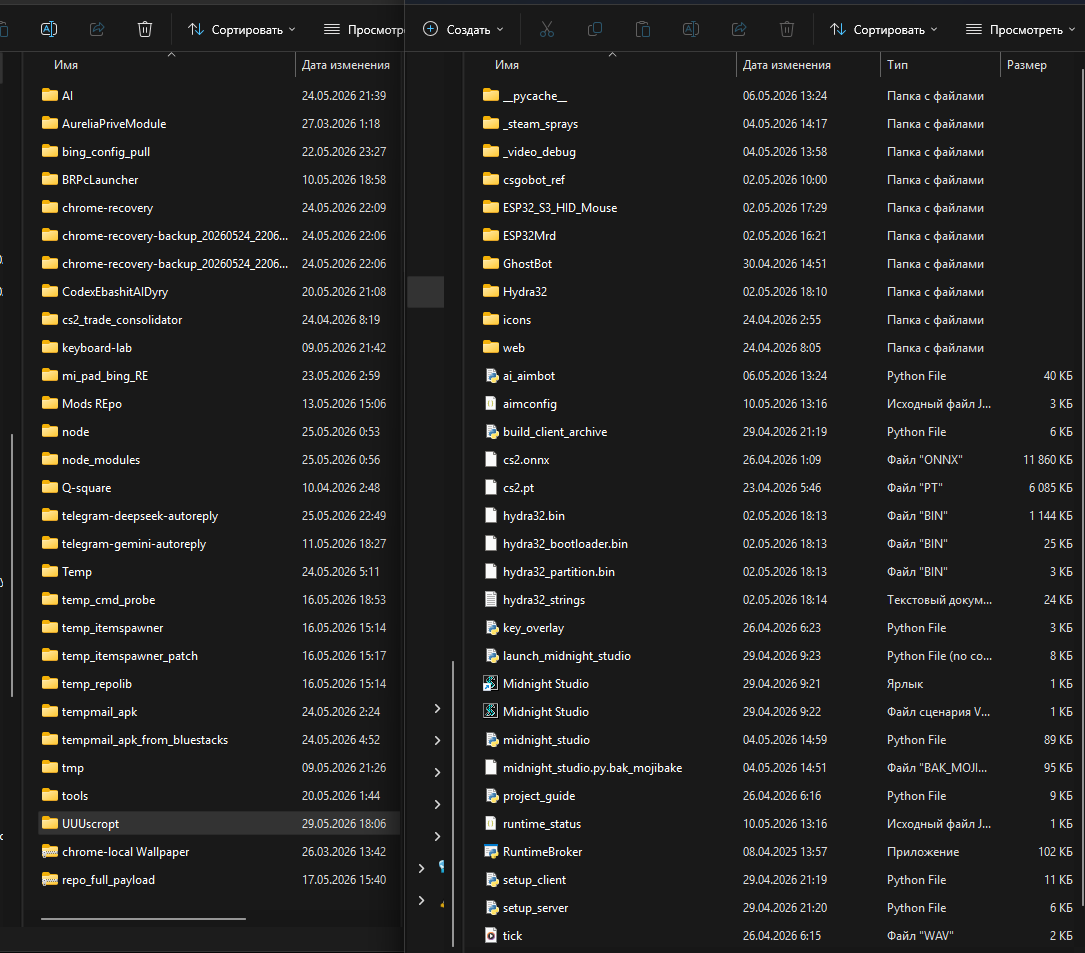
Desktop AI Companion (Electron + React)
Built a local desktop application with a 3D companion character rendered on top of the desktop. The project includes chat with a local LLM (Ollama), voice input/output, VRM avatar support, and an interactive UI.
Stack: Electron, React, Vite, TypeScript, Three.js, React Three Fiber.
DeepSeek Desktop GUI Agent
Developed a desktop GUI for working with AI models, including session management, model parameter controls, markdown response rendering, and a tool mode for running local tasks. The interface is optimized for long work sessions and fast local model startup.
Stack: Electron, JavaScript, HTML/CSS.
Telegram Auto-Reply Bot (DeepSeek/Ollama)
Built a Telegram auto-reply bot with support for DeepSeek API and local Ollama models. Added personal/group chat modes, short-term conversation memory, customizable response style, and command-based behavior control.
Stack: Python, Telegram Bot API, OpenAI-compatible API, dotenv.
Ollama + ComfyUI Text-to-Video Bridge
Built a local bridge project for generating videos via Wan2.2/ComfyUI directly from AI chat. Implemented a proxy panel, a memory/VRAM safe mode, and a single flow: "chat -> video generation -> result".
Stack: JavaScript (Node.js), local AI services (Ollama, ComfyUI).
Ref: README.
Q-square Android Prototype
Built an Android prototype with a launcher screen and two modes: API settings and a WebView interface for media services. Implemented UI customization (tab bar, element behavior, styles) and local settings storage.
Stack: Kotlin, Android SDK, Gradle.
My portfolio also includes several small test projects for Arduino and ESP32.
One of these projects is an experimental ESP32-S3-based system focused on computer vision and HID emulation. In the test version, a local AI model analyzes the screen image in real time, detects target visual objects, and extracts their coordinates. The data is then sent to ESP32-S3, which can emulate an HID device (for example, a mouse) to demonstrate automated control.
This project was created as a technical experiment to study computer vision, real-time image processing, interaction between a local AI model and a microcontroller, and input device emulation.
Important: this solution is a test prototype and a technical demonstration. It is not intended for violating online service rules, interfering with third-party software, or gaining unfair advantages in games. Final implementation and usage depend on specific project requirements.
Built a local desktop application with a 3D companion character rendered on top of the desktop. The project includes chat with a local LLM (Ollama), voice input/output, VRM avatar support, and an interactive UI.
Stack: Electron, React, Vite, TypeScript, Three.js, React Three Fiber.
DeepSeek Desktop GUI Agent
Developed a desktop GUI for working with AI models, including session management, model parameter controls, markdown response rendering, and a tool mode for running local tasks. The interface is optimized for long work sessions and fast local model startup.
Stack: Electron, JavaScript, HTML/CSS.
Telegram Auto-Reply Bot (DeepSeek/Ollama)
Built a Telegram auto-reply bot with support for DeepSeek API and local Ollama models. Added personal/group chat modes, short-term conversation memory, customizable response style, and command-based behavior control.
Stack: Python, Telegram Bot API, OpenAI-compatible API, dotenv.
Ollama + ComfyUI Text-to-Video Bridge
Built a local bridge project for generating videos via Wan2.2/ComfyUI directly from AI chat. Implemented a proxy panel, a memory/VRAM safe mode, and a single flow: "chat -> video generation -> result".
Stack: JavaScript (Node.js), local AI services (Ollama, ComfyUI).
Ref: README.
Q-square Android Prototype
Built an Android prototype with a launcher screen and two modes: API settings and a WebView interface for media services. Implemented UI customization (tab bar, element behavior, styles) and local settings storage.
Stack: Kotlin, Android SDK, Gradle.
My portfolio also includes several small test projects for Arduino and ESP32.
One of these projects is an experimental ESP32-S3-based system focused on computer vision and HID emulation. In the test version, a local AI model analyzes the screen image in real time, detects target visual objects, and extracts their coordinates. The data is then sent to ESP32-S3, which can emulate an HID device (for example, a mouse) to demonstrate automated control.
This project was created as a technical experiment to study computer vision, real-time image processing, interaction between a local AI model and a microcontroller, and input device emulation.
Important: this solution is a test prototype and a technical demonstration. It is not intended for violating online service rules, interfering with third-party software, or gaining unfair advantages in games. Final implementation and usage depend on specific project requirements.