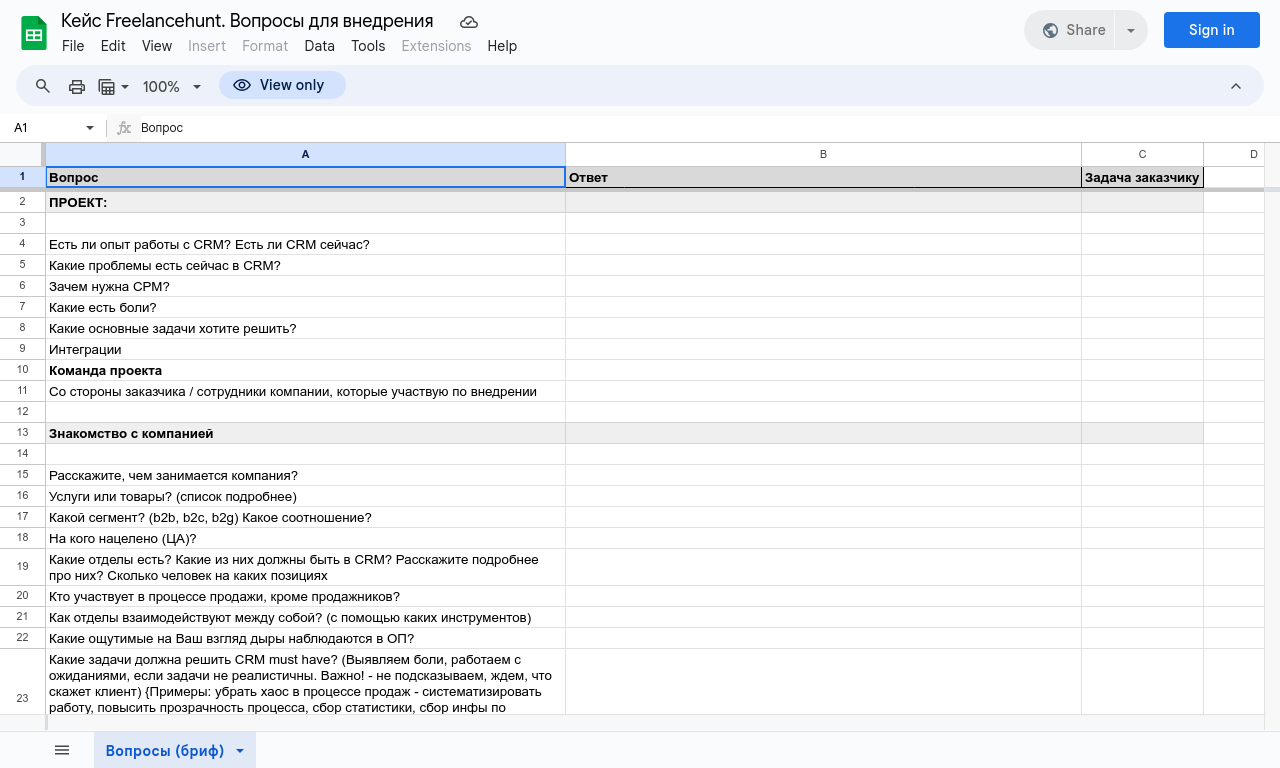
Do you want to implement a CRM system that meets the needs of your business and delivers real results? As a professional freelancer with many years of experience in CRM system implementation, I will help you achieve your goal. To do this effectively, it is important to get comprehensive answers before starting work.
Why is this important?
Every business is unique, and standard solutions often do not produce the desired effect. To configure a CRM system that is perfect for you, it is necessary to consider many factors, such as the structure of your company, business processes, reporting requirements, integrations with other systems, and much more. That's why I have developed a detailed table of 150 questions that will help identify all the key points and features of your business.
What do these questions include?
1. Analysis of current business processes:
1.1. Which processes require automation?
1.2. Which departments will use the CRM system?
1.3. What is the structure of interactions between departments?
2. Defining functional requirements:
2.1. Which CRM system functions are a priority?
2.2. What integrations with other systems are necessary?
2.3. What are the requirements for reporting and analytics?
3. User and administrator rights:
3.1. How are roles and access rights distributed?
3.2. What data should be available to different user levels?
4. Technical details and integrations:
4.1. Which systems are already in use in the company?
4.2. What are the integration requirements with existing systems?
4.3. Is there a need for a mobile version of CRM?
Benefits of working with me:
1. Individual approach: Each CRM system is tailored to the unique needs of your business.
2. Experience and professionalism: 30 cases and 4 years of successful CRM system implementation experience.
3. Time and cost savings: Proper configuration from the first time helps avoid many errors and rework.
How does it work?
1. Preliminary consultation: We discuss your business and your expectations from the CRM system.
2. Filling out the question table: Together, we fill out the table of 150 questions, which helps us determine all the necessary parameters for configuration.
3. Analysis and plan development: Based on your answers, I develop a detailed plan for CRM system implementation.
4. Implementation and configuration: I set up the CRM system according to the developed plan.
5. Testing: I conduct all necessary tests of the configured CRM system and all integrations. If errors are found, I correct them immediately. Only after successful testing, I present the CRM system to the client.
6. Training: I record training videos for all employees and managers. I conduct training for your employees and managers.
7. Adaptation: All employees start working in the CRM system. I observe how and who works, find errors, and suggest how to eliminate errors in managers' work. I provide additional weekly training on all unclear issues related to working in the CRM system. I record additional training videos on emerging issues and add them to your internal knowledge base, which any employee can use.
8. Feedback and adjustments: During the adaptation stage, it is important to collect feedback from managers and make minor adjustments to the settings if necessary. Because it is simply impossible to predict all possible scenarios initially. We can usually predict 85-90%, but managers will tell us the remaining 10-15% themselves when working in the CRM system. Therefore, this is the most important stage of work, when it is necessary to check the system's operation in real work with clients. This stage of work should not be spared money and time.
9. Support: Providing technical support after the project is closed and successfully put into operation.
Ready to start?
If you want to receive professional consultation and implement a CRM system that will truly work for your business, contact me.
Why is this important?
Every business is unique, and standard solutions often do not produce the desired effect. To configure a CRM system that is perfect for you, it is necessary to consider many factors, such as the structure of your company, business processes, reporting requirements, integrations with other systems, and much more. That's why I have developed a detailed table of 150 questions that will help identify all the key points and features of your business.
What do these questions include?
1. Analysis of current business processes:
1.1. Which processes require automation?
1.2. Which departments will use the CRM system?
1.3. What is the structure of interactions between departments?
2. Defining functional requirements:
2.1. Which CRM system functions are a priority?
2.2. What integrations with other systems are necessary?
2.3. What are the requirements for reporting and analytics?
3. User and administrator rights:
3.1. How are roles and access rights distributed?
3.2. What data should be available to different user levels?
4. Technical details and integrations:
4.1. Which systems are already in use in the company?
4.2. What are the integration requirements with existing systems?
4.3. Is there a need for a mobile version of CRM?
Benefits of working with me:
1. Individual approach: Each CRM system is tailored to the unique needs of your business.
2. Experience and professionalism: 30 cases and 4 years of successful CRM system implementation experience.
3. Time and cost savings: Proper configuration from the first time helps avoid many errors and rework.
How does it work?
1. Preliminary consultation: We discuss your business and your expectations from the CRM system.
2. Filling out the question table: Together, we fill out the table of 150 questions, which helps us determine all the necessary parameters for configuration.
3. Analysis and plan development: Based on your answers, I develop a detailed plan for CRM system implementation.
4. Implementation and configuration: I set up the CRM system according to the developed plan.
5. Testing: I conduct all necessary tests of the configured CRM system and all integrations. If errors are found, I correct them immediately. Only after successful testing, I present the CRM system to the client.
6. Training: I record training videos for all employees and managers. I conduct training for your employees and managers.
7. Adaptation: All employees start working in the CRM system. I observe how and who works, find errors, and suggest how to eliminate errors in managers' work. I provide additional weekly training on all unclear issues related to working in the CRM system. I record additional training videos on emerging issues and add them to your internal knowledge base, which any employee can use.
8. Feedback and adjustments: During the adaptation stage, it is important to collect feedback from managers and make minor adjustments to the settings if necessary. Because it is simply impossible to predict all possible scenarios initially. We can usually predict 85-90%, but managers will tell us the remaining 10-15% themselves when working in the CRM system. Therefore, this is the most important stage of work, when it is necessary to check the system's operation in real work with clients. This stage of work should not be spared money and time.
9. Support: Providing technical support after the project is closed and successfully put into operation.
Ready to start?
If you want to receive professional consultation and implement a CRM system that will truly work for your business, contact me.