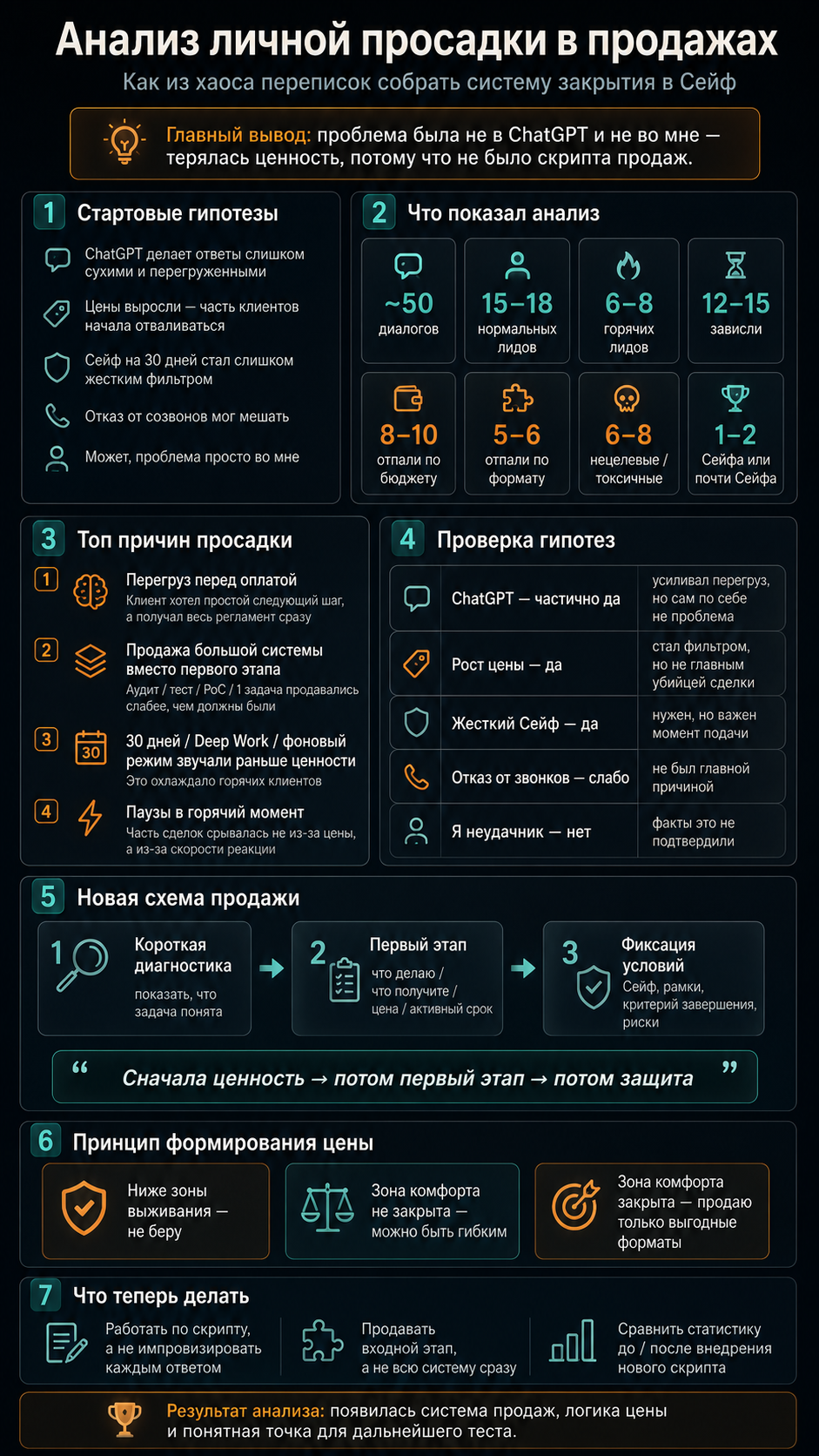
Sales Drop Analysis: How to Build a Closing System from the Chaos of Correspondence in Safe
I conducted an analysis of my own sales drop on Freelancehunt. There were applications, dialogues, and client interest, but the conversion to opening Safe became lower. Instead of emotional conclusions like "the market is dead," "AI is ruining sales," or "the problem is with me," statistics on correspondence were gathered, hypotheses were tested, and a new sales scheme was created: from the first touch to fixing the terms before the start.
At the start, there were hypotheses:
— ChatGPT makes responses too dry, legalistic, and overloaded;
— prices have gone up, some clients started dropping off;
— the 30-day Safe became too strict a filter;
— refusal to have calls could reduce trust;
— perhaps the problem lies with me as a performer.
What was done
Dialogues from the period from late March to early May were analyzed. Weak and successful correspondences were analyzed separately. Dialogues were categorized: hot leads, stalled, lost due to price, lost due to format, non-targeted, and fresh.
Approximate statistics on correspondences:
— about 50 dialogues;
— 15–18 commercially normal leads;
— 6–8 hot leads where the client already asked about price, terms, or start;
— 12–15 normal dialogues stalled due to overload or weak follow-up;
— 8–10 clients clearly did not fit the budget;
— 5–6 wanted a different format: call, voice, off-platform;
— 6–8 were non-targeted, vague, or toxic tasks.
Main conclusion
The problem was in the order of presentation.
Clients often asked "how much?", "how to start?", "can you?", and in response received a large block: risks, deadlines, Deep Work, 30 days, arbitration, KPIs, moderation, exclusions from the budget.
In essence, this was correct. Timing-wise — too early.
ChatGPT indeed enhanced accuracy, legal protection, and detail. In the absence of a script, this overloaded the client. Meanwhile, in successful cases, ChatGPT helped to better package the strategy, boundaries of responsibility, and protection.
The price increase also became a factor. Some clients filtered out. But the first stage format worked best: test, audit, PoC, diagnostics, 1 task.
The 30-day Safe is needed for protection in arbitration. The mistake was that it sometimes sounded earlier than the client could see the value. The new wording: active work takes X days, and the Safe is set with a buffer for accesses, checks, approvals, and pauses.
New solution
A 3-stage sales script was formed:
First touch: short diagnostics, main risk, first reasonable step, relevant experience.
Response to the question about price / deadlines: what I do, what the client receives, price, active term, Safe term as a technical buffer.
Before the start: fixing the terms in the working area — volume, result, deadlines, what is included, what is not included, completion criteria, external factors.
Price formation principle
Below the survival zone — I do not take.
Comfort zone not yet closed — can be flexible for the sake of stability, a normal client, continuation, case, and confidence.
Comfort zone closed — only profitable formats are sold: Deep Focus, background mode, VIP ×7, paid audit, or small first stage.
Outcome
The result was a full-fledged system: it became clear where the sale broke down, which hypotheses were partially confirmed, how to build the first stage, how to fix the terms, and how to form the price.
Cost of similar work for business: from $700 to $1200.
I conducted an analysis of my own sales drop on Freelancehunt. There were applications, dialogues, and client interest, but the conversion to opening Safe became lower. Instead of emotional conclusions like "the market is dead," "AI is ruining sales," or "the problem is with me," statistics on correspondence were gathered, hypotheses were tested, and a new sales scheme was created: from the first touch to fixing the terms before the start.
At the start, there were hypotheses:
— ChatGPT makes responses too dry, legalistic, and overloaded;
— prices have gone up, some clients started dropping off;
— the 30-day Safe became too strict a filter;
— refusal to have calls could reduce trust;
— perhaps the problem lies with me as a performer.
What was done
Dialogues from the period from late March to early May were analyzed. Weak and successful correspondences were analyzed separately. Dialogues were categorized: hot leads, stalled, lost due to price, lost due to format, non-targeted, and fresh.
Approximate statistics on correspondences:
— about 50 dialogues;
— 15–18 commercially normal leads;
— 6–8 hot leads where the client already asked about price, terms, or start;
— 12–15 normal dialogues stalled due to overload or weak follow-up;
— 8–10 clients clearly did not fit the budget;
— 5–6 wanted a different format: call, voice, off-platform;
— 6–8 were non-targeted, vague, or toxic tasks.
Main conclusion
The problem was in the order of presentation.
Clients often asked "how much?", "how to start?", "can you?", and in response received a large block: risks, deadlines, Deep Work, 30 days, arbitration, KPIs, moderation, exclusions from the budget.
In essence, this was correct. Timing-wise — too early.
ChatGPT indeed enhanced accuracy, legal protection, and detail. In the absence of a script, this overloaded the client. Meanwhile, in successful cases, ChatGPT helped to better package the strategy, boundaries of responsibility, and protection.
The price increase also became a factor. Some clients filtered out. But the first stage format worked best: test, audit, PoC, diagnostics, 1 task.
The 30-day Safe is needed for protection in arbitration. The mistake was that it sometimes sounded earlier than the client could see the value. The new wording: active work takes X days, and the Safe is set with a buffer for accesses, checks, approvals, and pauses.
New solution
A 3-stage sales script was formed:
First touch: short diagnostics, main risk, first reasonable step, relevant experience.
Response to the question about price / deadlines: what I do, what the client receives, price, active term, Safe term as a technical buffer.
Before the start: fixing the terms in the working area — volume, result, deadlines, what is included, what is not included, completion criteria, external factors.
Price formation principle
Below the survival zone — I do not take.
Comfort zone not yet closed — can be flexible for the sake of stability, a normal client, continuation, case, and confidence.
Comfort zone closed — only profitable formats are sold: Deep Focus, background mode, VIP ×7, paid audit, or small first stage.
Outcome
The result was a full-fledged system: it became clear where the sale broke down, which hypotheses were partially confirmed, how to build the first stage, how to fix the terms, and how to form the price.
Cost of similar work for business: from $700 to $1200.