# AI Fired the Manager: Generation and Auto-Publication on WordPress
I had a manual process for creating WordPress / Elementor sites: specifications in correspondence, access, templates, texts, images, articles, policies, edits, bug checks, and publication.
At some point, it became clear: the manager in this scheme becomes a bottleneck. They might forget a detail, pass the task in pieces, confuse priorities, send incomplete specifications, or create urgency where the system is not yet ready.
I decided to eliminate dependence on manual managerial chaos and began to translate the process into an AI workflow.
The scheme became:
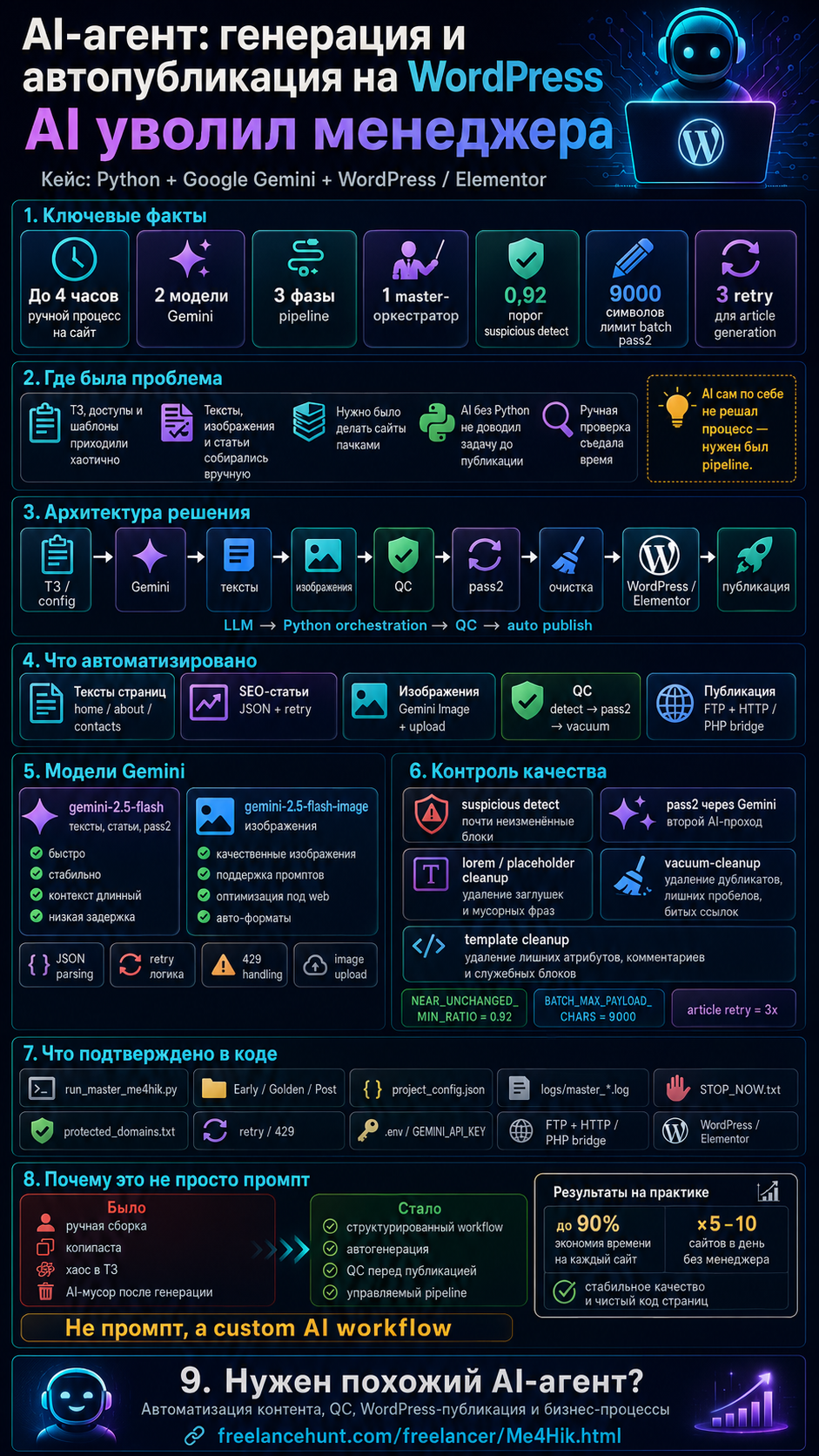
**Specifications / config → Gemini → texts → images → QC → pass2 → cleanup → WordPress / Elementor → publication**
Instead of manually assembling the site from scratch each time, the system takes structured data, generates content through Gemini, checks the result, cleans up AI junk, and prepares for publication on WordPress.
Two models are used internally:
* `gemini-2.5-flash` — texts, articles, processing problematic fragments;
* `gemini-2.5-flash-image` — images for the site.
Python manages the process as an orchestrator: it launches stages, saves data, checks results, sends problematic areas for a second AI pass, publishes content, and writes logs.
The most important part is quality control. AI can generate text, but it might leave a placeholder, lorem, an old phrase from the template, extra characters, or an almost unchanged block. Therefore, the project has a QC chain:
**suspicious detect → pass2 through Gemini → lorem cleanup → vacuum-cleanup**
Protective elements have been added separately: `STOP_NOW.txt`, `protected_domains.txt`, retry, handling 429, `.env`, `GEMINI_API_KEY`, `project_config.json`.
Result: AI began to perform the part of the work where managerial control, manual copy-pasting, and constant clarifications were previously needed.
This is not just a prompt for generating text. This is a working pipeline:
**LLM → Python orchestration → QC → WordPress / Elementor → auto publish**
Manual work on the site has been broken down into stages, measured, and partially automated. The process has begun to move from "the manager keeps everything in their head" to a system where data, generation, checking, and publication follow a clear chain.
#AIagent #AIworkflow #Gemini #Python #WordPress #Elementor #Automation #AIautomation #AIautomation #LLM #GoogleGemini #ContentAutomation #AutoPublication #WordPressAutomation #PythonAutomation
I had a manual process for creating WordPress / Elementor sites: specifications in correspondence, access, templates, texts, images, articles, policies, edits, bug checks, and publication.
At some point, it became clear: the manager in this scheme becomes a bottleneck. They might forget a detail, pass the task in pieces, confuse priorities, send incomplete specifications, or create urgency where the system is not yet ready.
I decided to eliminate dependence on manual managerial chaos and began to translate the process into an AI workflow.
The scheme became:
**Specifications / config → Gemini → texts → images → QC → pass2 → cleanup → WordPress / Elementor → publication**
Instead of manually assembling the site from scratch each time, the system takes structured data, generates content through Gemini, checks the result, cleans up AI junk, and prepares for publication on WordPress.
Two models are used internally:
* `gemini-2.5-flash` — texts, articles, processing problematic fragments;
* `gemini-2.5-flash-image` — images for the site.
Python manages the process as an orchestrator: it launches stages, saves data, checks results, sends problematic areas for a second AI pass, publishes content, and writes logs.
The most important part is quality control. AI can generate text, but it might leave a placeholder, lorem, an old phrase from the template, extra characters, or an almost unchanged block. Therefore, the project has a QC chain:
**suspicious detect → pass2 through Gemini → lorem cleanup → vacuum-cleanup**
Protective elements have been added separately: `STOP_NOW.txt`, `protected_domains.txt`, retry, handling 429, `.env`, `GEMINI_API_KEY`, `project_config.json`.
Result: AI began to perform the part of the work where managerial control, manual copy-pasting, and constant clarifications were previously needed.
This is not just a prompt for generating text. This is a working pipeline:
**LLM → Python orchestration → QC → WordPress / Elementor → auto publish**
Manual work on the site has been broken down into stages, measured, and partially automated. The process has begun to move from "the manager keeps everything in their head" to a system where data, generation, checking, and publication follow a clear chain.
#AIagent #AIworkflow #Gemini #Python #WordPress #Elementor #Automation #AIautomation #AIautomation #LLM #GoogleGemini #ContentAutomation #AutoPublication #WordPressAutomation #PythonAutomation