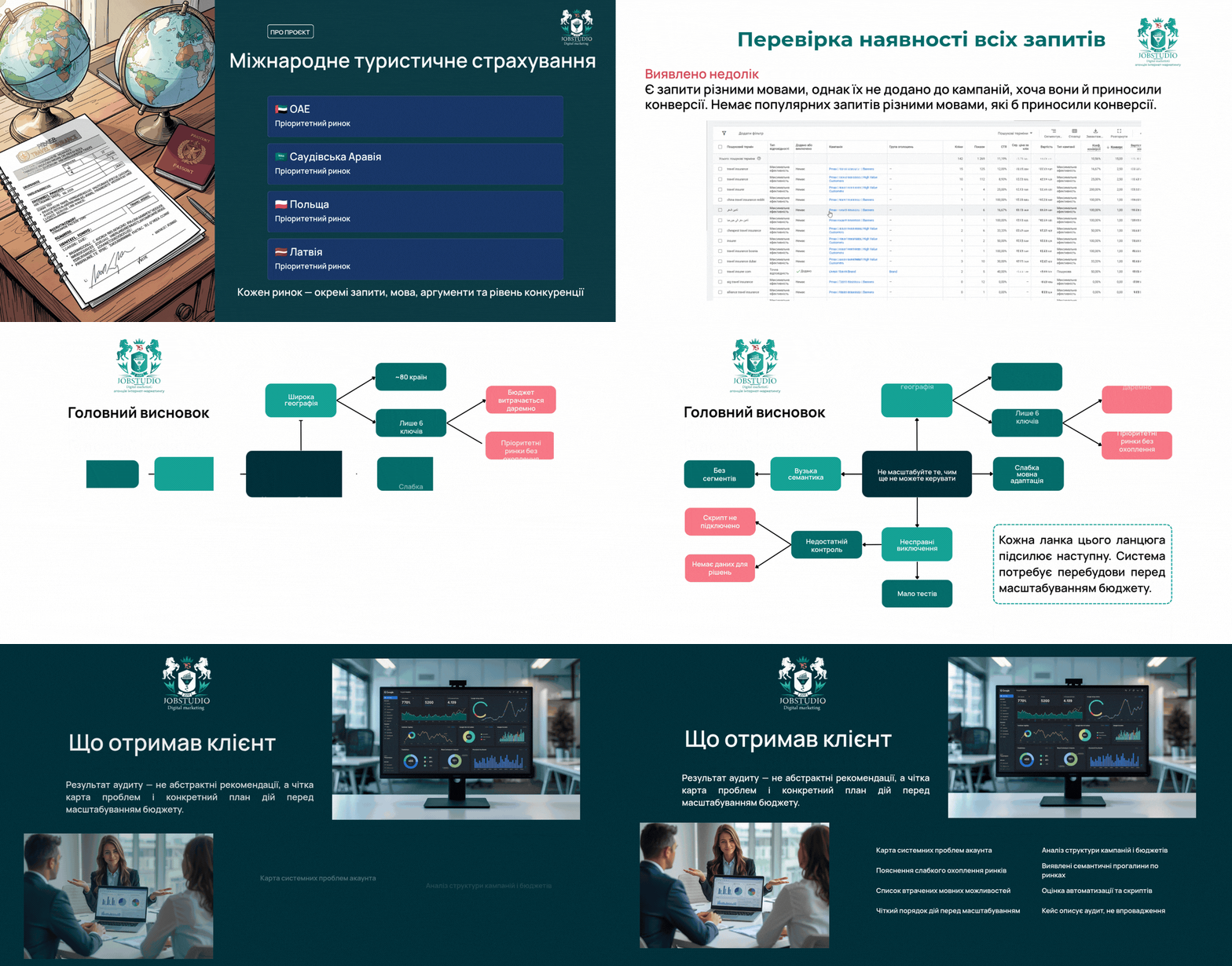
The scheme for attracting and retaining clients in this project was to be built not around a chaotic launch of advertising in dozens of countries, but around a clear funnel.
1. Attracting new demand
The first level is attracting users from priority markets: UAE, Saudi Arabia, Poland, and Latvia. For this, we recommended dividing the advertising structure based on the principle: country → language → type of demand → separate campaign → separate budget → separate KPI.
This scheme allows for not mixing different markets in one statistic. A user from Poland, the UAE, or Saudi Arabia searches for travel insurance in different languages, uses different phrases, and responds to different advertising arguments.
2. Capturing hot commercial demand
It was necessary to separately highlight users who already have a clear intention to buy or arrange travel insurance. For this, the semantics had to include not 5 general queries, but separate clusters:
• branded queries;
• hot commercial queries;
• general product queries;
• local queries in different languages;
• low-frequency queries;
• separate tests of competitive semantics.
This allows capturing not just random clicks, but users with different levels of readiness to purchase.
3. Quality control of traffic
To avoid wasting the budget on irrelevant queries, it was necessary to restore the operation of the negative keywords script, connect a working Google Sheets table, check the exclusion lists, and apply them to the necessary campaigns.
Without this, the advertising could receive impressions, but part of the budget would go to non-target traffic.
4. Guiding the user to the application
For each market, it was necessary to test different advertising messages: price, speed of processing, insurance coverage, support, internationality of the service, convenience of purchase. In some groups, there was only one adaptive search ad, so Google Ads did not have enough options for testing offers.
We recommended creating several substantively different ads for each important segment and evaluating them not only by CTR but also by conversions and CPA.
5. Retention through remarketing
Remarketing was to work not as a repetition of the same ad for everyone, but as a separate system for returning users.
Audiences needed to be divided by behavior:
• new visitors to the site;
• users who returned several times;
• users who viewed key pages;
• users who started the application process but did not complete the action;
• users who have already completed the target action.
Each group needs a separate message. For a new visitor — an explanation of the product and trust. For someone already familiar with the offer — a response to objections. For someone close to the application — a stronger argument for return.
6. Excluding those who have already converted
Users who have already completed the target action need to be excluded from some campaigns to avoid wasting the budget on repeat impressions where they are not needed.
Thus, the scheme for attracting and retaining looked like this: new demand → localized search advertising → quality traffic through negative keywords → testing offers → application → segmented remarketing → user return → re-engagement or completion of purchase.
The main value of the audit was that it showed: the problem was not only in the settings of Google Ads. It was necessary to rebuild the entire logic of advertising — from the first contact with the user to the repeated return and application.
1. Attracting new demand
The first level is attracting users from priority markets: UAE, Saudi Arabia, Poland, and Latvia. For this, we recommended dividing the advertising structure based on the principle: country → language → type of demand → separate campaign → separate budget → separate KPI.
This scheme allows for not mixing different markets in one statistic. A user from Poland, the UAE, or Saudi Arabia searches for travel insurance in different languages, uses different phrases, and responds to different advertising arguments.
2. Capturing hot commercial demand
It was necessary to separately highlight users who already have a clear intention to buy or arrange travel insurance. For this, the semantics had to include not 5 general queries, but separate clusters:
• branded queries;
• hot commercial queries;
• general product queries;
• local queries in different languages;
• low-frequency queries;
• separate tests of competitive semantics.
This allows capturing not just random clicks, but users with different levels of readiness to purchase.
3. Quality control of traffic
To avoid wasting the budget on irrelevant queries, it was necessary to restore the operation of the negative keywords script, connect a working Google Sheets table, check the exclusion lists, and apply them to the necessary campaigns.
Without this, the advertising could receive impressions, but part of the budget would go to non-target traffic.
4. Guiding the user to the application
For each market, it was necessary to test different advertising messages: price, speed of processing, insurance coverage, support, internationality of the service, convenience of purchase. In some groups, there was only one adaptive search ad, so Google Ads did not have enough options for testing offers.
We recommended creating several substantively different ads for each important segment and evaluating them not only by CTR but also by conversions and CPA.
5. Retention through remarketing
Remarketing was to work not as a repetition of the same ad for everyone, but as a separate system for returning users.
Audiences needed to be divided by behavior:
• new visitors to the site;
• users who returned several times;
• users who viewed key pages;
• users who started the application process but did not complete the action;
• users who have already completed the target action.
Each group needs a separate message. For a new visitor — an explanation of the product and trust. For someone already familiar with the offer — a response to objections. For someone close to the application — a stronger argument for return.
6. Excluding those who have already converted
Users who have already completed the target action need to be excluded from some campaigns to avoid wasting the budget on repeat impressions where they are not needed.
Thus, the scheme for attracting and retaining looked like this: new demand → localized search advertising → quality traffic through negative keywords → testing offers → application → segmented remarketing → user return → re-engagement or completion of purchase.
The main value of the audit was that it showed: the problem was not only in the settings of Google Ads. It was necessary to rebuild the entire logic of advertising — from the first contact with the user to the repeated return and application.