Case: scaling Google Ads for e-commerce auto parts
Project Context
The client approached with a task to scale Google Ads advertising in the auto parts niche — one of the most complex in terms of account structure and the functioning of Google algorithms. Prior to this request, the client had collaborated with several agencies. Despite the agencies' experience in Google Ads, the lack of deep expertise specifically in auto parts prevented achieving stable and predictable results.
Initial Situation
The project had a number of systemic difficulties:
— a large product feed
— dozens of categories
— thousands of parts with varying applicability
— a wide price range even within a single category
— different margins and the impact of products on the average check
After the audit, a key limitation was identified:
contractors launched one or several campaigns for the entire feed, resulting in:
— Google effectively showing only 5–10% of products
— the majority of the assortment not receiving any impressions at all
— algorithms "getting stuck" on a narrow group of products
Key Issues
Feed impression limitations
Google could not learn effectively from a large array of products within a single campaign, so only the most "convenient" positions for the algorithm made it to the auction.
Bias towards ROAS
The algorithm sold only those products that fit within the specified ROAS, ignoring positions that:
— were profitable for the business
— brought customers to adjacent categories
— increased LTV and repeat sales
Lack of connection between average check and conversion price
The conversion price was assessed equally for all products, although the average check and margin differed fundamentally.
Decision Made
I abandoned the standard logic of "one feed — one campaign" and developed a personalized account structure with deep segmentation.
Implementation
Segmentation by price segments
The entire assortment was divided into price segments. For each segment:
— a specific acceptable conversion price was set
— the average check was taken into account
— the economics of the specific group of products was considered
This allowed:
— to eliminate inadequate order costs
— to equalize effectiveness among different price categories
— to stop "squeezing" profitable but more expensive products
Working with a large feed through additional feeds
To address the issue of slow product entry into impressions, a fragmentation strategy was applied:
— a segment of approximately 100,000 products was divided into 8–10 sub-feeds
— separate campaigns were launched for each sub-feed
— during the learning phase, products with the best performance were selected
Next, products were reassembled based on the logic of:
— "stars"
— "cash cows"
— products with growth potential
— underperformers
Each group received its own advertising logic.
Result
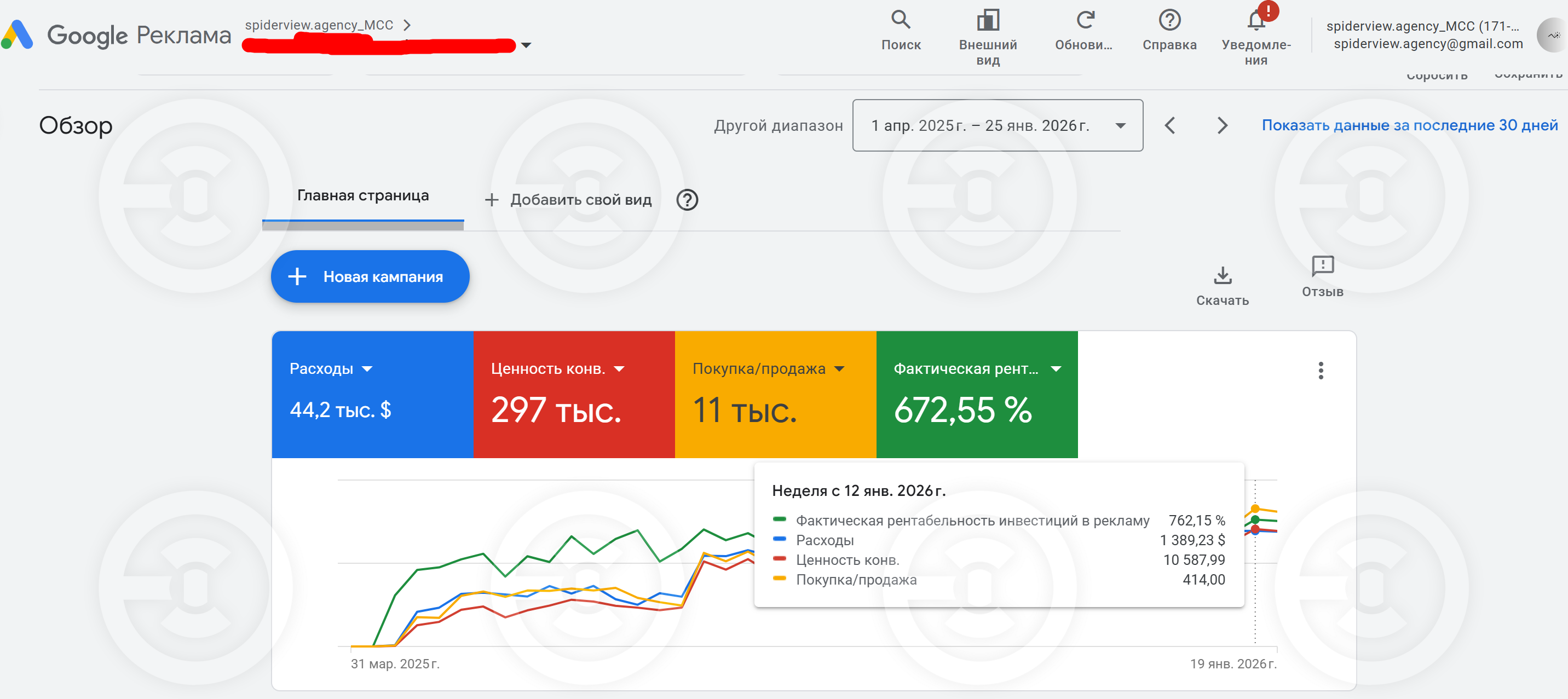
— scaling limitations were removed
— advertising stopped hitting algorithmic limits
— Google began to work evenly with the assortment
— advertising generates exactly the number of leads needed by the business
Important point:
scaling became manageable. If necessary, the volume of leads can be increased at any moment — without destroying the structure and losing effectiveness.
Summary for the Client
— a stable and controllable advertising system
— utilization of the real potential of the assortment
— turnover growth without bias towards individual products
— account structure tailored to the business, not to agency templates
The client approached with a task to scale Google Ads advertising in the auto parts niche — one of the most complex in terms of account structure and the functioning of Google algorithms. Prior to this request, the client had collaborated with several agencies. Despite the agencies' experience in Google Ads, the lack of deep expertise specifically in auto parts prevented achieving stable and predictable results.
Initial Situation
The project had a number of systemic difficulties:
— a large product feed
— dozens of categories
— thousands of parts with varying applicability
— a wide price range even within a single category
— different margins and the impact of products on the average check
After the audit, a key limitation was identified:
contractors launched one or several campaigns for the entire feed, resulting in:
— Google effectively showing only 5–10% of products
— the majority of the assortment not receiving any impressions at all
— algorithms "getting stuck" on a narrow group of products
Key Issues
Feed impression limitations
Google could not learn effectively from a large array of products within a single campaign, so only the most "convenient" positions for the algorithm made it to the auction.
Bias towards ROAS
The algorithm sold only those products that fit within the specified ROAS, ignoring positions that:
— were profitable for the business
— brought customers to adjacent categories
— increased LTV and repeat sales
Lack of connection between average check and conversion price
The conversion price was assessed equally for all products, although the average check and margin differed fundamentally.
Decision Made
I abandoned the standard logic of "one feed — one campaign" and developed a personalized account structure with deep segmentation.
Implementation
Segmentation by price segments
The entire assortment was divided into price segments. For each segment:
— a specific acceptable conversion price was set
— the average check was taken into account
— the economics of the specific group of products was considered
This allowed:
— to eliminate inadequate order costs
— to equalize effectiveness among different price categories
— to stop "squeezing" profitable but more expensive products
Working with a large feed through additional feeds
To address the issue of slow product entry into impressions, a fragmentation strategy was applied:
— a segment of approximately 100,000 products was divided into 8–10 sub-feeds
— separate campaigns were launched for each sub-feed
— during the learning phase, products with the best performance were selected
Next, products were reassembled based on the logic of:
— "stars"
— "cash cows"
— products with growth potential
— underperformers
Each group received its own advertising logic.
Result
— scaling limitations were removed
— advertising stopped hitting algorithmic limits
— Google began to work evenly with the assortment
— advertising generates exactly the number of leads needed by the business
Important point:
scaling became manageable. If necessary, the volume of leads can be increased at any moment — without destroying the structure and losing effectiveness.
Summary for the Client
— a stable and controllable advertising system
— utilization of the real potential of the assortment
— turnover growth without bias towards individual products
— account structure tailored to the business, not to agency templates

 Khmelnitskyi
  Available for hire