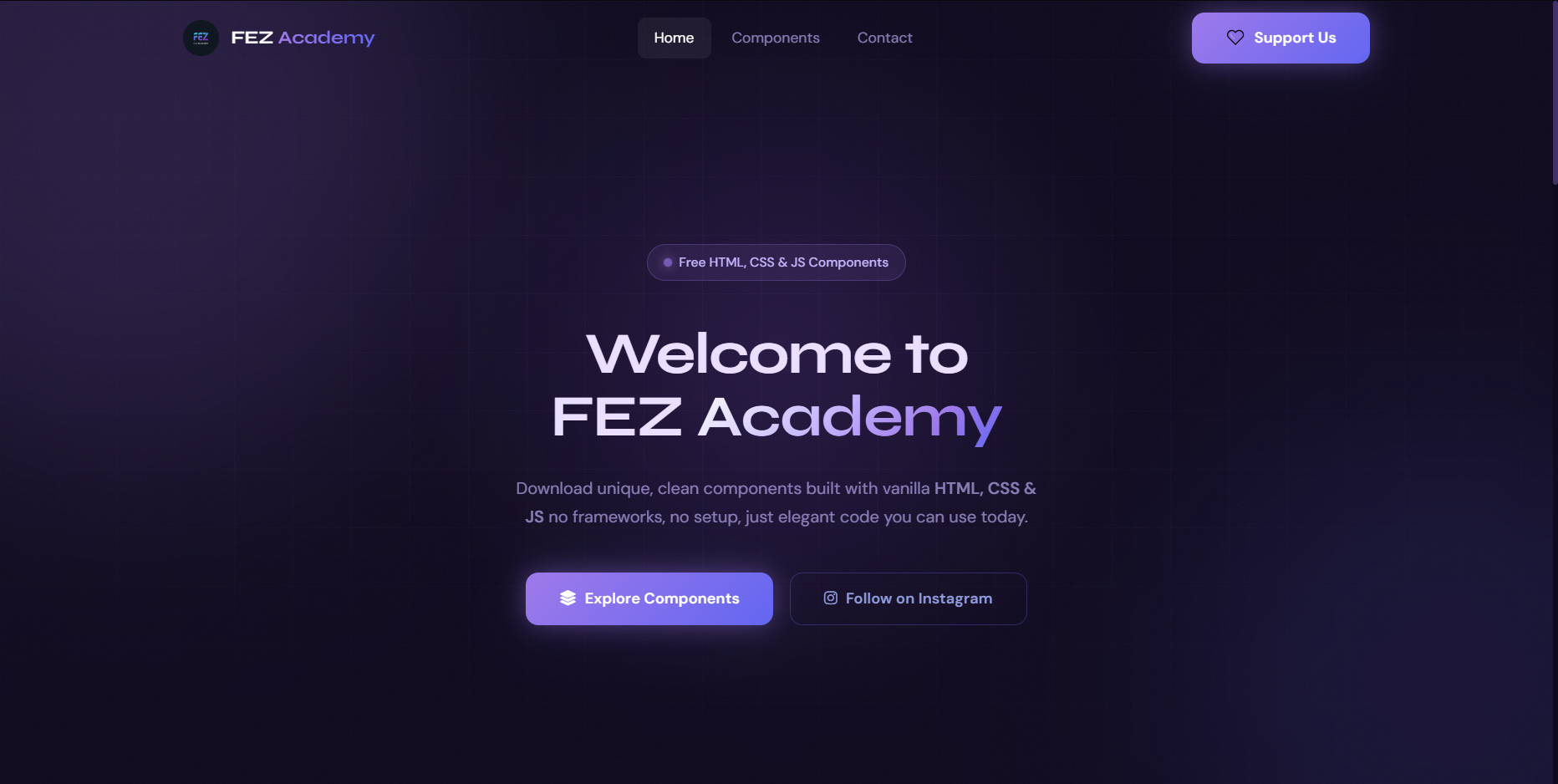
Development of a platform for the UI library FEZ Academy
Project technology stack:
Backend: Node.js (NestJS / Express) or Python (FastAPI / Django) [choose your main stack].
Databases: PostgreSQL (storing the structure of components, users, and analytics) + Redis (caching frequent requests).
API: REST API, fully documented using Swagger.
Infrastructure: Docker, Docker Compose, Nginx.
What has been implemented in the Backend part:
Database architecture design: Created a scalable relational structure for storing categories, UI components, metadata, and system download counters.
Development of a high-performance API: Optimized endpoints have been written for instant delivery of component code to the frontend. Server response time has been minimized due to proper database indexing and data caching.
Content management module (CMS/Admin panel): A secure internal API has been implemented for platform administrators, allowing easy addition, editing, and categorization of new HTML/CSS/JS components.
Analytics and logging: A metrics collection system (number of views, unique downloads of each component) has been integrated to track the popularity of interface elements.
Security and data protection: Validation of all incoming data (DTO) has been implemented, protection against common vulnerabilities, and CORS policies have been configured for secure interaction with the client side.
Business outcome:
The platform has received a reliable, fast, and fault-tolerant server solution. Thanks to query optimization and asynchronous data processing, the server can handle high peak loads during surges of developers without performance degradation (High Load ready). The code is fully structured according to SOLID principles and ready for further scaling (for example, connecting subscription systems or payment gateways).
Backend: Node.js (NestJS / Express) or Python (FastAPI / Django) [choose your main stack].
Databases: PostgreSQL (storing the structure of components, users, and analytics) + Redis (caching frequent requests).
API: REST API, fully documented using Swagger.
Infrastructure: Docker, Docker Compose, Nginx.
What has been implemented in the Backend part:
Database architecture design: Created a scalable relational structure for storing categories, UI components, metadata, and system download counters.
Development of a high-performance API: Optimized endpoints have been written for instant delivery of component code to the frontend. Server response time has been minimized due to proper database indexing and data caching.
Content management module (CMS/Admin panel): A secure internal API has been implemented for platform administrators, allowing easy addition, editing, and categorization of new HTML/CSS/JS components.
Analytics and logging: A metrics collection system (number of views, unique downloads of each component) has been integrated to track the popularity of interface elements.
Security and data protection: Validation of all incoming data (DTO) has been implemented, protection against common vulnerabilities, and CORS policies have been configured for secure interaction with the client side.
Business outcome:
The platform has received a reliable, fast, and fault-tolerant server solution. Thanks to query optimization and asynchronous data processing, the server can handle high peak loads during surges of developers without performance degradation (High Load ready). The code is fully structured according to SOLID principles and ready for further scaling (for example, connecting subscription systems or payment gateways).

 Zaporizhzhia
  Available for hire