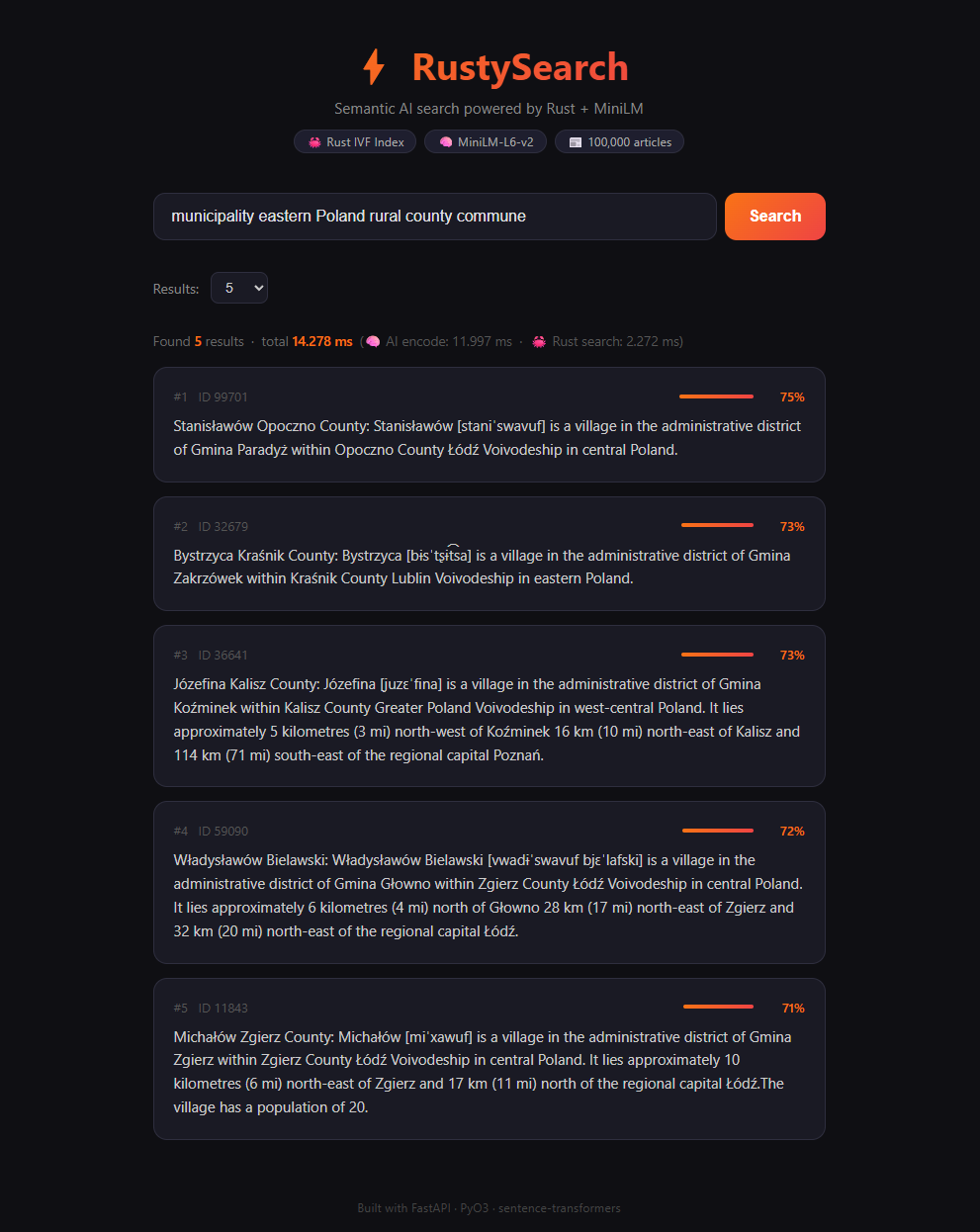
RustySearch is a computational core written in Rust that transforms any database into an intelligent response system. Instead of classical keyword matching, the system understands the semantics of the text, combining machine learning models with the speed of a low-level programming language.
Architecture: from text to vector
The search process is built on a hybrid approach and consists of two stages:
1. AI vectorization: A neural network (based on Transformer architecture) analyzes the input query and converts it into a multidimensional vector (embedding), capturing the meaning and context.
2. Rust core: The search algorithm instantly calculates the distance between vectors and finds the most relevant results in large data arrays.
Technical innovation under the hood
To avoid slow linear search, the system implements an Inverted File Index (IVF). Using the K-means clustering algorithm, the vector space is divided into Voronoi cells. As a result, the engine does not check each record in the database but directly accesses the required cluster, drastically speeding up the output.
Key advantages of the system
Performance: The search time among hundreds of thousands of records is less than 2 ms — this is 30–50 times faster than similar scripts in Python.
Versatility: The core works with any data sources, from local files (JSON/CSV) to industrial databases (SQL/NoSQL).
Flexibility of settings: The Rust architecture allows easy adaptation of the system to specific business tasks, changing similarity metrics, or integrating it into complex distributed networks.
Autonomy: Performance at the level of cloud vector databases (e.g., Pinecone), but with full control over your own data and without monthly subscriptions.
Areas of application
RAG systems (Retrieval-Augmented Generation): Creating intelligent assistants that answer questions based on internal documentation.
E-commerce: Accurate recommendation systems that suggest products based on descriptive or unconventional user queries.
Big Data analytics: Searching for similar patterns, duplicates, or anomalies in large datasets.
Efficiency in numbers
Algorithmic complexity: Reduced from linear O(N) to sublinear O(√N).
Accuracy (Recall): 90–98% while maintaining high processing speed.
Response time: Average search query latency — 1.4 ms.
#AI #MachineLearning #SemanticSearch #nlp #RAG #highload #LowLatency #PerformanceOptimization #Algorithms #SystemProgramming #Backend #Rust
Architecture: from text to vector
The search process is built on a hybrid approach and consists of two stages:
1. AI vectorization: A neural network (based on Transformer architecture) analyzes the input query and converts it into a multidimensional vector (embedding), capturing the meaning and context.
2. Rust core: The search algorithm instantly calculates the distance between vectors and finds the most relevant results in large data arrays.
Technical innovation under the hood
To avoid slow linear search, the system implements an Inverted File Index (IVF). Using the K-means clustering algorithm, the vector space is divided into Voronoi cells. As a result, the engine does not check each record in the database but directly accesses the required cluster, drastically speeding up the output.
Key advantages of the system
Performance: The search time among hundreds of thousands of records is less than 2 ms — this is 30–50 times faster than similar scripts in Python.
Versatility: The core works with any data sources, from local files (JSON/CSV) to industrial databases (SQL/NoSQL).
Flexibility of settings: The Rust architecture allows easy adaptation of the system to specific business tasks, changing similarity metrics, or integrating it into complex distributed networks.
Autonomy: Performance at the level of cloud vector databases (e.g., Pinecone), but with full control over your own data and without monthly subscriptions.
Areas of application
RAG systems (Retrieval-Augmented Generation): Creating intelligent assistants that answer questions based on internal documentation.
E-commerce: Accurate recommendation systems that suggest products based on descriptive or unconventional user queries.
Big Data analytics: Searching for similar patterns, duplicates, or anomalies in large datasets.
Efficiency in numbers
Algorithmic complexity: Reduced from linear O(N) to sublinear O(√N).
Accuracy (Recall): 90–98% while maintaining high processing speed.
Response time: Average search query latency — 1.4 ms.
#AI #MachineLearning #SemanticSearch #nlp #RAG #highload #LowLatency #PerformanceOptimization #Algorithms #SystemProgramming #Backend #Rust