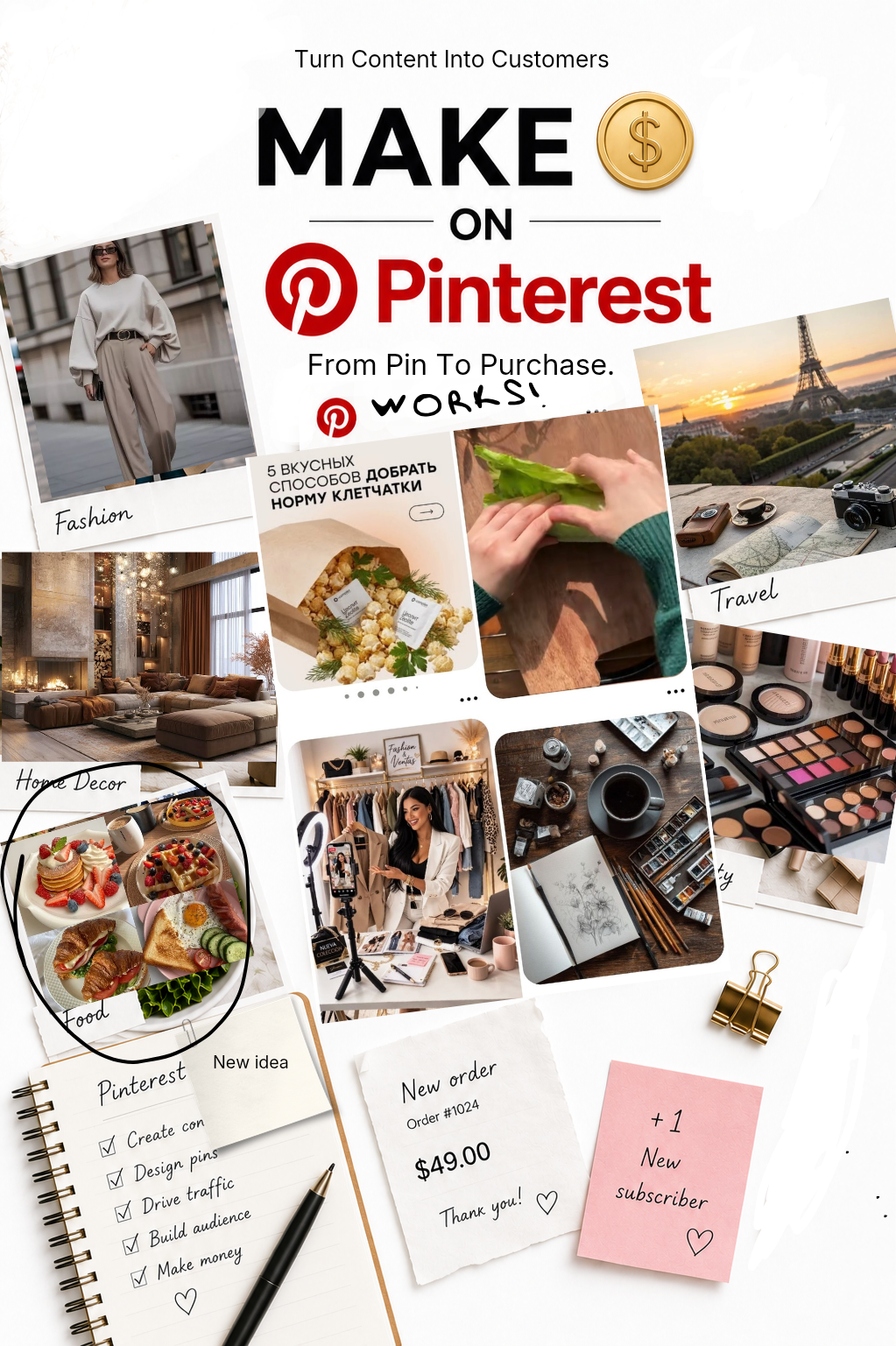
Concept of an advertising layout for Pinterest
Task
Most materials on promoting on Pinterest are built around graphs, icons, and template marketing elements. Such solutions convey information but rarely explain the actual value of the platform for business.
The goal of the project was to show not a set of features of Pinterest, but the user journey from content creation to acquiring a client and making a sale.
Solution
Instead of traditional infographics, I built the composition as a visual story.
The layout is based on a clear sequence:
Content → Pinterest → Client → Purchase
Real content categories, workflow elements, and visual markers of results were used: order, new subscriber, notes, and author annotations.
Approach
- Replaced template icons with real images of content.
- Used a layered composition to create a sense of a workspace.
- Added handwritten notes and stickers to emphasize human involvement in the process.
- Focused on the results of the work rather than abstract analytics.
- Built the layout based on the principles of visual storytelling, where each element supports the main idea.
Result
The final concept is perceived not as yet another marketing infographic, but as a real workspace of a specialist using Pinterest to attract clients.
This approach helps to convey the value of the platform more quickly and makes communication more lively, understandable, and emotionally engaging.
Task
Most materials on promoting on Pinterest are built around graphs, icons, and template marketing elements. Such solutions convey information but rarely explain the actual value of the platform for business.
The goal of the project was to show not a set of features of Pinterest, but the user journey from content creation to acquiring a client and making a sale.
Solution
Instead of traditional infographics, I built the composition as a visual story.
The layout is based on a clear sequence:
Content → Pinterest → Client → Purchase
Real content categories, workflow elements, and visual markers of results were used: order, new subscriber, notes, and author annotations.
Approach
- Replaced template icons with real images of content.
- Used a layered composition to create a sense of a workspace.
- Added handwritten notes and stickers to emphasize human involvement in the process.
- Focused on the results of the work rather than abstract analytics.
- Built the layout based on the principles of visual storytelling, where each element supports the main idea.
Result
The final concept is perceived not as yet another marketing infographic, but as a real workspace of a specialist using Pinterest to attract clients.
This approach helps to convey the value of the platform more quickly and makes communication more lively, understandable, and emotionally engaging.