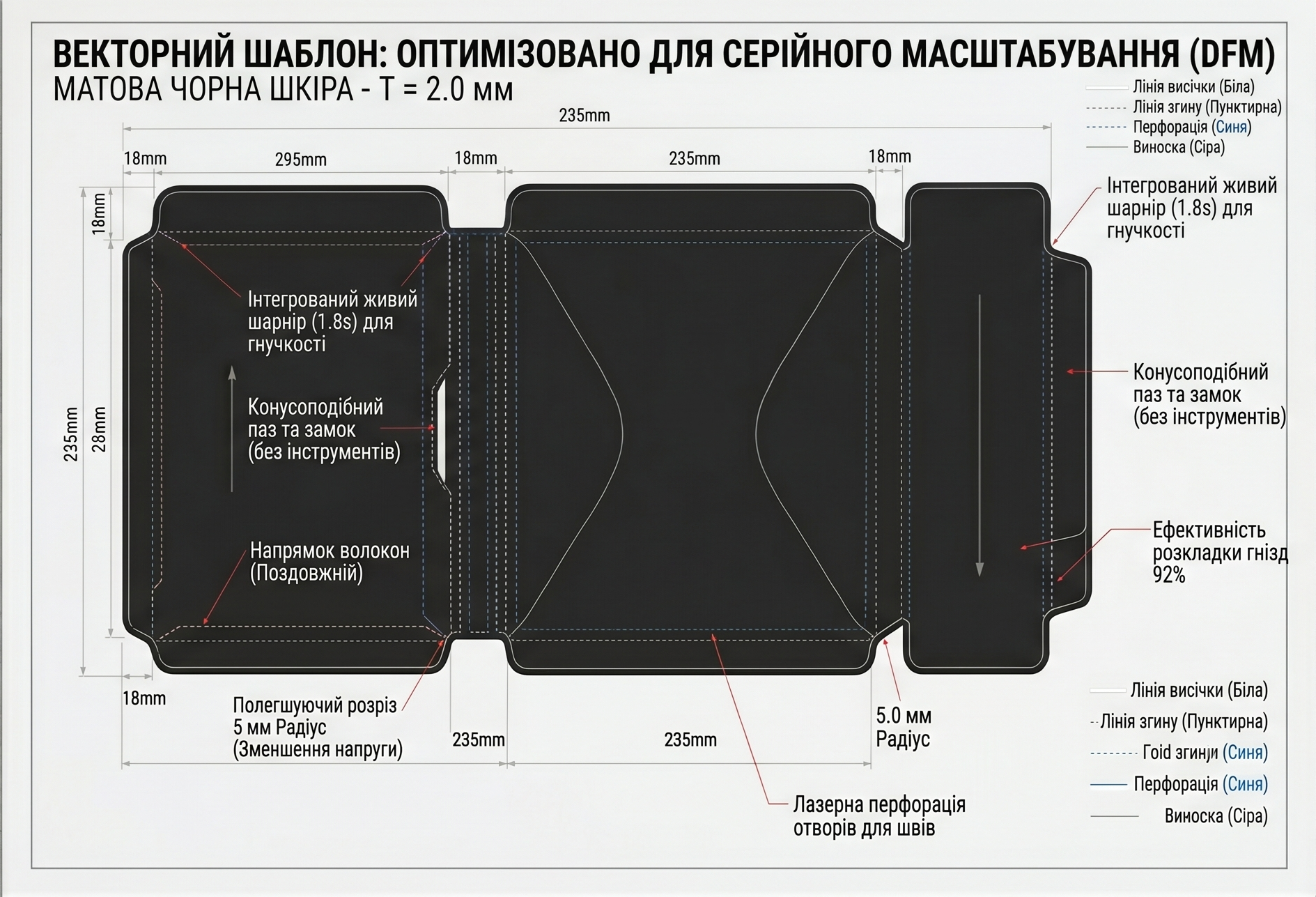
1. Technical audit of geometry (Vector purity) Defects often arise due to micro defects in the vector file itself, which are read by the laser, plotter, or die. Elimination of duplicated contours: Overlapping paths cause the laser or plotter to pass over the same spot twice. This leads to charring (cardboard), burn-throughs (leather/fabric), or material tearing. Control of contour closure: All contours responsible for through-cutting must be strictly closed (Join paths). Optimization of anchor points: Too dense placement of points on arcs causes "stuttering" of the CNC machine head, creating jagged edges on the cut. Radii must be described with the minimum possible number of points. 2. Designing compensation gaps (Tolerances and fits) Scaling requires consideration of material thickness ($s$), which can vary by $ ext{±}10 ext{ ext{%}}$ in series batches. Compensation for thickness at bends: For dense cardboard or corrugated cardboard, the inner bend radius cannot be zero. If compensation ($1.5 imes s$ or $2 imes s$ depending on density) is not accounted for, the material will crack along the score lines, or the product will "bulge" when assembled. Slot connections: The width of the slot must strictly correspond to the actual (not nominal) thickness of the material, taking into account the coating (lamination, UV varnish, paint). For mass production, slots are made with a conical approach (guides) to facilitate automatic or manual assembly. 3. Adaptation for cutting lines, scoring, and perforation Incorrect load distribution on the material is the main cause of defects during bending. Layer division: Clear color coding and layers: Red (Solid) — through-cutting (Cut). Green (Dashed) — scoring/bend (Crease). Blue — perforation or engraving. Rounding radii at inner corners: Straight inner corners (90°) in areas of stress concentration provoke material tearing during operation or assembly. Adding micro-roundings (radius from 0.5–1 mm) drastically reduces this risk. 4. Optimization of layout (Nest layout) for cutting Reducing waste and cost through proper placement of patterns on the sheet/roll. Considering the direction of fibers (for cardboard/paper): The lines of main folds of the packaging should run along the fibers of the material. If the fold is made across the fibers, the cardboard will crack, creating torn edges. Technological bridges (Bridges / Micro-locks): When cutting small parts on high-speed plotters, the product may fall out and jam the carriage. Micro-locks (bridges 0.4–0.8 mm thick) are added to the contour, which hold the part in the sheet until the cycle is fully completed. Distance between parts: The minimum distance between the contours of adjacent products must be at least $2 imes s$ (two material thicknesses) to avoid matrix deformation or overheating of the cutting zone. Checklist for the readiness of patterns for production: [ ] The direction of the material fibers relative to the fold lines has been checked. [ ] The thickness of the material + the thickness of the adhesive layer/lamination has been taken into account. [ ] All cutting contours are closed, duplicates of lines have been removed. [ ] Text and small elements have been converted to curves (Create Outlines).