Expert article: "Discipline without tears."
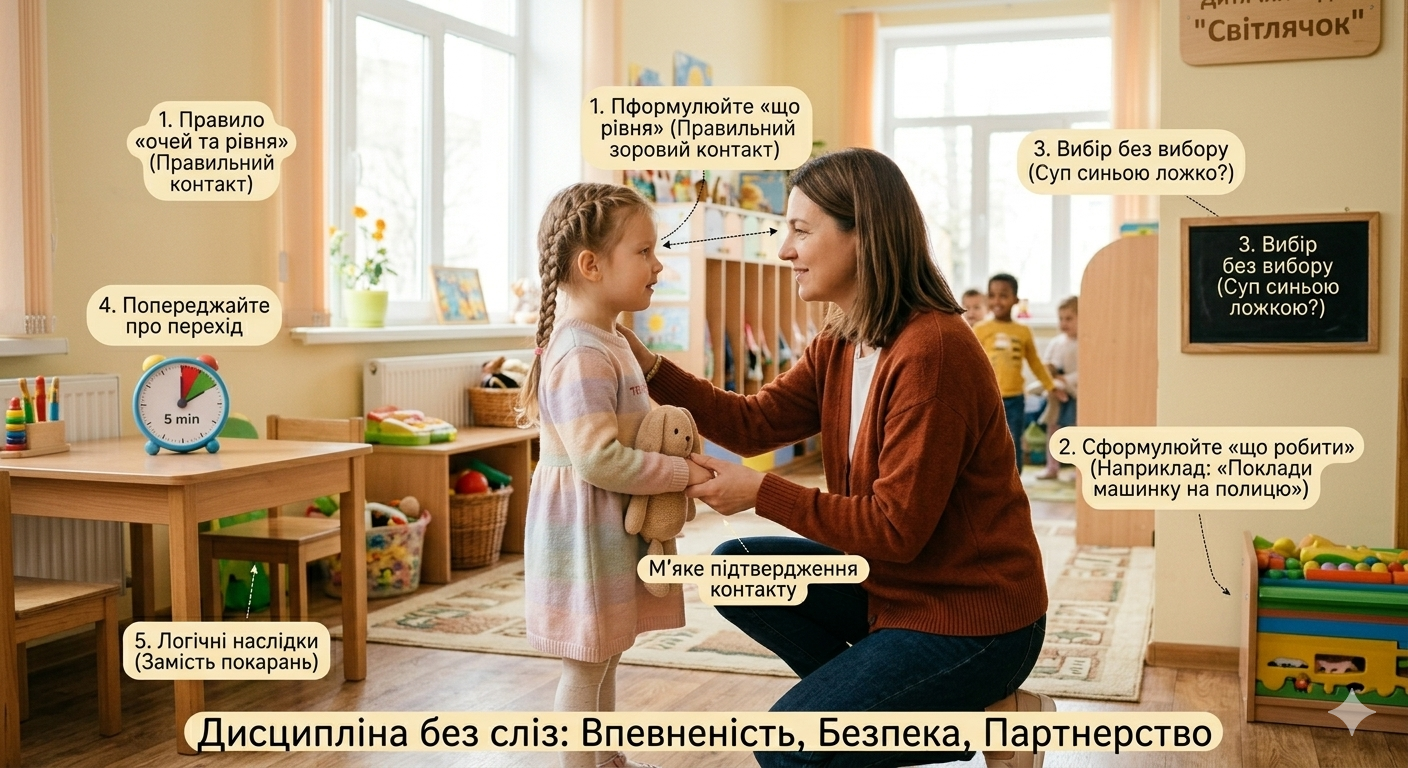
Discipline Without Tears: How to Make Your Child Hear You the First Time
Introduction "I tell him a hundred times, but he acts like he doesn't hear!" - a familiar phrase? In a kindergarten with a group of 20-25 children, if the educator repeats everything a hundred times to each child, the day will turn into chaos. In fact, children hear us perfectly well; we just often speak "on the wrong frequency." As a professional educator, I will share secrets on how to establish discipline while maintaining warm relationships with the child.
1. The "Eye Level" Rule
The biggest mistake is giving instructions from another room or looking down from above, towering over the child. To the child, you are now a giant whose voice sounds like background noise.
How to do it right: Sit at the child's eye level. Establish eye contact. You can gently place your hand on their shoulder. Only when you see that the child has "tuned in," should you speak your request.
2. Formulate "what to do," not "what not to do"
A child's brain up to 5-6 years old processes the word "not" poorly. When you say "Don't run!", the child first hears the action "run," and simply doesn't have time to stop.
Replace:
Instead of "Don't shout" - say "Please speak more quietly."
Instead of "Don't throw the toys" - say "Put the car on the shelf." Give the child a clear action plan, not a prohibition.
3. Choice Without Choice
This is a magical tool for educators. When we say "Come eat," we provoke resistance. When we give a choice - we give the child a sense of importance.
Example: "Will you eat soup with the blue spoon or the big adult one?" The child chooses the spoon but agrees to the main action - lunch.
4. Warn About Transitions in Advance
Children get very immersed in play. A sudden "That's it, turn off the cartoons, we're going to bed" causes hysteria because you are abruptly intruding into their world.
Method: Use the "5 minutes" rule. Say: "You have 5 more minutes of playtime, during which you need to finish building the tower, and then we will get ready." After 2 minutes, remind them. This way, the child has time to psychologically finish what they are doing.
5. Logical Consequences Instead of Punishments
Punishments (corner time, deprivation of sweets for spilled tea) only cause resentment. Logical consequences teach responsibility.
Example: If the child intentionally spills water - they take a cloth and wipe it up. If they throw a toy - the toy "goes to rest" on a high shelf for an hour. No shouting, just a calm explanation of the cause-and-effect relationship.
Discipline is not about fear, but about rules that make the child's world understandable and safe. In kindergarten, we value each child as an individual, and respect is the key to making the child want to hear us. Try changing the tone from commanding to partnering, and you will see how quickly your child's behavior changes.
Introduction "I tell him a hundred times, but he acts like he doesn't hear!" - a familiar phrase? In a kindergarten with a group of 20-25 children, if the educator repeats everything a hundred times to each child, the day will turn into chaos. In fact, children hear us perfectly well; we just often speak "on the wrong frequency." As a professional educator, I will share secrets on how to establish discipline while maintaining warm relationships with the child.
1. The "Eye Level" Rule
The biggest mistake is giving instructions from another room or looking down from above, towering over the child. To the child, you are now a giant whose voice sounds like background noise.
How to do it right: Sit at the child's eye level. Establish eye contact. You can gently place your hand on their shoulder. Only when you see that the child has "tuned in," should you speak your request.
2. Formulate "what to do," not "what not to do"
A child's brain up to 5-6 years old processes the word "not" poorly. When you say "Don't run!", the child first hears the action "run," and simply doesn't have time to stop.
Replace:
Instead of "Don't shout" - say "Please speak more quietly."
Instead of "Don't throw the toys" - say "Put the car on the shelf." Give the child a clear action plan, not a prohibition.
3. Choice Without Choice
This is a magical tool for educators. When we say "Come eat," we provoke resistance. When we give a choice - we give the child a sense of importance.
Example: "Will you eat soup with the blue spoon or the big adult one?" The child chooses the spoon but agrees to the main action - lunch.
4. Warn About Transitions in Advance
Children get very immersed in play. A sudden "That's it, turn off the cartoons, we're going to bed" causes hysteria because you are abruptly intruding into their world.
Method: Use the "5 minutes" rule. Say: "You have 5 more minutes of playtime, during which you need to finish building the tower, and then we will get ready." After 2 minutes, remind them. This way, the child has time to psychologically finish what they are doing.
5. Logical Consequences Instead of Punishments
Punishments (corner time, deprivation of sweets for spilled tea) only cause resentment. Logical consequences teach responsibility.
Example: If the child intentionally spills water - they take a cloth and wipe it up. If they throw a toy - the toy "goes to rest" on a high shelf for an hour. No shouting, just a calm explanation of the cause-and-effect relationship.
Discipline is not about fear, but about rules that make the child's world understandable and safe. In kindergarten, we value each child as an individual, and respect is the key to making the child want to hear us. Try changing the tone from commanding to partnering, and you will see how quickly your child's behavior changes.

 Krivoi Rog
  Available for hire