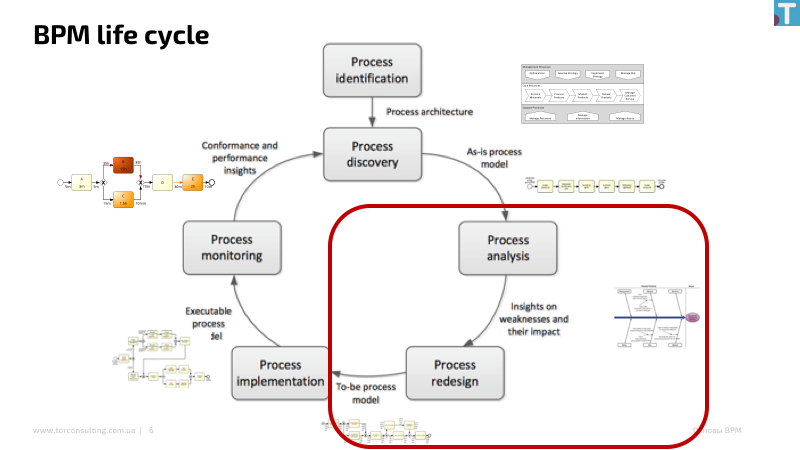
1 .Proved quality analysis of business processes:
Identify process stages that do not have value for the customer or business.
Identify different types of losses and identify potential process problems.
documenting process problems in the register of problems and analyzing their impact on the business both from a quality and quantitative point of view
- Building a Pareto chart to focus on the problems that offer the greatest commitment
- to classify the factors that are the basis of the problem, using the technique 5 why.The 2ndQuantitative analysis of business processes:
Identify process productivity indicators, such as cycle time and cost.
Calculate the critical path of the process using the critical path method
- Determine the time of expectation of the process from the use of resources
- obtaining indicators of process efficiency (e.g., cycle time or cost), task data (e.g., processing time) and resource data engaged in the process using imitating modeling
3 .Design of Business Processes:
- to clarify and approve the process re-design strategy with all stakeholders
- to create alternative models of processes "as it should be" and consider the advantages of each of them
The development of a perfect process “as it should be”.- Development of the management process to support the new design process.- Implementation of performance and efficiency of processes
- to propose a new organizational scheme that improves the performance and efficiency
- the calculation of value and the comparison of the process "as it should be" with the current business process "as it is".Documentation of new technological measures.Analysis and optimization of 1 process (< 30 steps) - 3-5 people-day.Cost of 1 person per day:
Identify process stages that do not have value for the customer or business.
Identify different types of losses and identify potential process problems.
documenting process problems in the register of problems and analyzing their impact on the business both from a quality and quantitative point of view
- Building a Pareto chart to focus on the problems that offer the greatest commitment
- to classify the factors that are the basis of the problem, using the technique 5 why.The 2ndQuantitative analysis of business processes:
Identify process productivity indicators, such as cycle time and cost.
Calculate the critical path of the process using the critical path method
- Determine the time of expectation of the process from the use of resources
- obtaining indicators of process efficiency (e.g., cycle time or cost), task data (e.g., processing time) and resource data engaged in the process using imitating modeling
3 .Design of Business Processes:
- to clarify and approve the process re-design strategy with all stakeholders
- to create alternative models of processes "as it should be" and consider the advantages of each of them
The development of a perfect process “as it should be”.- Development of the management process to support the new design process.- Implementation of performance and efficiency of processes
- to propose a new organizational scheme that improves the performance and efficiency
- the calculation of value and the comparison of the process "as it should be" with the current business process "as it is".Documentation of new technological measures.Analysis and optimization of 1 process (< 30 steps) - 3-5 people-day.Cost of 1 person per day: