578 AI photos of dishes for the culinary database: Midjourney production pipe
Illustrations & Drawings 4000 USD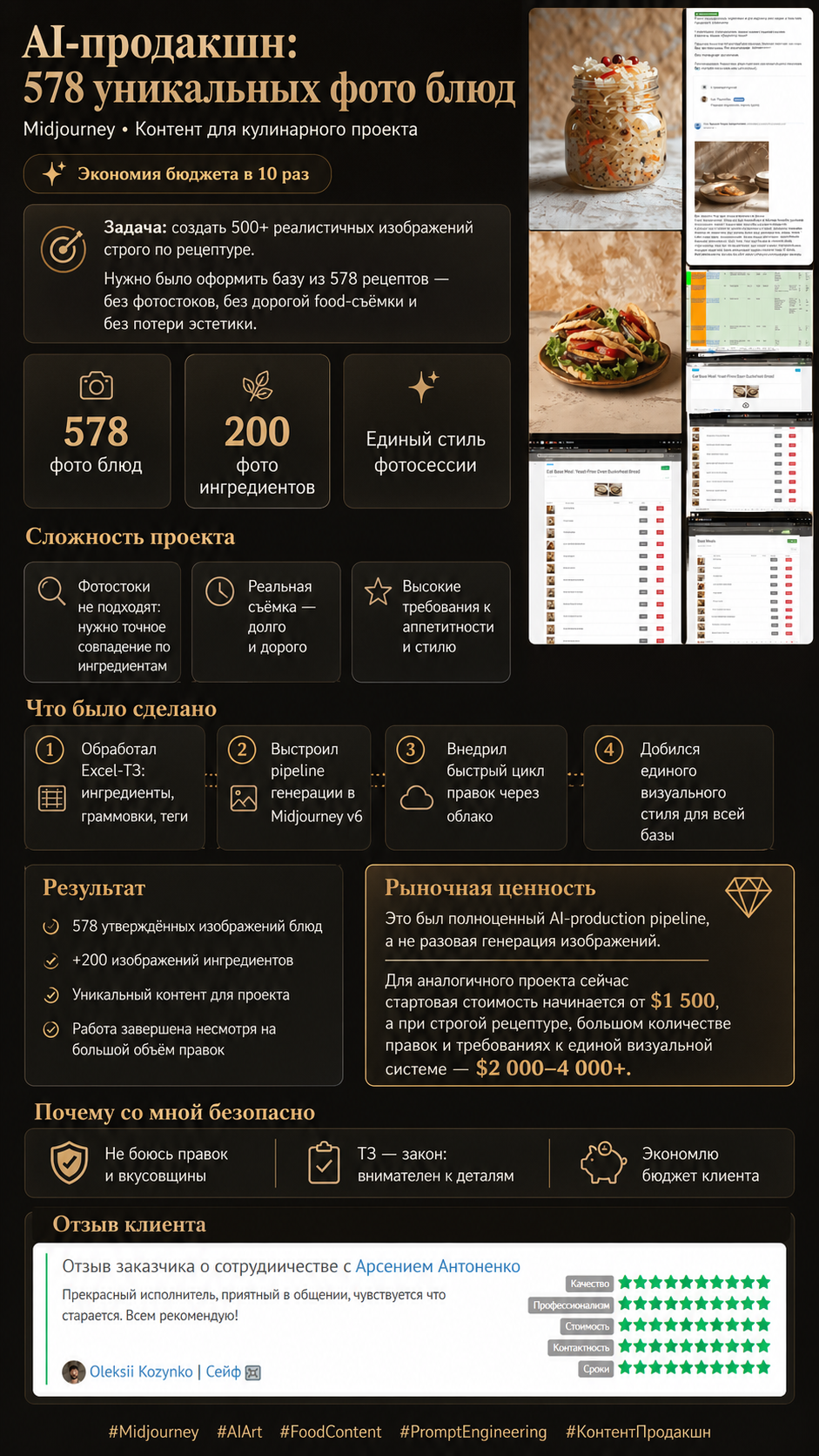
Implemented AI production of visual content for a culinary project: 578 unique dish images + 200 ingredient images.
The task was not just to "generate beautiful pictures," but to create a large visual catalog for a specific recipe database. For each dish, it was necessary to consider the composition, ingredients, visual presentation, and overall style of the project.
Client's Problem
The client needed to organize a large recipe database, but standard solutions were not suitable:
— stock photos did not provide an exact match with the recipes;
— real food photography would require cooking, a studio, a photographer, props, and a large budget;
— images needed to look appetizing, realistic, and in a unified style;
— some requirements were subjective: "tasty / not tasty," "not the right plate," "too bright an ingredient," "needs to look more like the recipe."
What Was Done
I built a full-fledged AI production pipeline, not just a one-time generation of images.
The work included:
— analyzing the Excel specifications with recipes, ingredients, weights, and tags;
— preparing prompts for each category of dishes;
— generating images in Midjourney v6;
— controlling the correspondence of images to the recipes;
— selecting the best options;
— a cycle of revisions through cloud comments;
— finalizing images until approval;
— maintaining a unified visual style: light, angle, dishes, background, atmosphere;
— final systematization of images for further use in the project.
Result
As a result, the following was prepared:
— 578 approved dish images;
— 200 ingredient images;
— a unified visual style for the entire database;
— ready content for the website, blog, cookbook, and internal recipe database;
— a production process that replaced expensive and lengthy traditional food photography.
The project was completed despite a large volume of revisions and subjective requirements for the "appetizing" quality of the images.
Why This Is Valuable
This project saved the client months of work and a significant budget. With traditional food photography, hundreds of dishes would have to be prepared, a studio rented, a photographer and stylist hired, ingredients purchased, and post-processing done. Instead, the client received a large visual catalog through the AI production pipeline.
This was a full-fledged AI production pipeline, not a one-time image generation. For a similar project, the starting cost now begins at $1,500, and with strict recipes, a large number of revisions, and requirements for a unified visual system — $2,000–4,000+.
Why It Is Safe to Work with Me
I am not afraid of revisions and subjective assessments. If the client says "doesn't look tasty," I do not argue but redo it until the desired result is achieved.
I work carefully with the specifications. If specific ingredients are listed in the recipe, I ensure that the image corresponds to the logic of the dish and does not turn into a random beautiful picture.
I can handle large volumes. The project involved hundreds of recipes, revisions, comments, tables, and final systematization — all of this was brought to completion.
The task was not just to "generate beautiful pictures," but to create a large visual catalog for a specific recipe database. For each dish, it was necessary to consider the composition, ingredients, visual presentation, and overall style of the project.
Client's Problem
The client needed to organize a large recipe database, but standard solutions were not suitable:
— stock photos did not provide an exact match with the recipes;
— real food photography would require cooking, a studio, a photographer, props, and a large budget;
— images needed to look appetizing, realistic, and in a unified style;
— some requirements were subjective: "tasty / not tasty," "not the right plate," "too bright an ingredient," "needs to look more like the recipe."
What Was Done
I built a full-fledged AI production pipeline, not just a one-time generation of images.
The work included:
— analyzing the Excel specifications with recipes, ingredients, weights, and tags;
— preparing prompts for each category of dishes;
— generating images in Midjourney v6;
— controlling the correspondence of images to the recipes;
— selecting the best options;
— a cycle of revisions through cloud comments;
— finalizing images until approval;
— maintaining a unified visual style: light, angle, dishes, background, atmosphere;
— final systematization of images for further use in the project.
Result
As a result, the following was prepared:
— 578 approved dish images;
— 200 ingredient images;
— a unified visual style for the entire database;
— ready content for the website, blog, cookbook, and internal recipe database;
— a production process that replaced expensive and lengthy traditional food photography.
The project was completed despite a large volume of revisions and subjective requirements for the "appetizing" quality of the images.
Why This Is Valuable
This project saved the client months of work and a significant budget. With traditional food photography, hundreds of dishes would have to be prepared, a studio rented, a photographer and stylist hired, ingredients purchased, and post-processing done. Instead, the client received a large visual catalog through the AI production pipeline.
This was a full-fledged AI production pipeline, not a one-time image generation. For a similar project, the starting cost now begins at $1,500, and with strict recipes, a large number of revisions, and requirements for a unified visual system — $2,000–4,000+.
Why It Is Safe to Work with Me
I am not afraid of revisions and subjective assessments. If the client says "doesn't look tasty," I do not argue but redo it until the desired result is achieved.
I work carefully with the specifications. If specific ingredients are listed in the recipe, I ensure that the image corresponds to the logic of the dish and does not turn into a random beautiful picture.
I can handle large volumes. The project involved hundreds of recipes, revisions, comments, tables, and final systematization — all of this was brought to completion.