Case: advertising in Google for the official online store of UFO
Contextual Advertising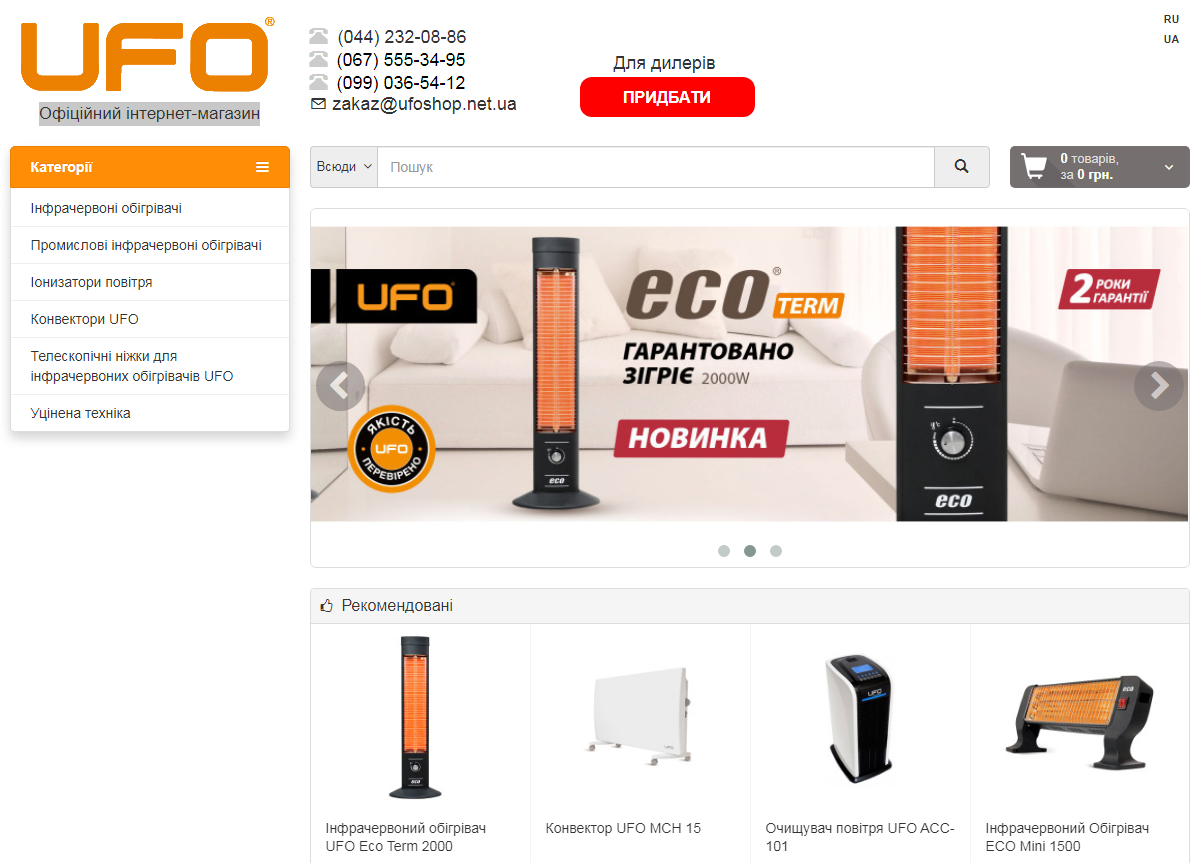
What improvements were made before the advertising campaign?
1) Four groups were created in both Russian and Ukrainian languages: Brand queries (which included the word UFO), Infrared heater (included: infrared heater or IR heater), Transactional queries (included the word heater in combination with transactional queries: buy, how much does it cost, price, Kyiv, Ukraine, inexpensive), General queries (all possible phrases with the word heater, but only in exact match to exclude non-targeted queries).
2) Google Analytics statistics showed that different audience segments reacted differently to the ads. It was decided to use bid adjustments for each segment, depending on the conversion rate (for example, from 9:00 AM to 2:00 PM the cost per click was set at 100%, and from 2:00 PM to 5:00 PM the cost per click was reduced by 47%).
3) The advertising on the Google Ads account was set up for both macro conversions (purchases) and micro conversions (click on phone, start of order placement). It was decided to use settings for automatic campaign settings focused only on macro conversions (purchases). Additionally, the macro conversion was set up — Order Confirmation in 1 click.
What improvements were made during the advertising process?
1) Daily, I reviewed the search queries for which ads were actually shown the previous day. Based on these queries, I adjusted the list of negative keywords and keywords daily. Additionally, I removed keywords with a quality score below average.
2) The first few days of advertising showed that almost all orders in Search Advertising came only from brand queries. It was decided to keep only this group of ads for advertising.
3) As a competitive advantage, it was used that a 10% discount could be obtained when paying by card. The fact that brand advertising turned out to be the most effective allowed us to conclude that for the target audience, the decisive factor in the decision-making process is the guarantee from the official manufacturer. Accordingly, the emphasis in the texts shifted from the discount to the 4-year guarantee from the official store.
4) I noticed that some queries included names of cities in neighboring countries. I excluded displays in the regions of neighboring countries.
5) I noticed that orders paid by card on the website were registered as orders that came from the LiqPay site. To ensure that these orders were also recorded as macro conversions in Google Ads, I changed the macro conversion setting from "Transactions" to "Click on the order confirmation button."
6) During the advertising process, I also had to address issues related to compliance with Google's advertising display rules. For example, Product advertising was suspended because the product images contained text.
7) Immediately after launching the ads with the new settings, Smart Product Ads, with the Maximum Conversions strategy, performed better than Search Ads, with the Maximum Clicks strategy (the conversion rates of these two advertising campaigns were compared). However, after 1.5 months of advertising and making changes to it, the conversion rate for Search Advertising became significantly higher. A decision was made to increase the advertising budget towards Search Advertising.
8) It often happened that advertising was suspended for 1-3 days due to the account running out of funds, and when paying by invoice, the ads usually resumed at the beginning of the next working day. This led to a loss of clients on those days when the ads were suspended. I paid attention to this, and we started to monitor and ensure that we paid for advertising in advance to avoid suspension.
9) Regarding Remarketing, almost all improvements came down to disabling mobile applications for displaying ads (they are usually less effective).
Advertising results.
If we conduct a short-term analysis of the first week before I made changes to the advertising and the first week after these changes were made, there was a noticeable increase in almost all metrics.
1) Four groups were created in both Russian and Ukrainian languages: Brand queries (which included the word UFO), Infrared heater (included: infrared heater or IR heater), Transactional queries (included the word heater in combination with transactional queries: buy, how much does it cost, price, Kyiv, Ukraine, inexpensive), General queries (all possible phrases with the word heater, but only in exact match to exclude non-targeted queries).
2) Google Analytics statistics showed that different audience segments reacted differently to the ads. It was decided to use bid adjustments for each segment, depending on the conversion rate (for example, from 9:00 AM to 2:00 PM the cost per click was set at 100%, and from 2:00 PM to 5:00 PM the cost per click was reduced by 47%).
3) The advertising on the Google Ads account was set up for both macro conversions (purchases) and micro conversions (click on phone, start of order placement). It was decided to use settings for automatic campaign settings focused only on macro conversions (purchases). Additionally, the macro conversion was set up — Order Confirmation in 1 click.
What improvements were made during the advertising process?
1) Daily, I reviewed the search queries for which ads were actually shown the previous day. Based on these queries, I adjusted the list of negative keywords and keywords daily. Additionally, I removed keywords with a quality score below average.
2) The first few days of advertising showed that almost all orders in Search Advertising came only from brand queries. It was decided to keep only this group of ads for advertising.
3) As a competitive advantage, it was used that a 10% discount could be obtained when paying by card. The fact that brand advertising turned out to be the most effective allowed us to conclude that for the target audience, the decisive factor in the decision-making process is the guarantee from the official manufacturer. Accordingly, the emphasis in the texts shifted from the discount to the 4-year guarantee from the official store.
4) I noticed that some queries included names of cities in neighboring countries. I excluded displays in the regions of neighboring countries.
5) I noticed that orders paid by card on the website were registered as orders that came from the LiqPay site. To ensure that these orders were also recorded as macro conversions in Google Ads, I changed the macro conversion setting from "Transactions" to "Click on the order confirmation button."
6) During the advertising process, I also had to address issues related to compliance with Google's advertising display rules. For example, Product advertising was suspended because the product images contained text.
7) Immediately after launching the ads with the new settings, Smart Product Ads, with the Maximum Conversions strategy, performed better than Search Ads, with the Maximum Clicks strategy (the conversion rates of these two advertising campaigns were compared). However, after 1.5 months of advertising and making changes to it, the conversion rate for Search Advertising became significantly higher. A decision was made to increase the advertising budget towards Search Advertising.
8) It often happened that advertising was suspended for 1-3 days due to the account running out of funds, and when paying by invoice, the ads usually resumed at the beginning of the next working day. This led to a loss of clients on those days when the ads were suspended. I paid attention to this, and we started to monitor and ensure that we paid for advertising in advance to avoid suspension.
9) Regarding Remarketing, almost all improvements came down to disabling mobile applications for displaying ads (they are usually less effective).
Advertising results.
If we conduct a short-term analysis of the first week before I made changes to the advertising and the first week after these changes were made, there was a noticeable increase in almost all metrics.