From chaotic visibility to systematic growth
Search Engine Optimization (SEO)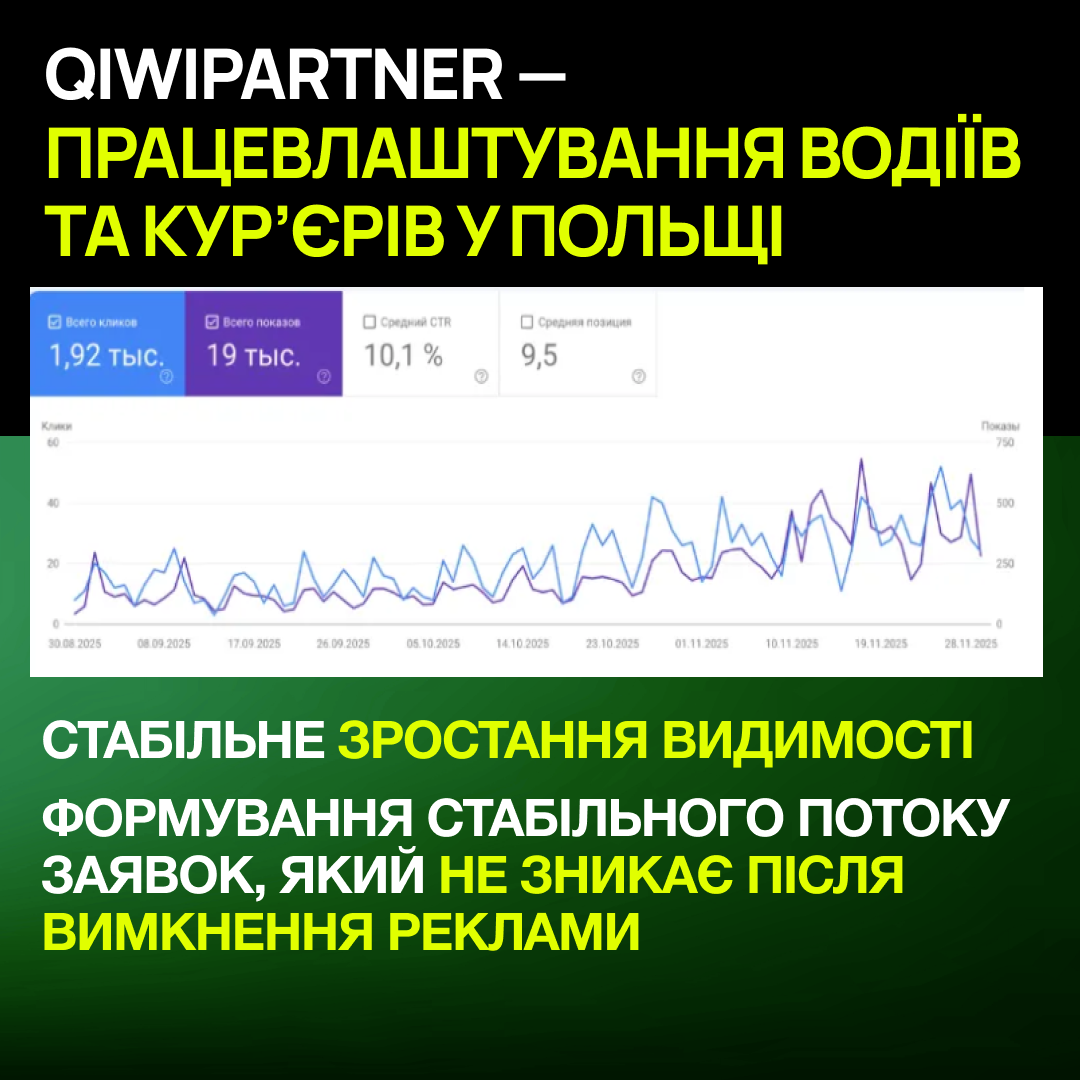
Client: Recruitment platform Qiwipartner (employment of drivers and couriers in Poland).
Task:
Build SEO as a managed channel for attracting candidates that scales independently of the advertising budget.
Challenge:
High competition in the "jobs here and now" niche, low trust from job seekers, and the risk of traffic cannibalization due to multilingualism (PL/UA/RU/EN). At the start, SEO was chaotic: pages ranked unevenly, and analytics did not provide insight into where leads were coming from.
Solution:
1. Clustering based on real demand: developed a page structure along three vectors: type of work, specific cities in Poland, and language variations of queries.
2. Elimination of SEO cannibalization: configured hreflang logic and URL structure so that language versions reinforced each other rather than competing in search.
3. Technical recovery: cleaned the site of duplicates, broken links, and organized the crawling budget for quick indexing of new job postings.
4. Content based on intent: replaced generic texts with specific information about working conditions, requirements, and FAQs that address migrants' concerns.
5. Data-driven approach: implemented analytics focused on the quality of organic sessions and growth in visibility for non-branded commercial queries.
Results:
1. Stable growth in visibility: improvement in average position in key clusters "jobs/vacancies" and expansion of the semantic core.
2. Quality organic traffic: increased duration of interaction with job pages, indicating engagement from the target audience.
3. Created a foundation for scaling: the site architecture allows for adding new cities and directions without losing relevance.
4. Reduced cost of acquisition: formation of a stable flow of applications that does not disappear after turning off advertising.
Task:
Build SEO as a managed channel for attracting candidates that scales independently of the advertising budget.
Challenge:
High competition in the "jobs here and now" niche, low trust from job seekers, and the risk of traffic cannibalization due to multilingualism (PL/UA/RU/EN). At the start, SEO was chaotic: pages ranked unevenly, and analytics did not provide insight into where leads were coming from.
Solution:
1. Clustering based on real demand: developed a page structure along three vectors: type of work, specific cities in Poland, and language variations of queries.
2. Elimination of SEO cannibalization: configured hreflang logic and URL structure so that language versions reinforced each other rather than competing in search.
3. Technical recovery: cleaned the site of duplicates, broken links, and organized the crawling budget for quick indexing of new job postings.
4. Content based on intent: replaced generic texts with specific information about working conditions, requirements, and FAQs that address migrants' concerns.
5. Data-driven approach: implemented analytics focused on the quality of organic sessions and growth in visibility for non-branded commercial queries.
Results:
1. Stable growth in visibility: improvement in average position in key clusters "jobs/vacancies" and expansion of the semantic core.
2. Quality organic traffic: increased duration of interaction with job pages, indicating engagement from the target audience.
3. Created a foundation for scaling: the site architecture allows for adding new cities and directions without losing relevance.
4. Reduced cost of acquisition: formation of a stable flow of applications that does not disappear after turning off advertising.