AI & Machine Learning
96-
NeuroLabyrinth - a platform for parallel learning of agents
AI & Machine Learning
This is a high-performance reinforcement learning system built around the multi-agent environment Maze RL, optimized for real computational loads and scaling.
The project implements a fully vectorized simulation, where dozens of agents are trained simultaneously in the same environment. The architecture is specifically designed to move away from the classic single-agent approach and replace it with parallel learning in a shared environment, which radically increases the efficiency of computational resource usage.
… Each agent operates independently, but within a unified environment, allowing for the modeling of competitive and collective behavior simultaneously. The system supports batch processing of observations and actions, where all agents undergo a forward pass in a single operation, without N separate model calls. This provides a significant performance boost and makes the system suitable for scaling to hundreds of agents.
The environment is built on procedural generation of complex mazes with controlled structural entropy: cycles, traps, dead ends, false paths, and narrow corridors. This creates a rich learning space where the agent cannot rely on trivial strategies and is forced to develop a robust navigation policy.
The system supports dynamic visualization on Pygame, where all agents are displayed in real-time, including their positions, progress, and aggregated learning statistics. If necessary, the visualization can be turned off, and the system switches to a high-speed headless mode, achieving thousands of agent-steps per second on the CPU.
Training is based on a DQN architecture with a replay buffer, target network, and epsilon decay, adapted for multi-agent mode. Instead of the classic episodic cycle, a streaming step training is used, where model updates occur continuously as experience is received from all agents.
As a result, it is a system that serves both as a research platform and an engineering tool: it demonstrates the behavior of complex RL agents under conditions of dense parallelization, allows for testing scaling strategies, and visually observes collective learning in real-time.
Essentially, it is not just an agent simulator, but a full-fledged environment for developing and stress-testing reinforcement learning algorithms in multi-agent scenarios with high interaction density.
-
AI Content Engine — 30 Posts for $1
AI & Machine LearningFull closed-loop content system that writes in brand voice 6 connected Make.com scenarios: INGESTION: loads brand voice, audience pain points, vectors into Pinecone GENERATION: queries RAG vectors, structured prompt to Claude, 6 draft variants INTEGRATION WEBHOOKS: unified pipeline triggerable from Slack forms or other scenarios PUBLISH: pushes approved variant to LinkedIn and X via Buffer FEEDBACK LOOP: collects engagement metrics, auto-adds top posts back to Pinecone as style references REDDIT CHECK: monitors subreddits for fresh audience pain points, updates audience language automatically
https://www.loom.com/share/3e08552f874f407bad4b558bd0bdf9d8
… #make.com #pinecone #claude #promptengineering #Buffer
-
Voice AI agent for a real estate agency (RAG)
AI & Machine LearningBuilt a RAG pipeline for an agent that autonomously called clients and consulted them. The main difficulty was scoring and ranking retrieved chunks in the context of a live call: implemented query rewriting, hybrid search (keyword + vector), re-ranking by relevance. Configured the embedding model on a corpus of documents about real estate objects. The agent escalated edge cases through HITL.
-
AI cover maker for songs
AI & Machine Learning
(Pinterest → Stable Diffusion XL + LoRA (Gradio UI))
A tool for generating covers for music releases that simplifies the path from visual inspiration to finished design. The solution combines reference images from Pinterest with Stable Diffusion XL and LoRA in a user-friendly web interface based on Gradio.
… Designed for music artists: allows for quick finding of visual references, adapting style, and generating unique covers using an image-to-image approach on a local diffusion pipeline.
-
AI Assistant for ServiceFusion: Query Jobs by Chat, Not Clicks
AI & Machine Learning
The Situation
A field service operator running on ServiceFusion wanted dispatchers and office staff to stop clicking through menus every time they needed to check a customer's job history, pull open estimates, or see which technician was assigned to a job. The team was already using Claude for other tasks. The obvious next step: let Claude talk directly to ServiceFusion.
The Problem
… ServiceFusion exposes a REST API, but AI assistants cannot call it directly. The Model Context Protocol (MCP) is the emerging standard for giving AI clients structured access to external tools, and no MCP server existed for ServiceFusion. Building one correctly meant solving three problems at once:
OAuth2 token lifecycle. ServiceFusion uses short-lived access tokens that expire and must be refreshed transparently, so the AI never hits an auth failure mid-conversation.
Multi-tenancy. A single server instance had to isolate credentials and API calls for multiple companies, each with their own ServiceFusion account.
Self-service onboarding. The operator did not want to configure every new tenant manually.
The Solution
I built a multi-tenant MCP server in Node.js and TypeScript that sits between AI clients (Claude, Cursor, ChatGPT) and ServiceFusion. It exposes 13 structured tools covering the core entities dispatchers actually use: customers, jobs, estimates, technicians, and equipment.
The server handles two independent OAuth2 layers. One authenticates incoming AI clients to the MCP server. The second manages the server's own ServiceFusion tokens, including automatic refresh with a concurrency lock so simultaneous requests never trigger duplicate refreshes.
All sensitive credentials (client IDs, secrets, tokens) are encrypted at rest with AES-256-GCM in Supabase PostgreSQL. New tenants self-register via REST API, confirm via OTP, and supply their ServiceFusion credentials to activate. No manual operator work per signup.
A lightweight admin panel lets the operator view usage per tenant, adjust rate limits, and activate or deactivate accounts.
Tech Stack: Node.js 20, TypeScript, @ modelcontextprotocol/sdk, Express, Supabase (PostgreSQL), AES-256-GCM encryption, Zod, Winston, Docker, nginx, Let's Encrypt
The Results
13 MCP tools live across customers, jobs, estimates, technicians, and equipment
Zero manual setup per tenant. Self-service OTP registration and activation flow
Transparent OAuth2. Expired tokens refresh automatically with race-condition protection
Per-tenant rate limits (free, pro, enterprise tiers) enforced at the request layer
Full usage tracking (tool name, endpoint, status code, response time) logged per tenant for billing and analytics
Deployed to production on Hetzner VPS behind nginx with SSL, coexisting with a sibling MCP server on the same host
How It Works
1. Tenant POSTs to /api/register with company name and email, receives a 6-digit OTP
2. Tenant confirms via /api/confirm, then activates by supplying ServiceFusion OAuth credentials
3. Credentials are encrypted with AES-256-GCM and stored in Supabase
4. AI client (Claude, Cursor) calls /mcp with a bearer token; middleware identifies the tenant and checks rate limit
5. On tool invocation, the server checks token validity and refreshes automatically if expired
6. Structured response flows back to the AI client, and the call is logged for usage analytics
-
Automated FL Tax Deed Auction Research: Hours of Work, Zero Click
AI & Machine Learning
Automated FL Tax Deed Auction Research: Hours of Work, Zero Clicks
The Situation
Florida tax deed auctions list dozens to hundreds of properties per auction day across multiple counties. A serious bidder has to vet each parcel before the auction: acreage, zoning, flood risk, road access, assessed value, aerial view. The research lives across six different county property appraiser portals, FEMA flood maps, Google Maps satellite, Street View, and parcel boundary services like id.land. Each county has its own quirky SPA. Each data point lives in a different tab.
… The Problem
Manual research on auction day runs four to six hours for a single county's list. Multiply by six counties and the math breaks: bidders either skip parcels, miss flood risk signals, or bid blind. The tedium is the real cost. An experienced investor should be filtering and analyzing, not copy-pasting parcel IDs into six different forms.
The target operator is sophisticated enough to self-host and wants full control over their data, API keys, and scraping infrastructure. No SaaS lock-in, no per-seat fees, no sending proprietary investment logic to a vendor.
The Solution
I built a self-hosted intelligence platform that turns hours of manual county-portal research into an overnight pipeline run. The operator triggers one run, walks away, and wakes up to a filterable shortlist of auction parcels ranked by AI verdict.
How the pipeline works (7 stages, event-driven):
1. Scrape listings from realtaxdeed.com behind a Surfshark VPN (the site blocks non-US IPs and non-browser user agents). Handles a multi-step login with up to 5 sequential notice pages, paginates through all auction items.
2. Scrape property data from each county's appraiser portal. Putnam County alone required splitting parcel IDs like 01-10-26-0250-0270-0081 into 6 separate form fields inside an SPA.
3. Resolve GPS coordinates via id.land, dismissing modals and navigating state/county/parcel dropdowns.
4. Capture screenshots: Google Maps satellite, Street View, id.land parcel boundary, FEMA flood zone.
5. Check FEMA flood zone using an undocumented ArcGIS &extent= URL parameter (replaced a brittle UI-search automation flow).
6. Run AI analysis via Claude Sonnet 4 with tool_use for structured output: numeric subscores (land quality, flood risk, road access, development, value), overall 0-100 score, flags, reasoning, and a buy/review/skip verdict.
7. Write results to Supabase, pushed live to a React dashboard via Realtime subscriptions.
Tech Stack: NestJS, Playwright, BullMQ, Redis, Supabase (PostgreSQL + Storage + Realtime), Claude Sonnet 4 API, React, Vite, Tailwind, Leaflet, Docker Compose, Caddy, Surfshark VPN via gluetun.
The Results
- Hours of manual cross-portal research replaced with a single pipeline trigger
- End-to-end pipeline working for Putnam County: 10/10 parcels scraped, 10/10 GPS resolved, 40 screenshots captured per run
- AI cost calibrated at approximately $0.012 per parcel for full vision analysis
- 6-county configuration system lets new counties drop in via config files plus a processor strategy
- Self-hosted architecture keeps all data, API keys, and scraping infrastructure under operator control
- Real-time dashboard shows pipeline runs, parcel details, queue health, AI verdicts, CSV export, interactive map
How It Works (operator view)
1. Operator hits "Trigger Pipeline" in the dashboard (or POSTs to the API)
2. System scrapes the auction listing page, creates a parcel record per item
3. Each parcel flows through all 7 stages automatically
4. Dashboard updates live as parcels complete each stage
5. When AI analysis finishes, operator sees a ranked, filterable list with verdicts
6. Export to CSV or drill into parcel detail with all screenshots side-by-side
-
3M+ Deed Records Processed: Property Research from Days to Minutes
AI & Machine Learning
The Situation
A US-based legal-tech founder was building a property research platform for real estate attorneys: lawyers who hunt for undervalued land parcels as investment opportunities for their clients. Their work depends on finding specific language buried inside deed records such as easements, restrictions, access rights, and boundary clauses.
Before this project, finding the right parcels meant manually searching DataTree and county databases, reading individual deed PDFs, and cross-referencing with tax maps, zoning data, and demographics across separate tabs. A single qualified lead could take days. Some questions couldn't be answered at all.
…
The Problem
Attorneys were missing deals because the research cost was too high. Every property had to be hand-checked against keyword criteria, then enriched with geo data and infrastructure records from four different sources. The founder had tried manual workarounds and off-the-shelf tools. Nothing connected the sources. Nothing filtered by the specific legal language his clients needed to find.
The question wasn't "can we make this faster?" It was "can we make questions answerable that weren't answerable before?"
The Solution
I built an end-to-end property intelligence platform with two layers.
The frontend is a React SPA deployed on Vercel where attorneys search, filter, and review properties. Each result opens into a detail view with deed history, lot-size restrictions, tax maps, infrastructure, and county demographics, all rendered dynamically from a Supabase backend with row-level security.
The backend is n8n-as-API. Rather than running n8n as "automation glue," I used it as the production API layer for the deed-processing pipeline. When an attorney runs a keyword search, the request routes through a Supabase Edge Function to n8n webhooks. The pipeline fetches deed records from DataTree, filters by legal keywords, enriches matches with Zonomics geo data, runs AI analysis via Claude (OpenRouter), and writes progress back to Supabase in real time. Attorneys see staged progress as records are matched and enriched.
This architecture gave the founder a backend that's fully controllable, easy to modify, and fast to extend: new data sources or analysis steps ship in hours, not sprints. To support that velocity, I built a custom Claude Code toolkit that manages n8n workflows programmatically (creating, syncing, and debugging them from natural-language specs).
Tech Stack: n8n, Supabase (PostgreSQL, Auth, Storage, Edge Functions), React 19, TypeScript, Vite, Vercel, DataTree API, Zonomics API, Claude API (via OpenRouter), OpenAI API, Google Maps Embed API, Node.js, Zod, Anthropic SDK
The Results
- 3M+ deed records processed through the pipeline
- Days to minutes per qualified research query
- Questions now answerable that weren't before (multi-source queries that were economically infeasible manually)
- Production system actively used by the founder's team, serving legal clients
- Backend fully controllable: new data sources, keywords, and AI analysis steps ship without rebuilding
- Architected for microSaaS: system is already being prepared for external access by a limited set of attorneys
How It Works
1. Attorney enters keyword criteria (legal language they need in deeds) and geographic scope
2. Request routes through Supabase Edge Function to n8n webhook
3. n8n pipeline fetches matching deed records from DataTree
4. Matches enriched with Zonomics geo data, tax maps, infrastructure, demographics
5. Claude analyzes each deed for relevance; results scored and sorted
6. Attorney downloads only the deeds that match all their criteria via signed Supabase URLs
-
400 USD AI-Real Estate Agency
AI & Machine Learning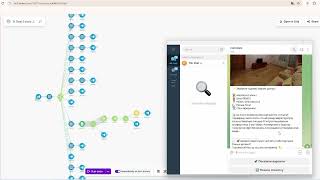
The AI real estate agency project for property selection is a service that uses artificial intelligence for quick and accurate property selection based on the client's request. The system analyzes needs, budget, location, and other criteria, automatically selects the best options from the market, filters out irrelevant offers, and helps make the optimal decision. This significantly saves time, avoids unnecessary viewings, and provides the most relevant properties without manual searching.
-
6 USD 100%
AI & Machine LearningTranslation of text from Russian language to Ukrainian
-
AI photo session:
AI & Machine Learning
AI visual in the style of "luxury lifestyle" with a focus on the product and premium presentation. Created for advertising creatives and content on social media (post/story). Tools: Nanobanana / ChatGPT
-
90 USD Automation "Task manager" (Make.com)
AI & Machine Learning
The team of freelancers (SMM, designer, targeting specialist) works with several brands simultaneously. Due to a limited budget, the team did not use paid task managers (Trello, ClickUp, Asana) and coordinated work only in a Telegram chat.
Problem:
Discussions of tasks in the chat led to confusion, loss of important messages, missed deadlines, and inconsistencies among performers. Some tasks were duplicated, and some were simply forgotten due to the lack of centralized control.
…
Solution: A task management system was created based on Google Sheets and Make.
- The Team Lead adds tasks to the Google Sheet, specifies the responsible person, status, and deadline;
- Automation in Make checks for new entries;
- A separate tab is created for each specialist with their current tasks;
- Make automatically sends individual messages in Telegram to each team member — with a list of new or updated tasks, deadlines, and additional comments.
Result:
- Complete abandonment of paid task managers → budget savings of $20–30/month;
- Reduction in the number of overdue tasks by over 50%;
- Communication in Telegram became clear, without lost messages;
- The SMM Team Lead gained full control over execution without additional tools;
- Thanks to the structuring of processes, the team was able to simultaneously manage 2 more projects without increasing the number of people.
Effect of automation:
- Time savings: up to 4 hours per week for each specialist;
- Increase in team productivity by approximately 25–30%;
- Improvement in the quality of execution and predictability of deadlines;
A noticeable reduction in the manager's workload due to transparent task control.
-
AI screenwriter for short videos (Shorts / Reels / TikTok)
AI & Machine Learning
I created an AI system that automatically prepares scripts for short videos. The user sends an idea or text — the system transforms it into a ready structure with 5 scenes for video production.
How it works:
AI analyzes the input text and logically breaks it down into scenes (beginning, development, conclusion);
… it fixes the character and style so they remain consistent across all scenes;
for each scene, it generates:
a professional AI prompt,
instructions for animation,
text for the narrator;
it supports edits through dialogue (for example, changing the style or atmosphere).
Result for the user:
quick script preparation without manual work;
stable structure and consistency of characters;
savings of up to 80% time on pre-production;
a ready base for video generation in AI tools.
Tools: n8n, Claude 4.5 Sonnet, context memory, advanced prompt engineering.


-
96AI & Machine Learning
-
5AR & VR Development
-
235Bot Development
-
63C & C++
-
84C#
-
264Content Management Systems
-
95Cryptocurrency & Blockchain
-
177Data Parsing
-
70Databases & SQL
-
121Desktop Apps
-
44Embedded Systems & Microcontrollers
-
154Gaming Apps
-
3230HTML & CSS
-
27Java
-
293Javascript and Typescript
-
485PHP
-
224Python
-
82Testing & QA
-
2452Web Programming

-
34783D Modeling
-
360AI Art
-
2280Artwork
-
7244Banners
-
2053Business Card Design
-
56Clothing design
-
2015Corporate Style
-
209Exhibition Booth Design
-
575Icons & Pixel Graphics
-
11667Illustrations & Drawings
-
399Industrial Design
-
642Infographics
-
964Interface Design (UI/UX)
-
6056Interior Design
-
13692Logo Design
-
886Mobile Apps Design
-
1535Outdoor Advertising
-
4143Packaging and label design
-
1005Presentations
-
9172Print Design
-
2086Social Media Page Design
-
43Type & Font Design
-
4044Vector Graphics
-
6VR & AR Design
-
10513Web Design

-
10AI Consulting
-
1224Content Management
-
38Customer Support
-
20Cybersecurity & Data Protection
-
55Data Processing
-
73Enterprise Resource Planning (ERP)
-
101Information Gathering
-
666Online Stores & E-commerce
-
10Payment Systems Integration
-
93Tuition
-
5001Website Development
-
168Website Maintenance


-
12App Store Optimization (ASO)
-
977Contextual Advertising
-
250Email Marketing
-
220Lead Generation & Sales
-
38Link Building
-
52Marketing Research
-
1Public Relations (PR)
-
1192Search Engine Optimization (SEO)
-
34Search Engine Reputation Management (SERM)
-
651Social Media Advertising
-
838Social Media Marketing (SMM)
-
6Teaser Advertisements
-
343Website SEO Audit


